Campus Esserberg
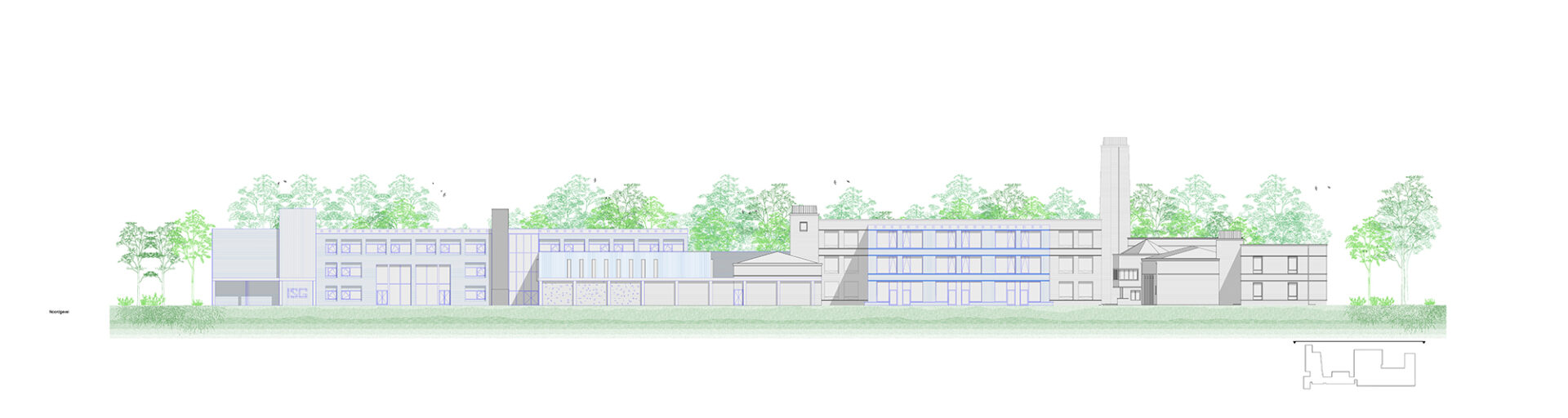
Located on the Esserberg estate between Groningen and Haren, the new campus will offer international and bilingual education for children and youth aged 0 to 18 years. The exceptional green location and the Bossche School architecture of the existing West Wing provide a rich cultural and historical foundation on which we are “building on” to realize a generous, cherished, and future-proof school environment.
More than in the current situation, the new campus will facilitate cross-pollination, knowledge exchange, and community building. However, in large school communities—and especially in international campuses—it is also important that students experience their own world so that they do not feel lost due to the size and complexity. We recognize this duality and aim for a school environment that offers both dynamism and openness on one hand, and tranquility and security on the other.
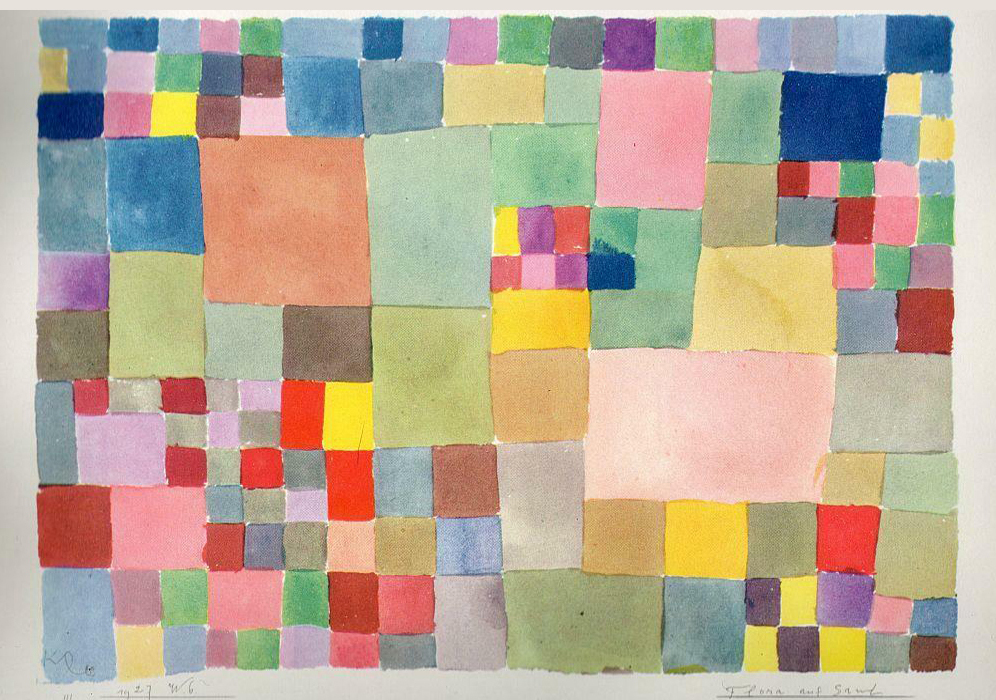
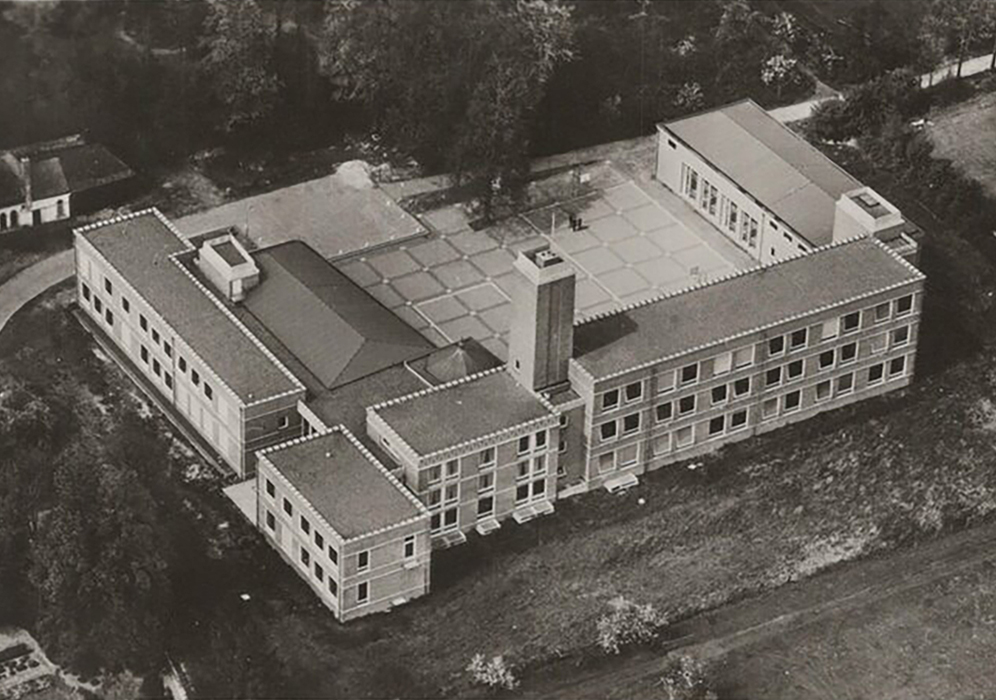
In designing both the buildings and the outdoor spaces they define, we are inspired by the philosophy of the Bossche School. This design philosophy provides harmonious unity through the use of a limited range of architectural elements. It is used to shape both the larger whole and the human scale. As a result, a coherent ensemble of legible buildings and outdoor spaces emerges, with a clear structure and recognizable domains that connect with the child’s experience of the world.


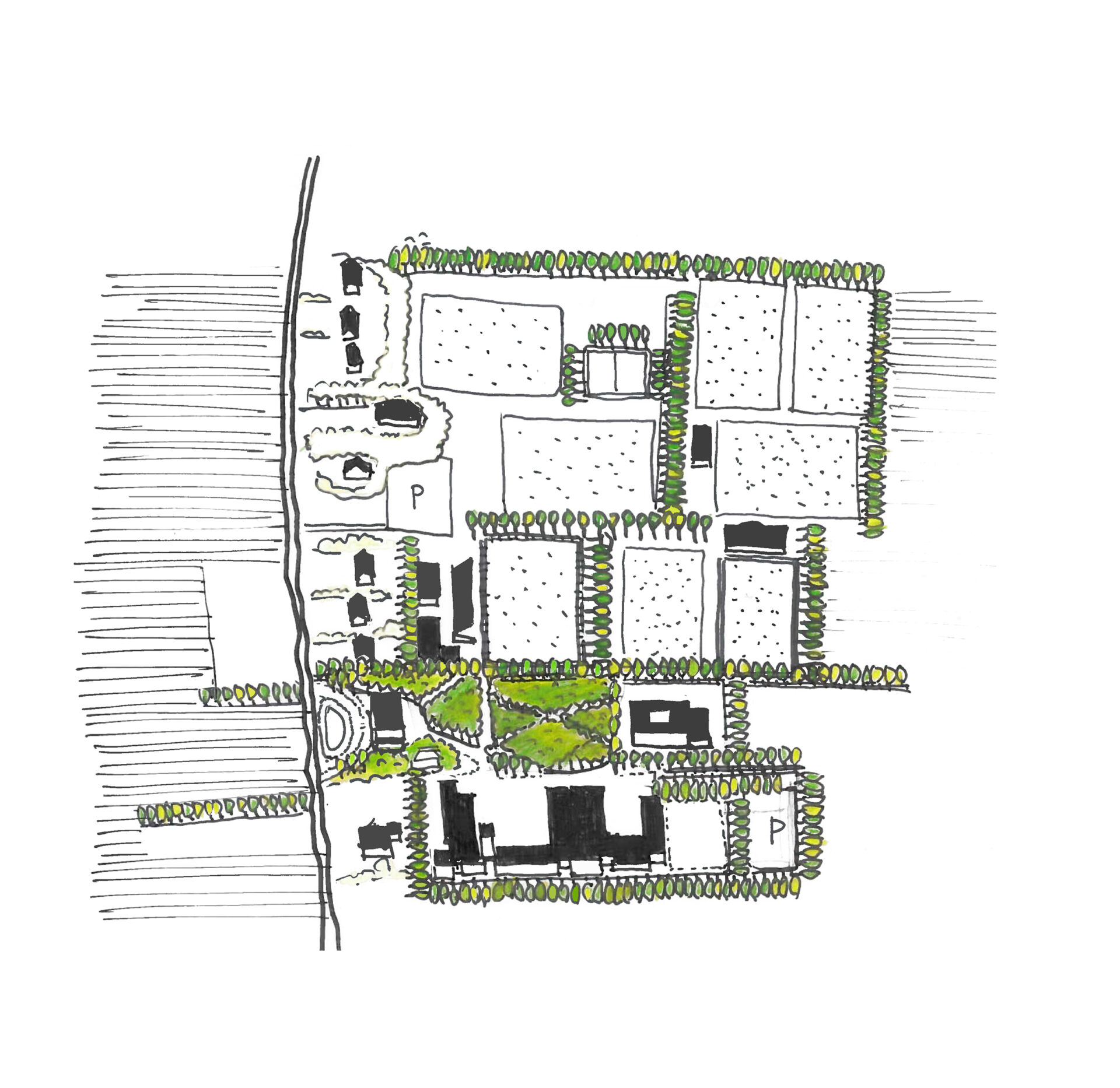
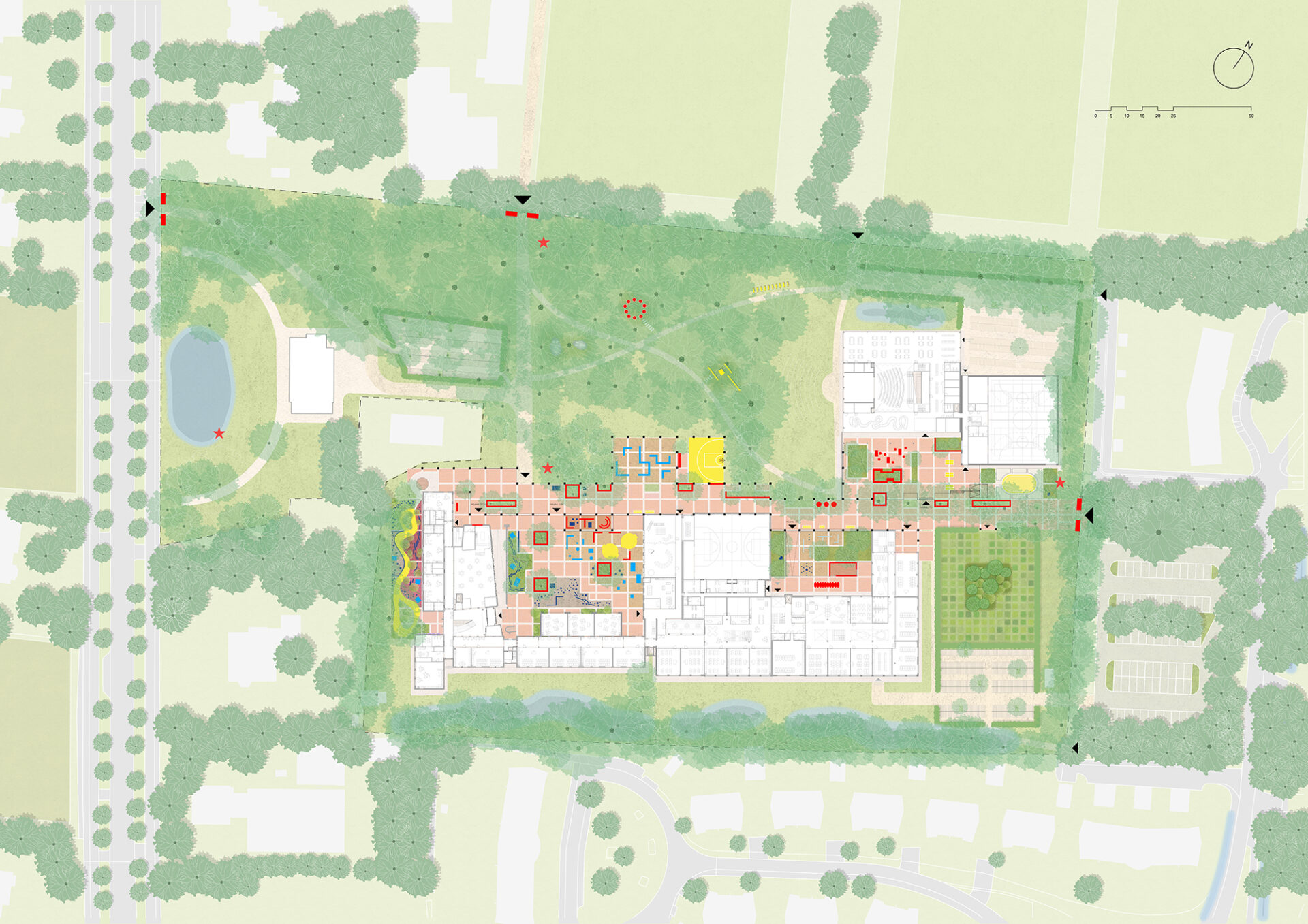
The historical framework of green rooms defined by tree-lined hedgerows forms the landscape backbone of the plan. It provides the campus with a sense of enclosure and serves as the unifying element that weaves the diverse programs into a single whole. The cultural-historical and landscape typology of the estate gives the campus its spatial identity. New buildings and outdoor spaces are carefully integrated as autonomous components in a cohesive architectural composition. This creates a clear structure that offers space and hierarchy for a patchwork of places designed for different target groups and age ranges. Most of the outdoor program is concentrated along the Landgoedlaan. This allows the wooded park to remain forest, unnecessary pathways to be returned to nature, and the ecological value of the estate to be enhanced.
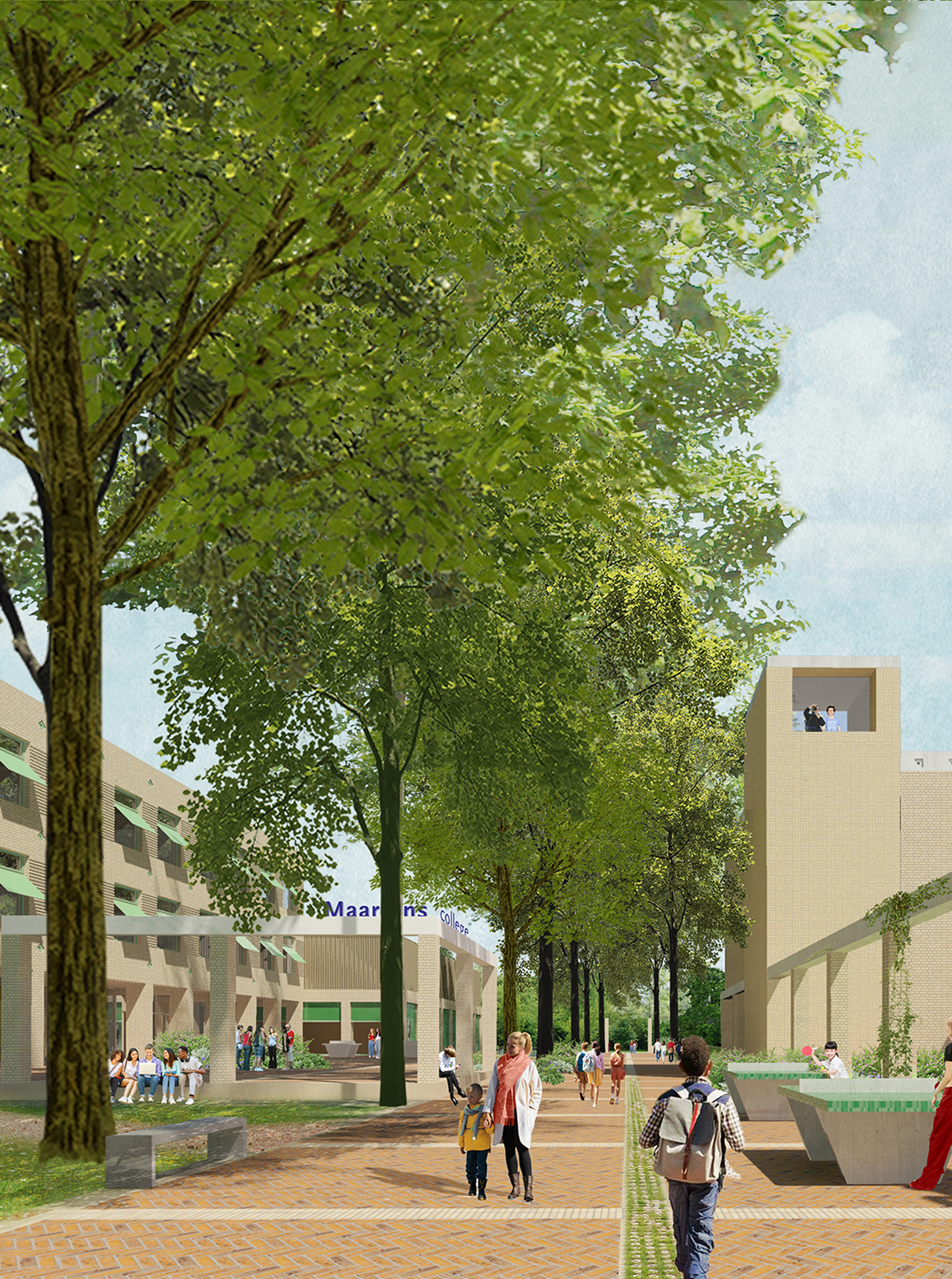
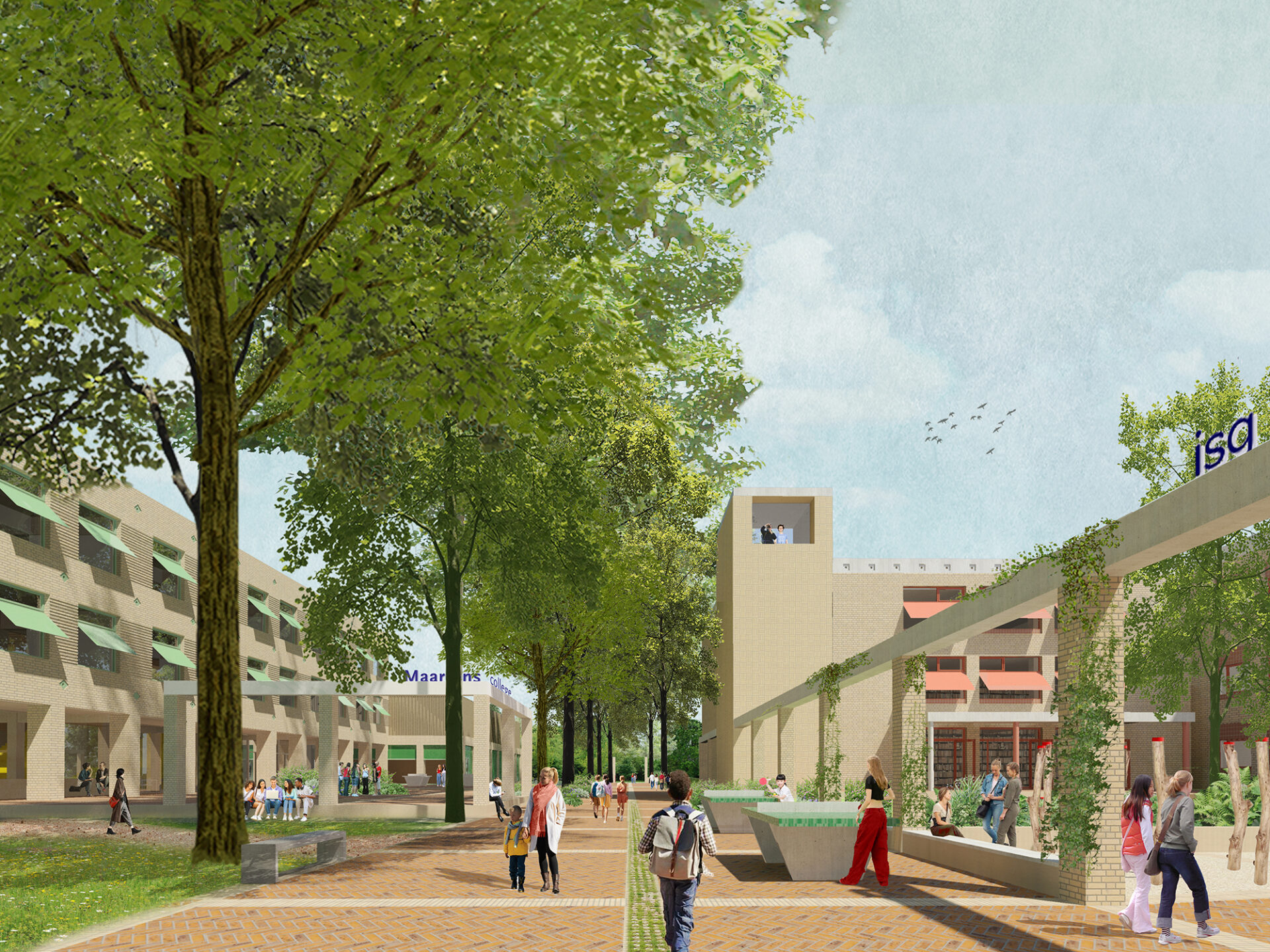
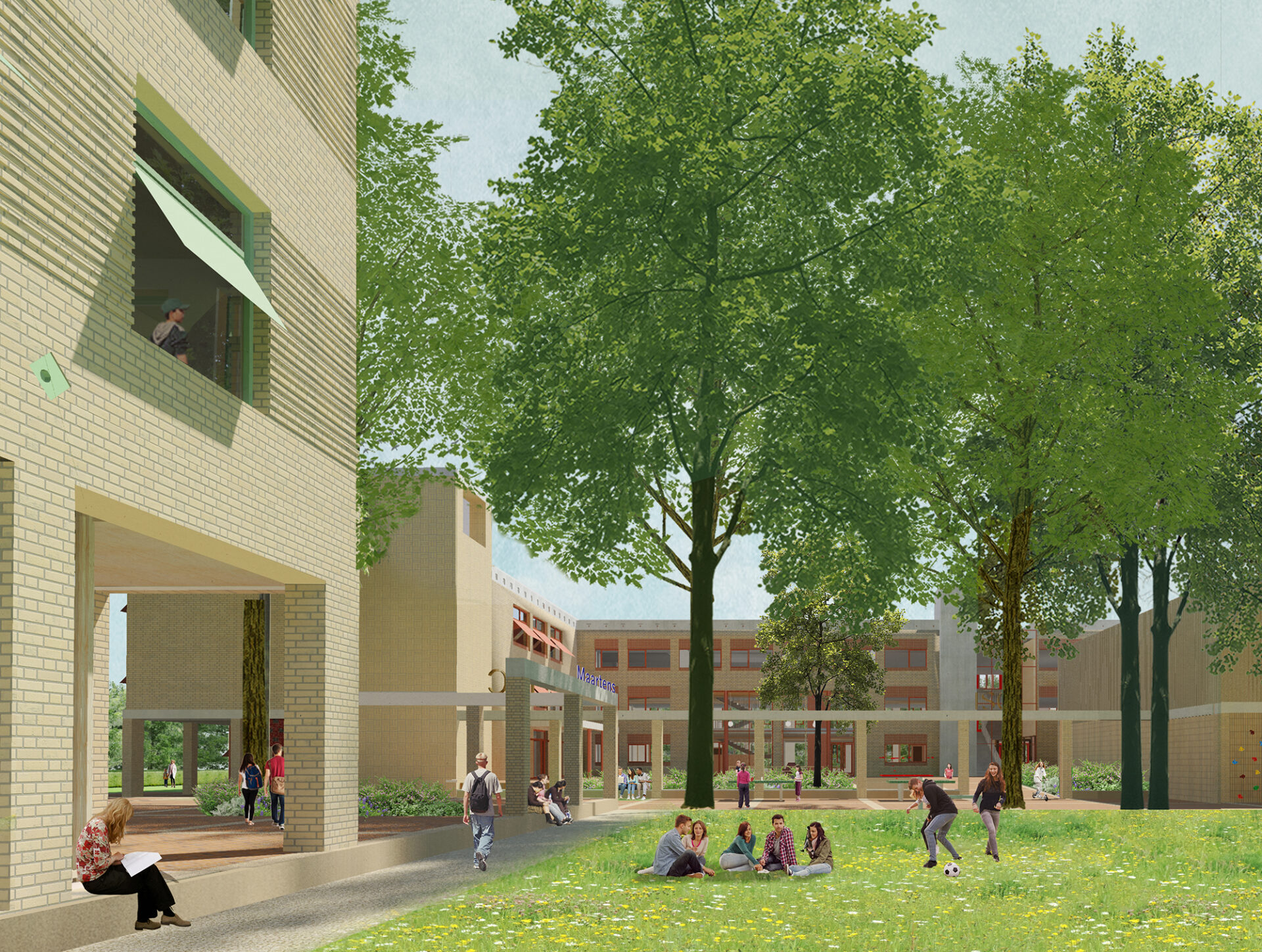
The Landgoedlaan forms the central spatial connector of the campus. It links all facilities and gives them an address on the campus. In addition to its role as a circulation route, the Landgoedlaan provides space for encounters and interaction among different users. It acts as a xenophile space: a space for the “friendly stranger,” where hospitality, respect, and community-building are central.
The space is lined with existing monumental trees and a new pergola structure, inspired by the architecture of the Bossche School. This pergola forms a frame that defines the space from the surrounding nature, creating a sense of enclosure. The pergola not only provides the Landgoedlaan with a recognizable identity but also marks the transition between the public domain of the lane and the private schoolyards.

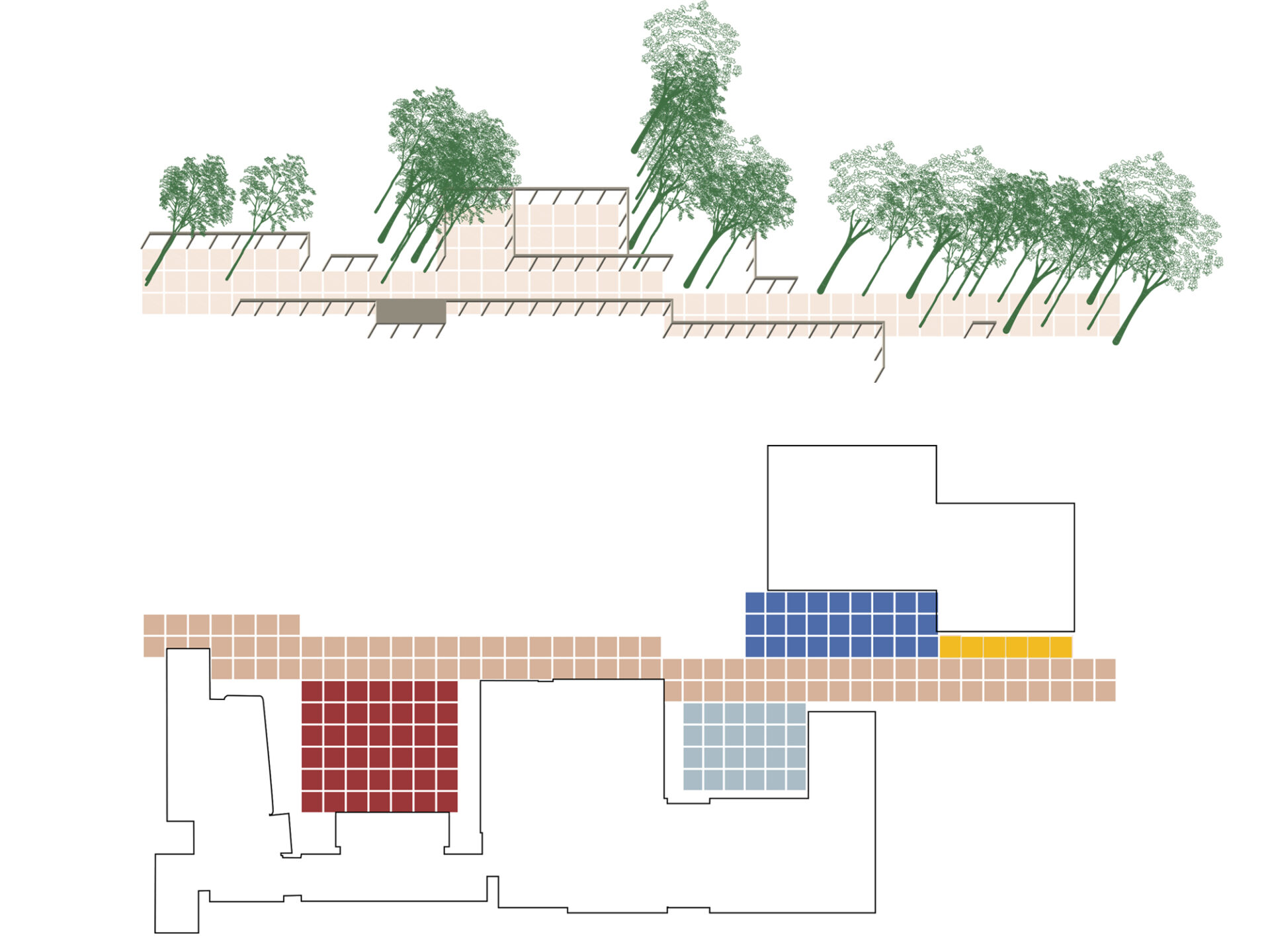
The original 5x5m grid in the paving of the West Wing is extended into the Landgoedlaan to structure the entire ensemble of buildings and organize the various outdoor domains. It introduces a comprehensible scale that aligns with the child’s perspective and makes it possible to structure outdoor spaces for different age groups in a clear manner. At the same time, it offers unity and recognizability for the community. The grid is made from paving bricks and filled in with reused building materials from the East Wing. The 5x5m module allows for a wide range of potential programmatic uses that encourage learning, socializing, play, and movement. Based on a catalogue, we will work with users to determine the final “patchwork of places” for the lane and courtyards.
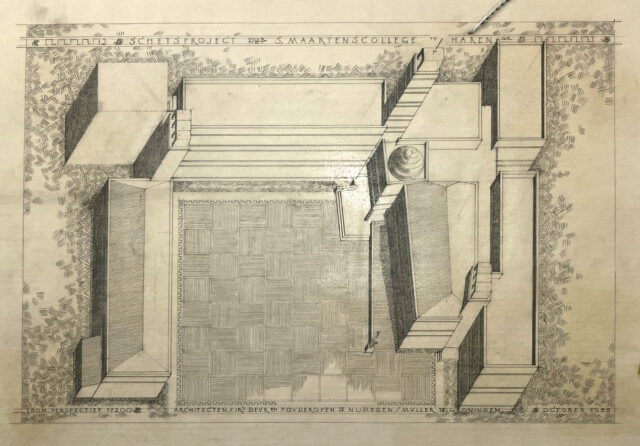
The new buildings, as well as the extensions, adopt the architectural DNA of the existing West Wing. This results in a family of buildings that belong together while each retaining its own character. Analogous to the West Wing, both extensions and new buildings are designed as composite volumes, in which the grain size and the yellow-brown ceramic bricks of the West Wing are recognizable. Through subtle differences in facade rhythm, relief, brickwork patterns, and ornamentation, each school gains its own identity. The different domains are further emphasized in the interior design, tailored to the experience of each specific age group.
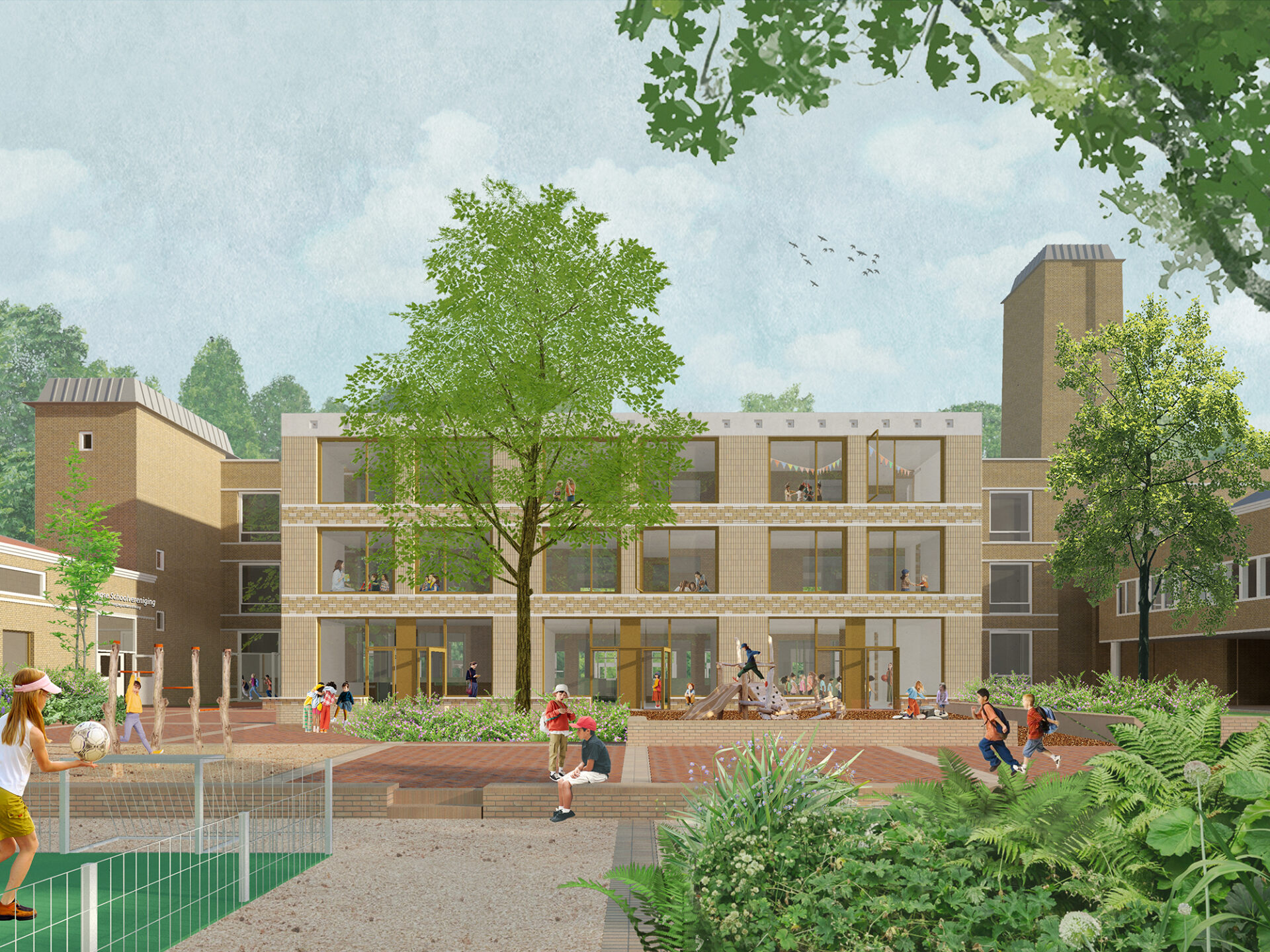
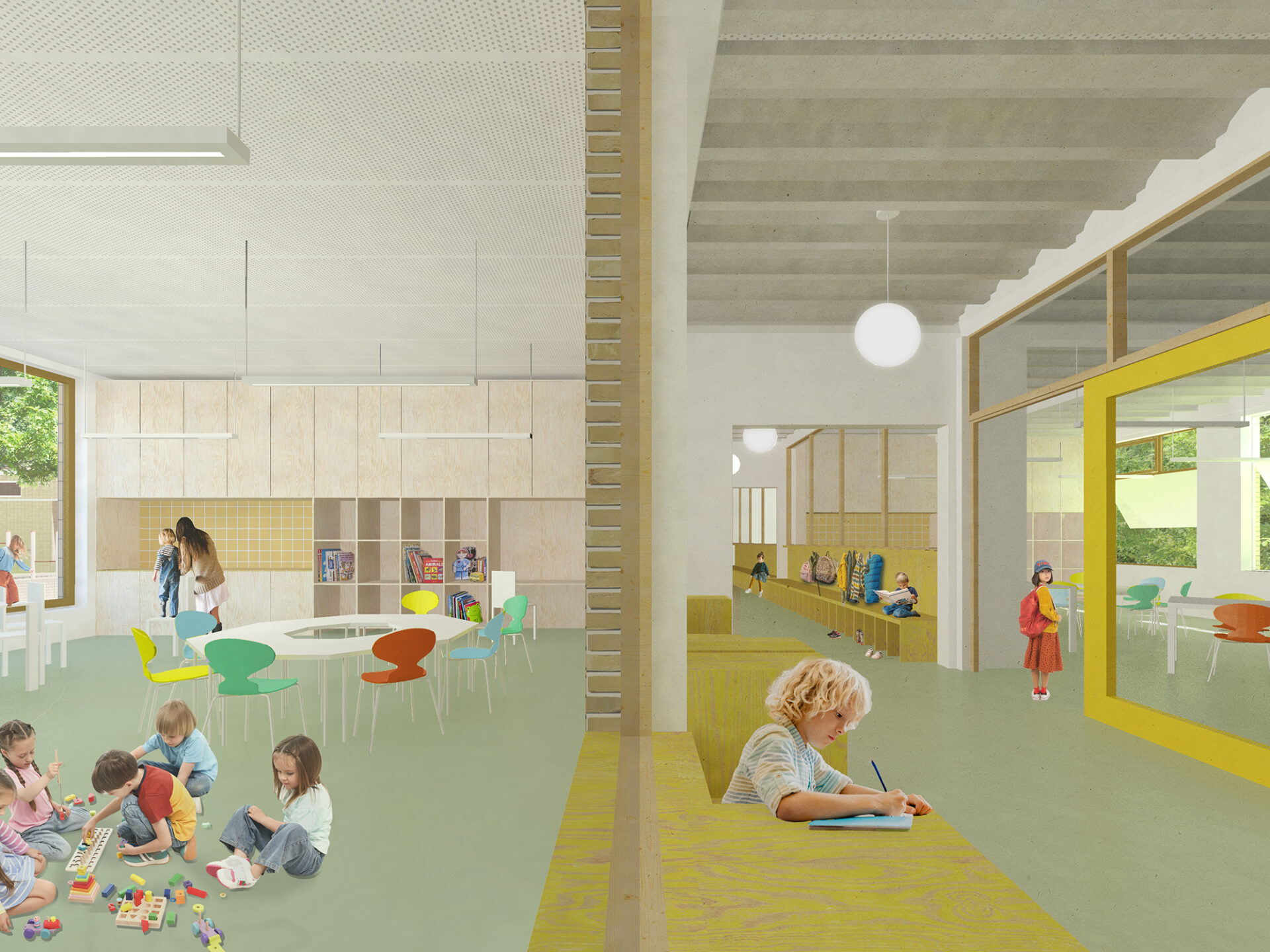
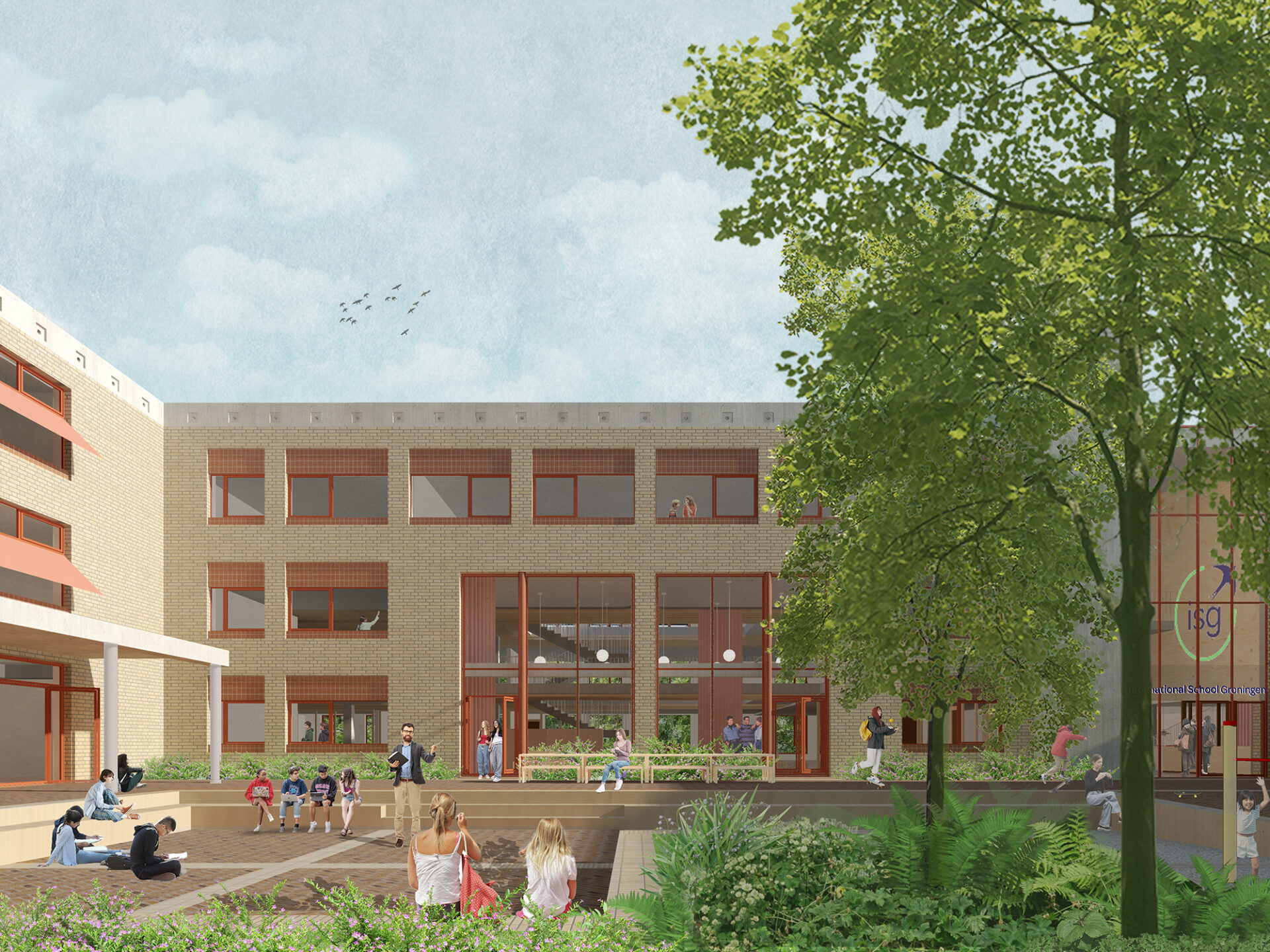
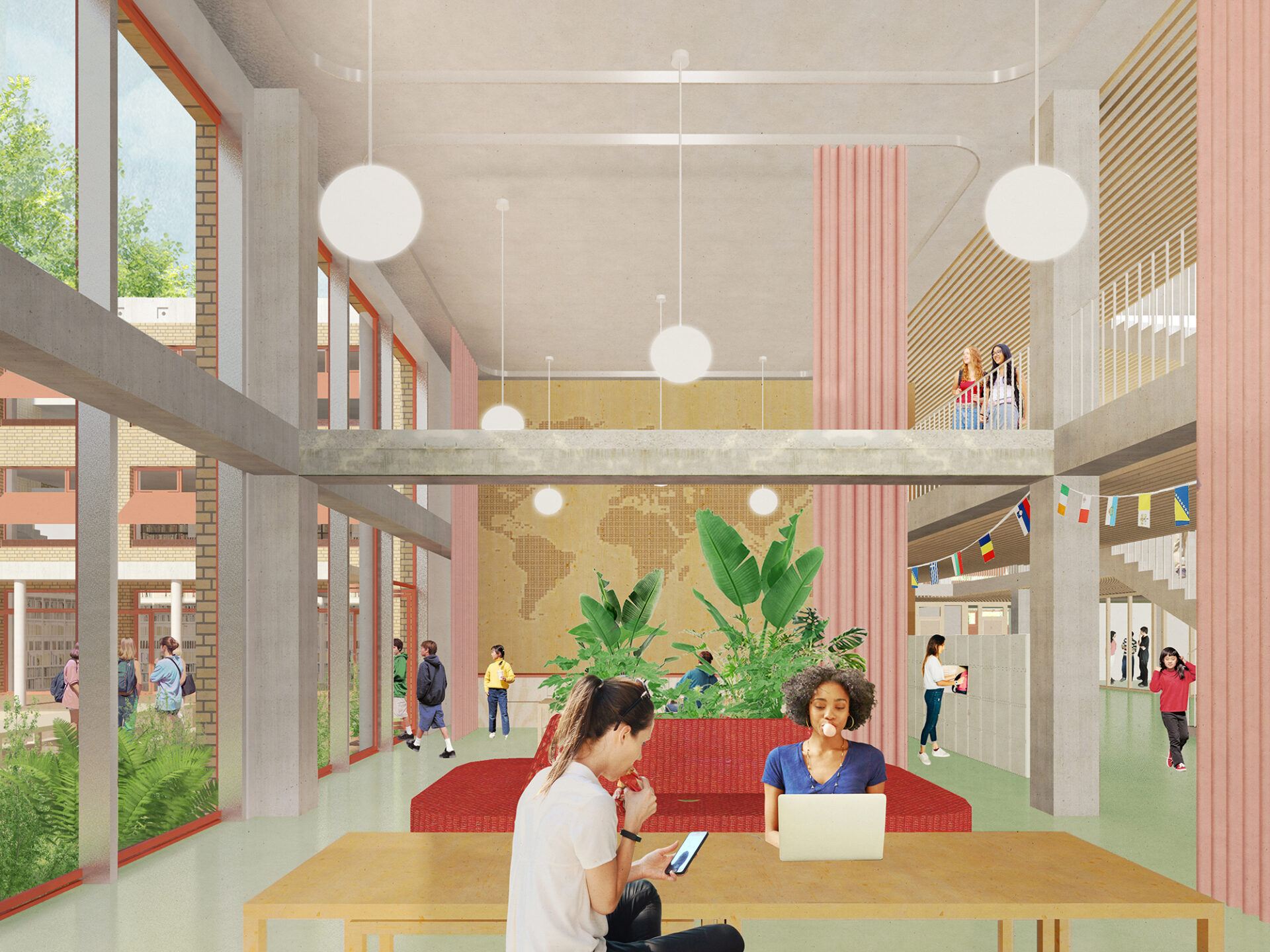
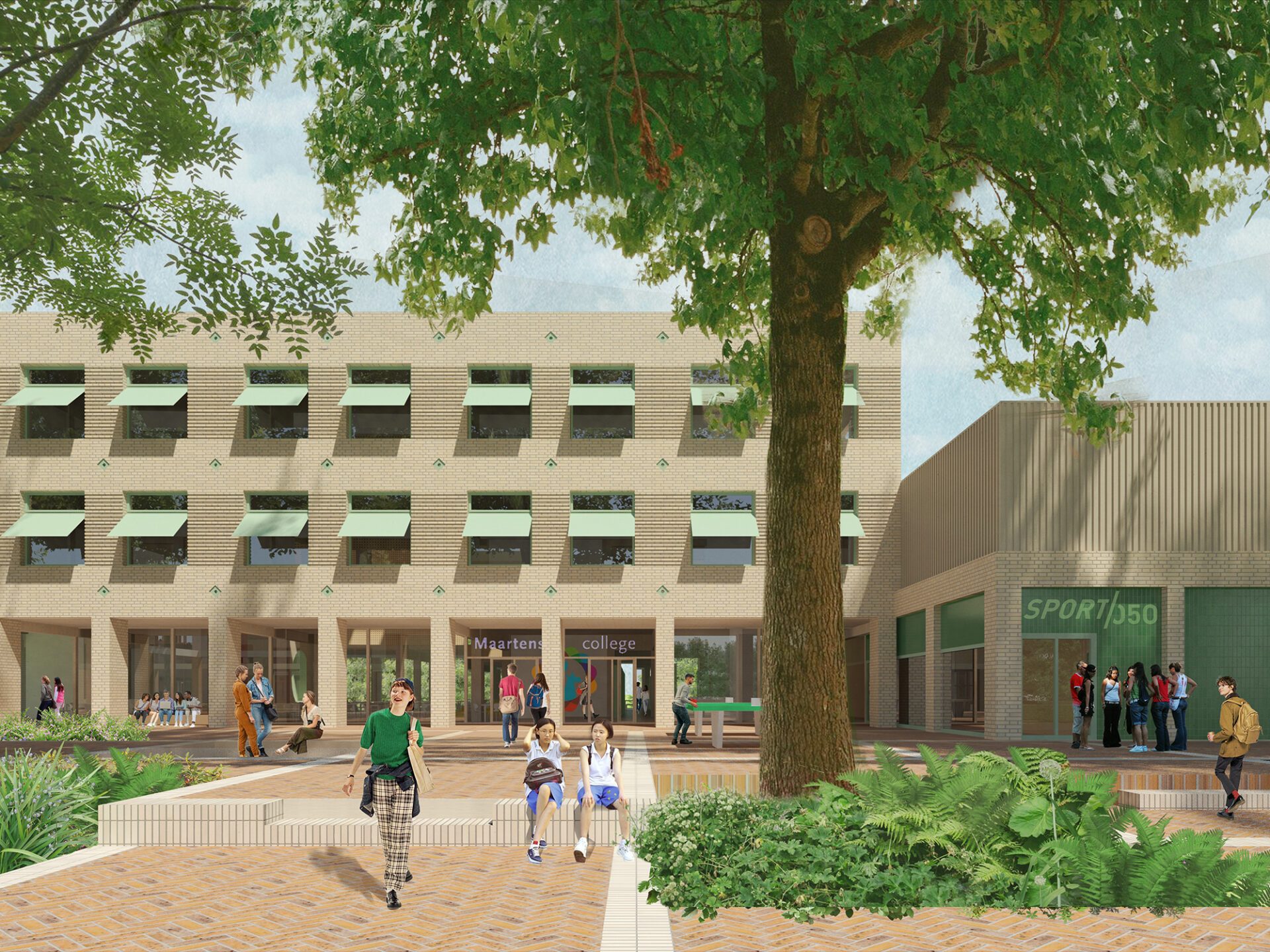
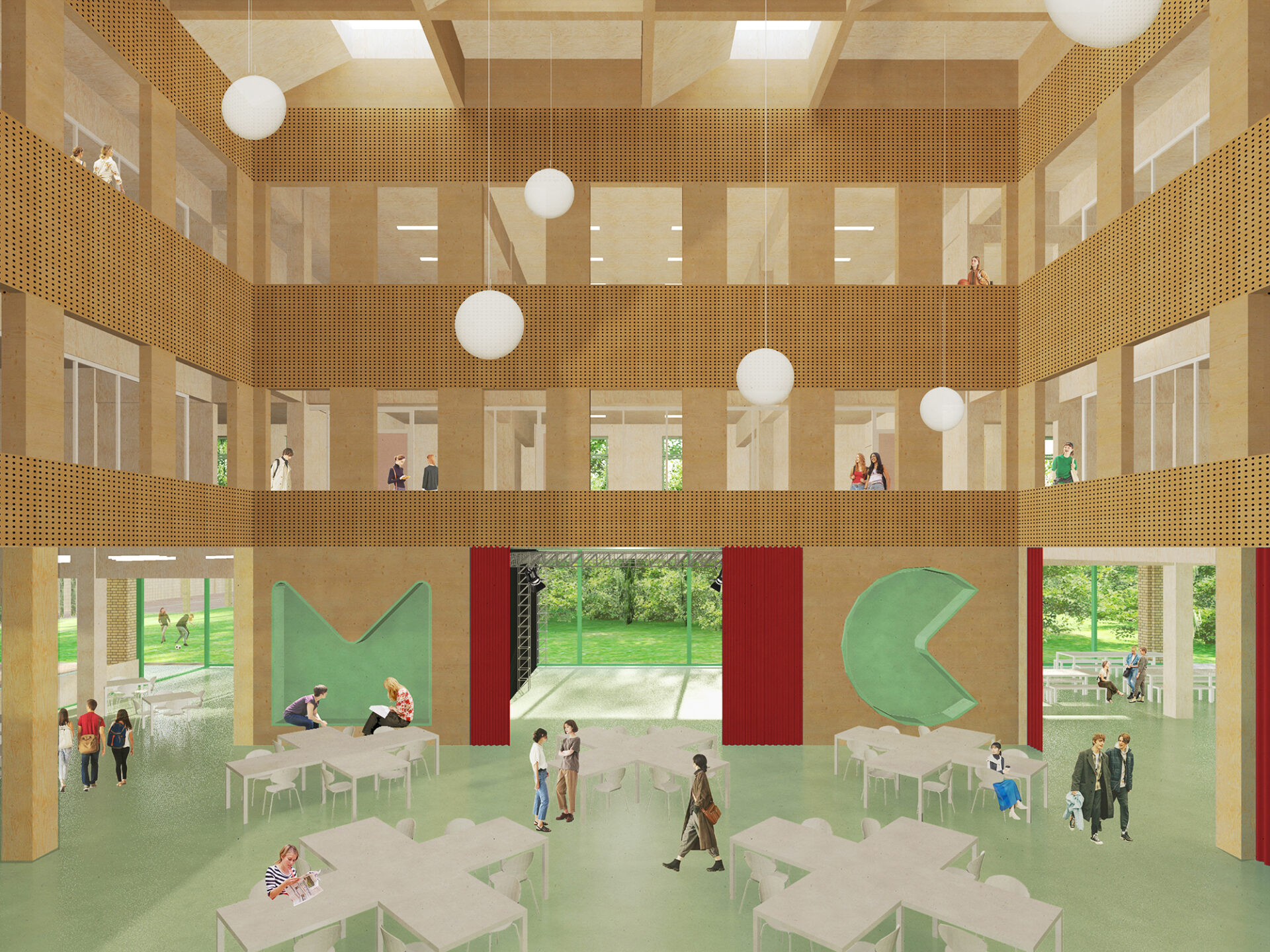
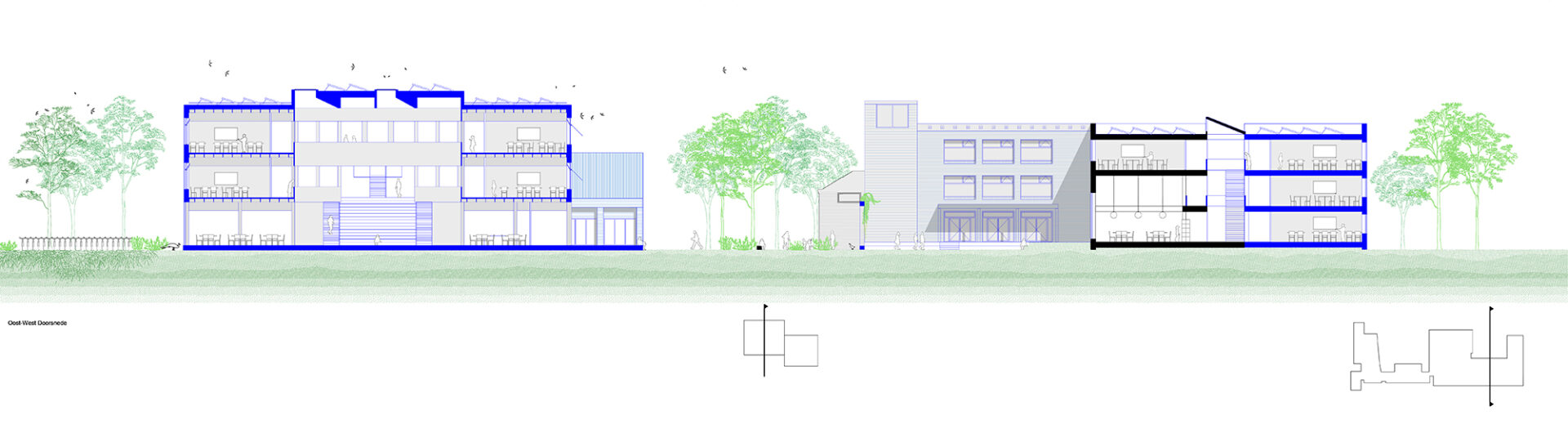
The school buildings are modular and flexible in layout (based on the standard module of a classroom), allowing them to adapt within a single structural framework to evolving educational insights and conditions. The modules can be combined to form larger spaces or subdivided further to accommodate smaller support functions. Along the Landgoedlaan, all major communal functions are organized to ensure they are visible and accessible to the campus community.

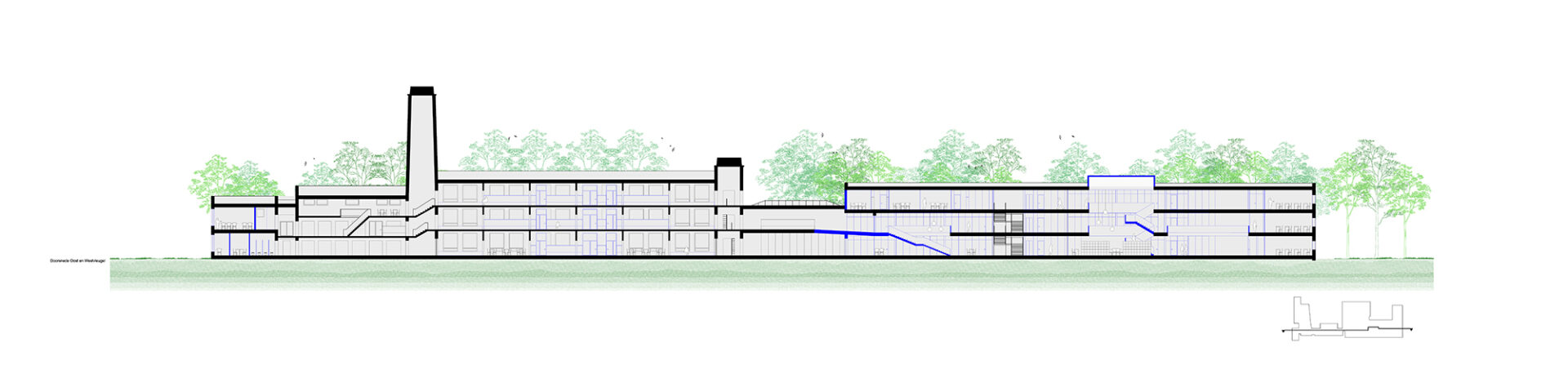
To keep new construction as compact as possible, as much of the program as possible is realized in and adjacent to the existing East and West Wings, effectively “retrofitting” them. In addition to energy efficiency and careful material selection, the design aims to create a high-quality and comfortable learning environment that is functional, cherished, and therefore future-proof.
We primarily strive for low-tech buildings that, through smart design and material choices, intrinsically support a pleasant indoor climate. The layout of the shell—with a demountable column-beam structure and a strategically chosen grid—makes it possible to reconfigure the floor plans in the future. Finally, we aim to create beloved buildings that are durable and aesthetically layered—buildings people feel connected to and take care of.

Office enfilade
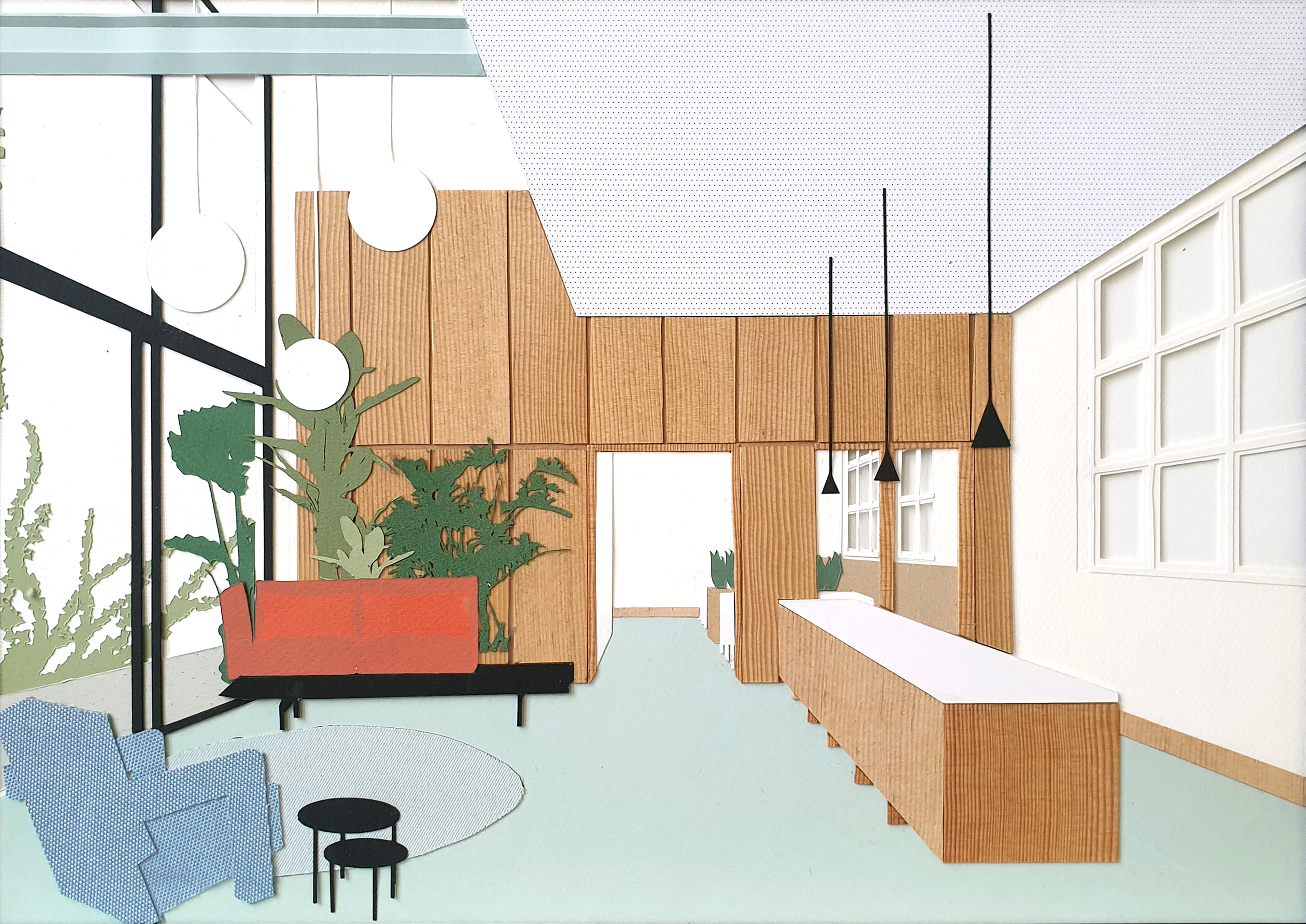
Office enfilade proposes a new interior design for the former “Kitchen building” of the monestary complex of the Oude Dijk Tilburg. The new office for developer van der Weegen offers an opportunity to create a tailor-made interior to the organization and its core values, as well as to the monumental building.


walls – rooms – wood paneling
The spatial structure is characterized by the classical typology of the enfilade: a series of connecting rooms. The enfilade as an office typology is a cross over between the opposites of the collective office garden and that of the individualistic cell office. She therefore potentially incorporates the ideal balance between meeting, cooperation and contact on the one hand and concentration and tranquility on the other.

To make the diversity of functions, atmospheres, floors and business units into a powerful whole, we introduce the interior concept of 3D classical wall panels. This basically consists of a uniform wooden lining for the passageways as well as the lower part of the high walls. This accentuates the enfilade and forges all spaces together through paneling or high plinth and also incorporates fixed furniture and furniture walls.



Domūs Houthaven
Domūs Houthaven is a residential ensemble featuring 235 smart compact apartments and an array of shared facilities on a plinth of commercial spaces The complex is designed as a family of interconnected blocks surrounding a raised communal courtyard. The interconnectedness and the generous collective facilities encourage interaction among residents. In Domus, you live alone, or as a couple, without being alone.
The ensemble forms the final keystone of the superblock on the northwest edge of Amsterdam’s Houthaven, which is in the process of being developed into a new residential neighborhood.

Domūs Houthaven is the first realization of Domūs Living, an innovative urban concept developed by Shift, Synchroon and …,staat creative agency. Domūs Living combines compact apartments with the benefits of shared amenities, public services and a community nearby. It enables sustainable high-density residential buildings that use space, energy and materials efficiently. The concept targets the growing group of one- and two- persons households that put social contacts and experiences above ownership. They are open to different forms of sharing, not only because it is sustainable but also because it is fun and valuable. For example, because it prevents loneliness. Domūs is also responding to the growing group of people who like to work “from home not from home”.


The volumetric design of the project follows the principle of unity in diversity. The individual blocks – with an own grain size, facade rhytm and color – feature distinct apartment typologies and access. This differentiation enables identification with one’s own home within the large-scale complex and reduces the project to a scale consistent with the characteristic grain size of the new urban district.


To strengthen the cohesion between the different building volumes, they share the same architectural DNA. The choice of rational brick volumes with generous facade openings and robust detailing refers to the industrial character of the harbor area. Each building volume has its own masonry grid with varying depths of recesses. These grids bring together mass and transparency in such a way that daylight, views and privacy are tailored to the specific type of apartment per block.


The building volumes are visually separated and at the same time physically connected by a common circulation space. Placing the blocks slightly apart creates entrances and corridors with plenty of daylight. Not only do they connect all the dwellings, they also open up a range of communal facilities as well as the communal garden for all residents. Placing two blocks further apart on the south side creates an opening that provides the garden with sunlight and views. To maintain connectedness within the ensemble, the gap is bridged by an aerial bridge on the fifth floor.


The communal facilities are geared toward various forms of everyday use. All residents have access to a multifunctional work- and livingroom next to the communal garden and a spacious cooking studio with roof terrace on the fifth floor. The work- and livingroom forms the social heart of the residential ensemble. The space is open and flexible and at the same time homely. Shift designed four large freestanding pieces of furniture that function as room dividers. They create different places and allow multiple activities simultaneously without affecting the continuity of the space. People work, eat, play and hang out. In addition, both large and small group activities take place. The integration of a laundromat and the manager’s office bring additional hustle and bustle.


The roof pavilion accessible via the air bridge houses a cooking studio and a guesthouse. The cooking studio is designed as a glass house with an unobstructed view of the Spaarndammer neighborhood. It is equipped with a professional cooking island and seating for groups both inside and outside on the roof terrace. The guest room is equipped with a bathroom allowing residents to have their guests stay here independently. In the belly of the building, under the communal garden, is a generous bike shed for nearly 500 bikes and a double-level parking garage with 70 parking spaces including 5 for shared cars.


communal facilities and apartment types

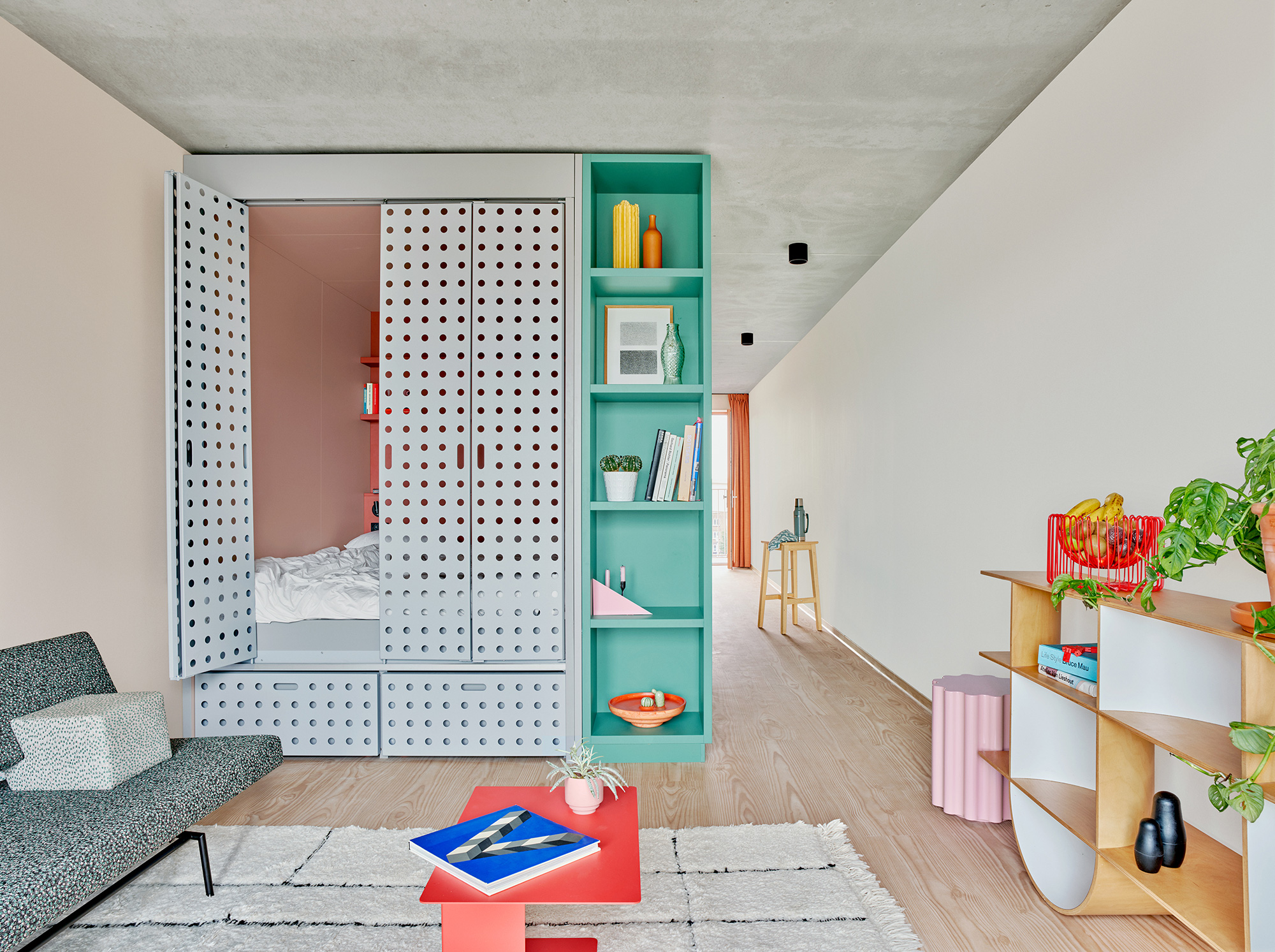
All apartments offer a high degree of spaciousness and flexibility, despite their compact area of between 43 and 60m2. They all contain a smart living core consisting of a configuration of modules for (open) kitchen, bathroom, closet space and bed alcove. In this way, the remaining space, the actual living space, is maximized both in size and in terms of use. Each module of the smart core has its own color. This gives the furniture a sculptural effect that underlines and enhances the specific character of each apartment type. The polychrome furniture piece contrasts with the concrete ceiling that has been left untreated.


The alcove bed frees the home from a bedroom without lapsing into the solution of a regular studio apartment where you actually live in your bedroom. When the alcove doors are closed, you have one large living space. Once the perforated doors of the alcove are open, the space transforms into one large bedroom. Such a solution makes use of the fact that the privacy offered by separate bedroom is not an issue in single-person household or cohabiting couples.


The plinth of the ensemble seeks to connect with the neighborhood by providing spaces for public amenities. The first functions to appear here soon will be a gym, a daycare center and a Domus café. This café is connected to the collective work- and livingroom and establishes a symbiotic relationship with it.


Matryoshka house
Matryoskha House transforms an early 20th century townhouse into two high-end apartments by radically opening it up. Situated in the center of Rotterdam, the house was in a derelict state due the previous owner’s conversion of it into a sub-standard workers’ hotel. Bothered by the neglect, a neighbor acquired the property and gave Shift architecture urbanism the commission to give it an extreme makeover.

The house was stripped to nothing but its envelope and flooring structure, the later partly removed in each unit to create double-height living spaces. The private spaces are suspended in these tall spaces creating the matryoshka effect: a box within a box.
The lower apartment features double-height spaces at both the front and rear façade, isolating the volume of the bedrooms and bathroom as floating in its center. The two voids provide the living areas of this 14m deep half-basement level with plenty of daylight.
The upper apartment is conceived as an inversion of the mass-void relationship of the lower apartment. Here the bedrooms, rather than the voids, are placed against the façades, opening up a spectacular double-height space at the center of the apartment, brightly lit by a large skylight.


The historic elements of the street façade were restored. The rear façade was removed entirely and replaced by a portal frame construction in galvanized steel providing structural stability. A large sliding door and three floor-to-ceiling double doors ensure that both living rooms can be fully opened up towards the garden.

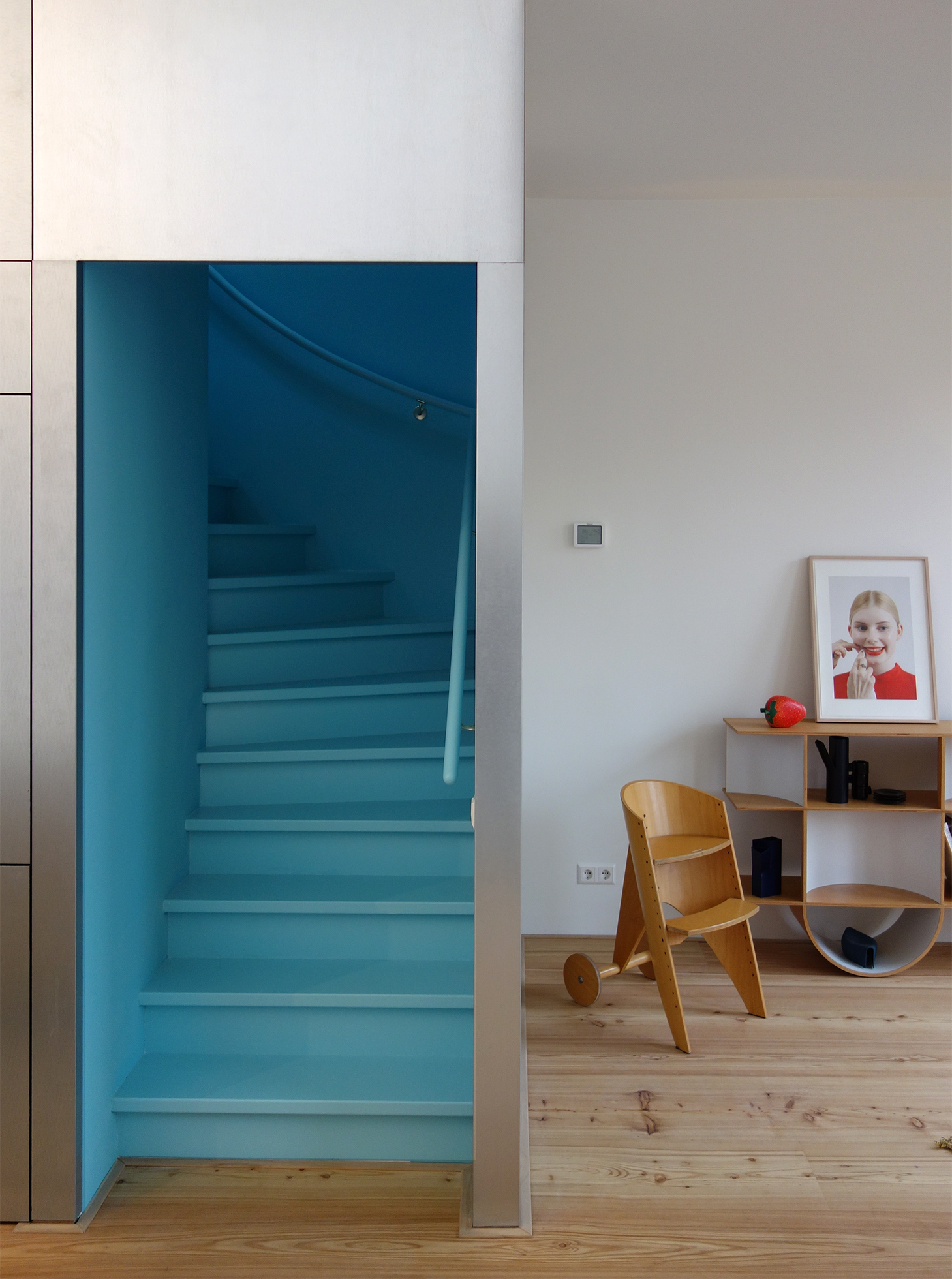
In the center of the apartments a single galvanized steel cladded volume incorporates stairs, toilets, storage spaces and kitchen equipment. A free-floating kitchen island finished in white tiles stands at the heart of each apartment.


The interior of the house is a dialogue between old and new, contemporary and traditional, polished and rough, finished and unfinished. When possible original details of the old house were preserved.
Brickwork was left exposed and roof trusses left bare, stained glass window panes were restored and placed within new frames. Warmer materials and colors balance the use of reflective metal, concrete and black steel.



Vertical Loft
This so called do-it-yourself dwelling in the centre of Rotterdam is part of a bold experiment initiated by the municipality to revitalize dilapidated urban areas. Run-down pre-war dwellings are renovated on the outside and brought back to their monumental appearance, while the interiors are stripped bare.

The empty shell dwellings are primarily bought by enthusiastic young people who transform them according to their specific needs, desires and budgets. Real estate developers have picked up the initiative and a new demand driven market of urban housing has been generated in recent years. The result is a growing number of contemporary custom-made dream houses within the uniform old fabric of the traditional nineteenth and early twentieth century city.

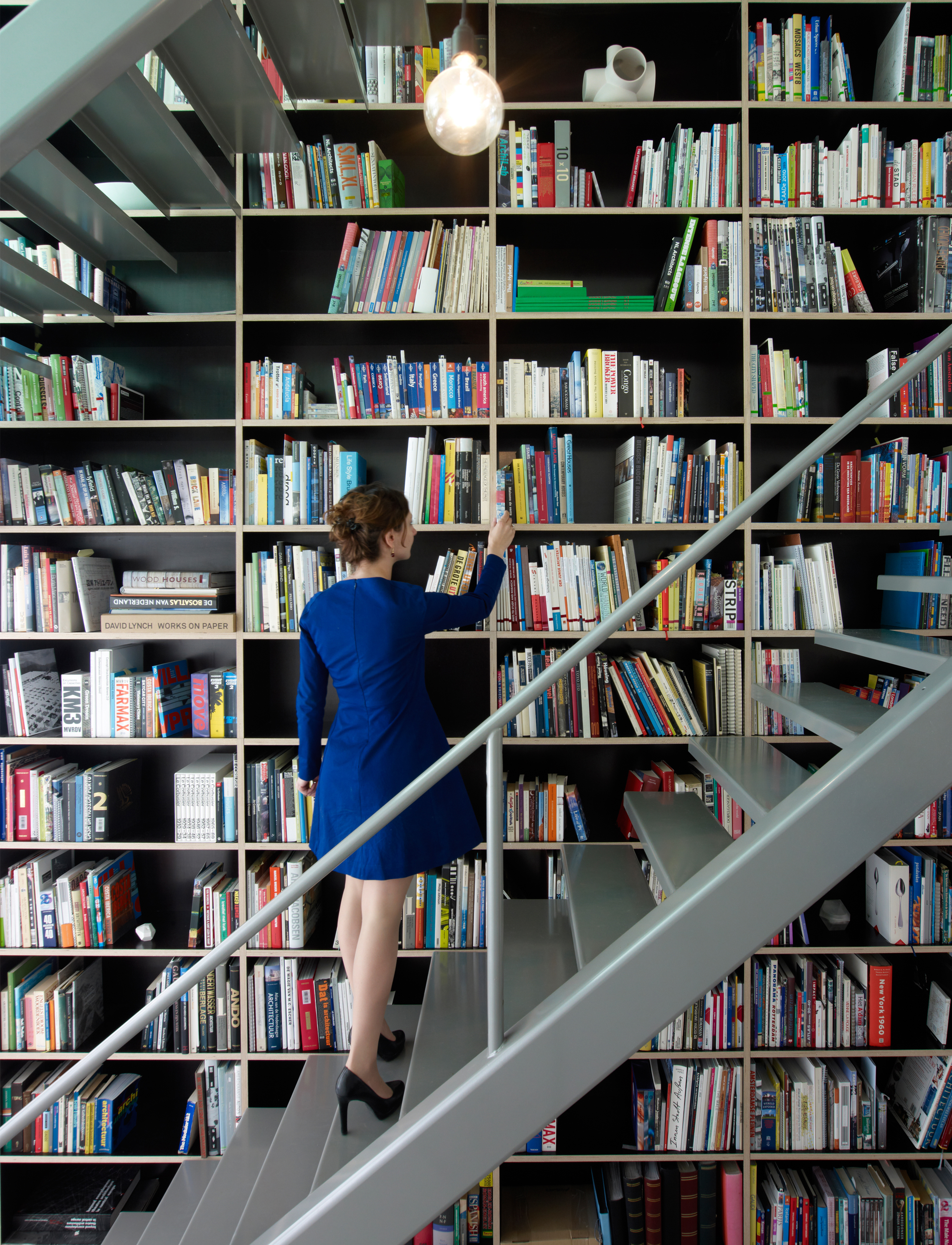
Vertical loft is a house without walls, where the three floors are stitched together into one continuous space. One oversized closet connects all the floors and functions as a storage device for the whole house. This piece of XXL-furniture, measuring 10 meters in length and 9 meters in height, replaces the load bearing middle wall of the original house. Its modular system integrates kitchen appliances, bookshelves, wardrobe, and a walk in closet.


The introduction of a central void reinforces the presence of the closet. The void enables diagonal views through the house in which the closet is experienced in its full height. It also makes daylight penetrate far into the 14 meter deep house. Two steel stairs in the void make the bookshelves accessible and create a vertical circulation along and through the closet.


The extreme makeover of the house is combined with a selective preservation of elements of the old casco. Industrial materials such as the phenol coated multiplex of the closet and the polyurethane flooring are balanced by the longitudinal brick wall that is left bare, the stained glass and the original doors that are restored and re-used. The roughness of the wall, full with traces of the past, tells stories about the continuous makeovers that the house has undergone in the last hundred years.


Open house
Shift architecture urbanism has redesigned an historic family house in the “Indies Neighborhood” of Amsterdam to maximize its relationship with both the street and its garden. A multifunctional wall cabinet, 14 meters in length, plays a key role in opening up the ground floor. This furniture element contains all servant functions, allowing for one open and flexible space for living that spans between street and garden.

The relation to the street is emphasized by the absence of an entrance hall: one enters the house directly into the open living space. Thus, the house is linked to the attractive sidewalk with its vertical gardens, typical for Amsterdam. The seamless continuation of indoor living area into the private garden is strengthened by extending the wall cabinet into the garden to define a private terrace.


The juxtaposition of three contrasting finishes for the cabinet differentiates the main living space. Each material provides the space with a specific character that connects to its use: a warm plywood for the living, a sanitary pink laminate for the kitchen and dining area, and a weather resistant anodized aluminum for the terrace.

The plywood section of the cabinet integrates a small winter-entrance, a stair, TV & audio and a wardrobe. The part in pink laminate contains kitchen appliances and cupboards. Its arch-shape makes room for a recessed kitchen in black MDF. The last piece in natural aluminum accommodates a toilet and a garden storage. The aluminum cladding reflects the garden vegetation back into the house, enhancing the experience of the private garden, a true luxury in the old neighborhoods of Amsterdam.


In contrast to the common use and open character of the ground floor, the two upper floors are divided for a functional layout of individual rooms for this young family. The first floor contains a working space, a master bedroom with walk-in-closet and a bathroom for the parents. The second floor contains three small bedrooms and a second bathroom for their three kids.


Open House is an example of how the Dutch inner city housing stock can be adapted to the needs and desires of young families with kids, avoiding them to flee the city for its lack of (outdoor) space and appropriate dwellings. Urban residential areas such as the “Indies Neighborhood” should house multiple generations, cultures and incomes to remain attractive and socially sustainable.
