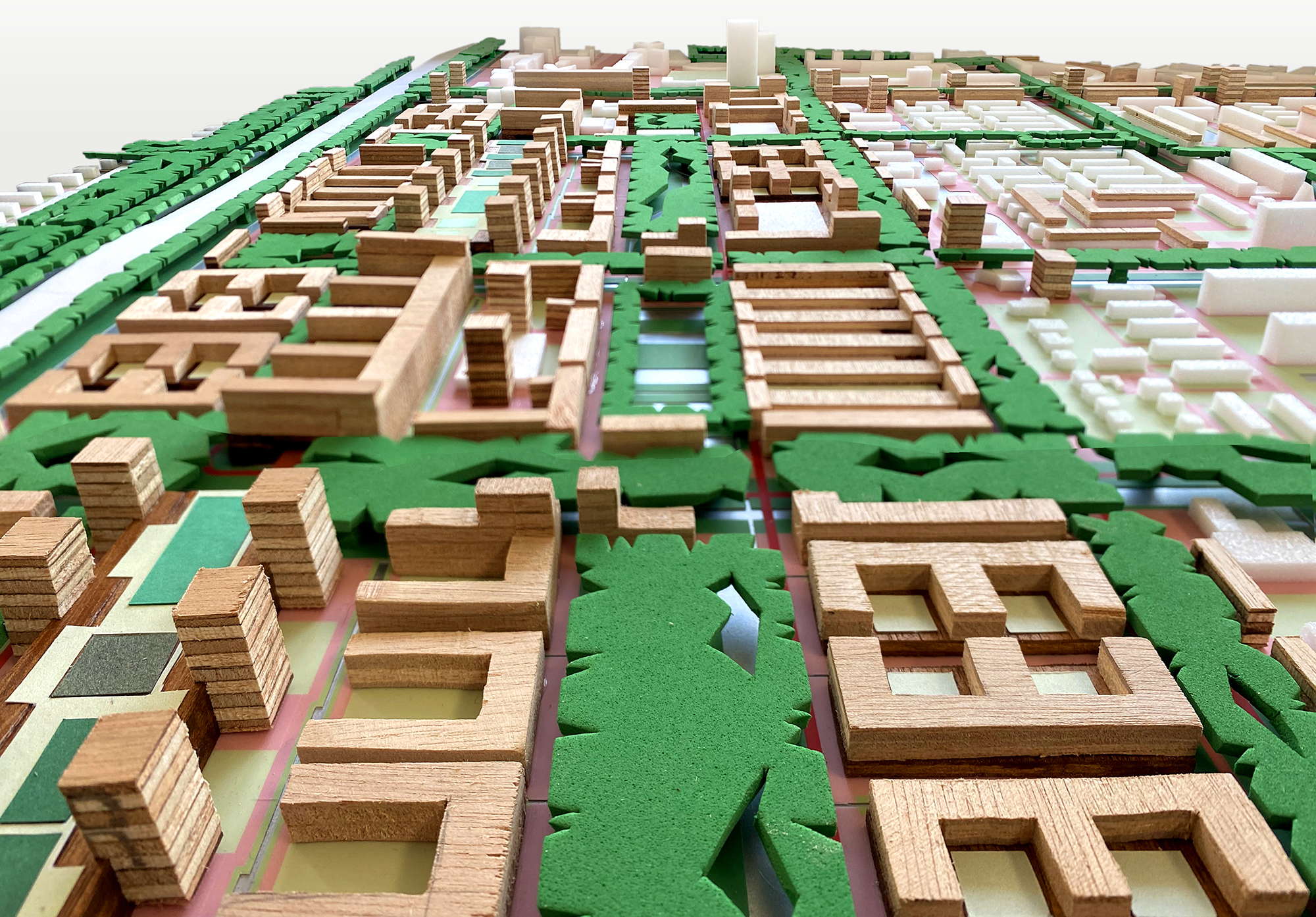

The new existing city
is the title of our entry for the Ministerie van Maak exhibition, following the call to 100 designers to come up with concrete solutions for the housing shortage, the energy transition and the consequences of climate change. Our plan shows how the Rotterdam post-war district Het Lage Land can be densified with 15,000 new homes, new working places and various amenities. The 100 models are showcased during the 2022 Rotterdam Architecture Biennale, in the largest scale model ever made of the Netherlands.
We believe that a significant part of the housing to be built in the coming years must find a place in the existing city. After all, that is where all the facilities, the infrastructure and especially the public transport nodes are located. Inner city densification can also serve as an opportunity to address the water, climate and energy assignments in the existing neighborhoods. And it can provide the necessary new housing typologies for existing residents, elderly for instance, so that they don’t have to leave the neighborhood.


Rotterdam “urbanized landscape”: an agglomeration of introvert islands within the system of the traffic machine
(after a drawing by Frits Palmboom)
Our location, the post-war modernist district Het Lage Land in Rotterdam, is fertile ground for further densification. Not only with homes, but also with spaces for work, water and greenery. The modernist idiom of separation of functions has resulted here in spacious, introverted residential islands surrounded by oversized transition areas, residual spaces and infrastructure. There is a need for a new urban layer that densifies, differentiates and connects this district with the city around it.


the postwar district Het Lage Land is in need of a new urban layer
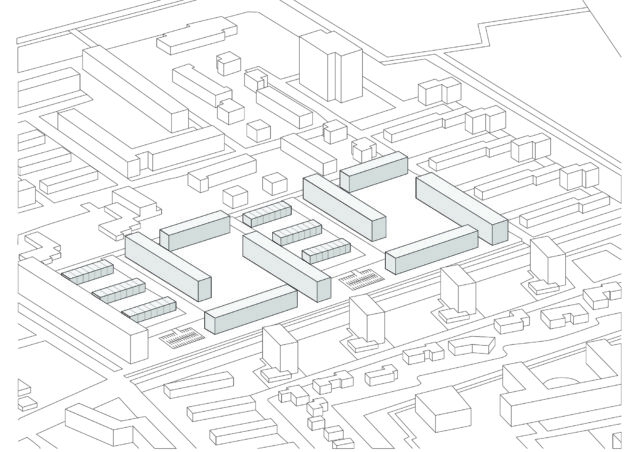
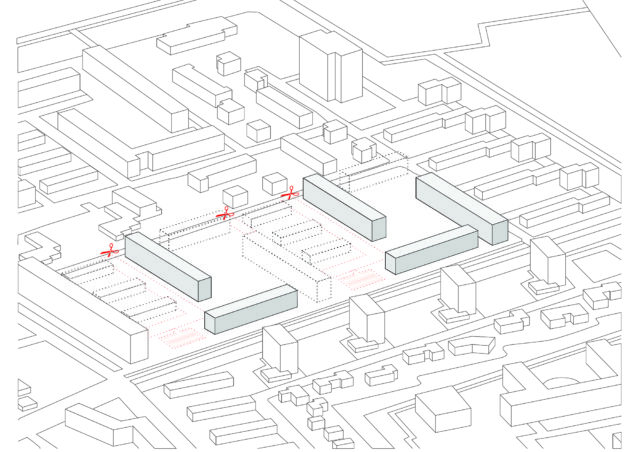
The plan makes use of Oswald Mathias Ungers’ concept of Grossformen (megaforms), that unite flexibility and adaptability with permanence and a strong architectural expression. By framing the existing district with a metropolitan fabric consisting of city streets and work-live city blocks, the plan injects urbanity, form and connections in the peripheral residual buffer zones, characteristic of most modernist districts.


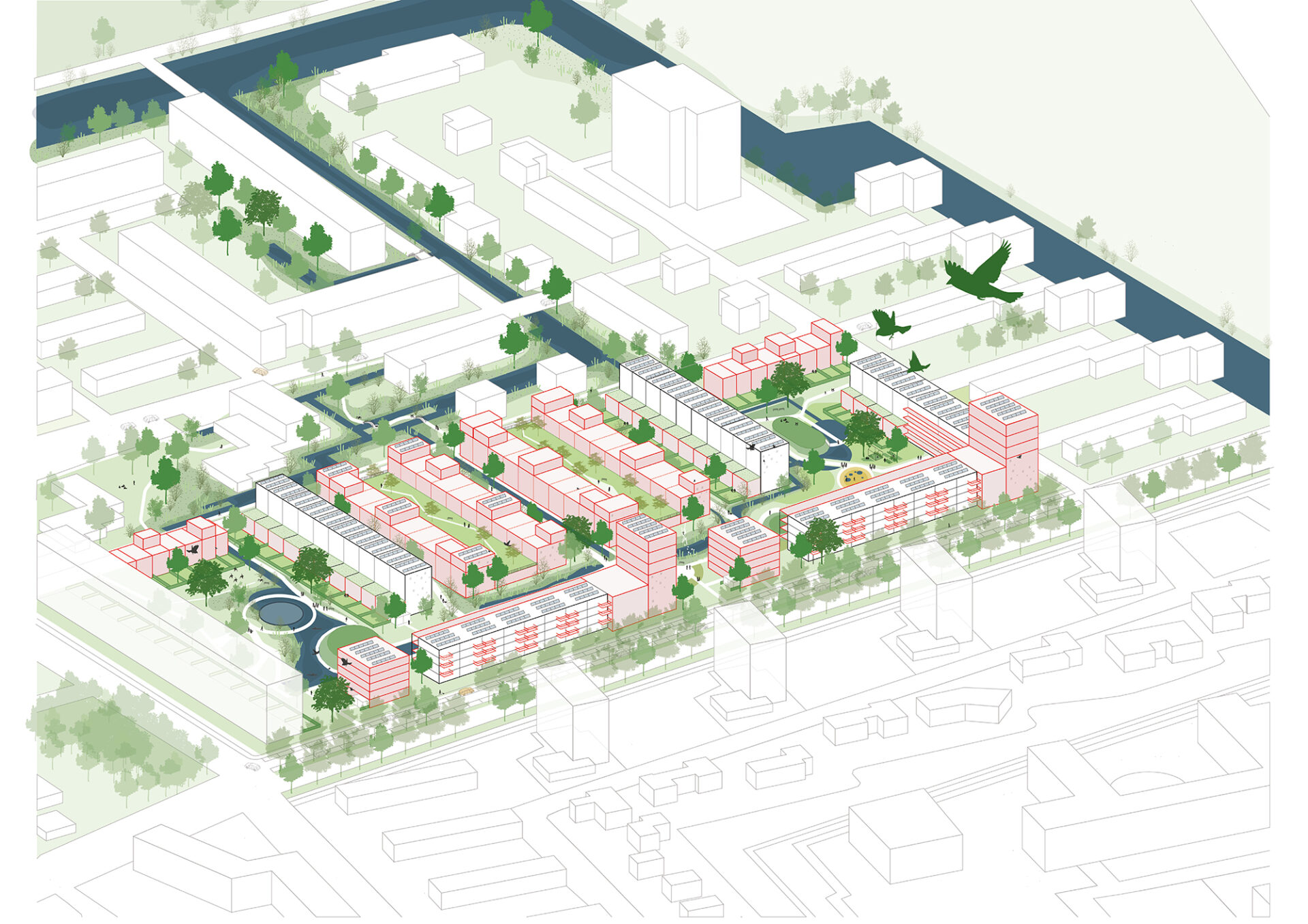
We transform the Prins Alexanderlaan, a 100-metre-wide thoroughfare east of the district, into a metropolitan city street. The metro line, located on the ground level, is flanked and topped with facilities and dwellings. The space for the car is limited in favor of cyclists and pedestrians. This gives the adjacent district Lage Land a representative front in the form of sturdy city blocks with dwellings, facilities, shops and offices that focus on the new city street.


We transform the Prins Alexander industrial premises and the adjacent communal- gardens location into a new mixed live-work district. The current low occupancy and low employment rate on this prime location situated right next to the Rotterdam Alexander train station, makes it ideal to partly preserve and partly intensify the existing businesses with new ones and combine them with up to 10,000 new homes. The railway line, located on a dike, will be provided with underpasses and an overpass, dissolving its barrier effect. The parking program of the entire district will be situated above the railway line. The business/industry areas are located under and inside the building blocks. They are accessed from a circular loop, which means that the entire development itself can be car-free.


We transform the neighborhood itself with acupunctural infills and a green-blue network that enhances the biodiversity and the sponge effect of the district. New slow traffic paths connect the neighborhood with its surroundings, including the Kralingse Bos, which we are expanding with a sports forest up to the highway. The Prinsenlaan will be transformed into a linear park connecting the Kralingse Bos with the Schollebos.


acupuncture in the existing district


Large-scale densification, as we advocate it, is complex. Too complex to be left solely to the market. The management should lie with the municipality. The design disciplines also need to sit more firmly at the table. After all, it is the architects par excellence who can think integrally and literally give shape to THE NEW EXISTING CITY.


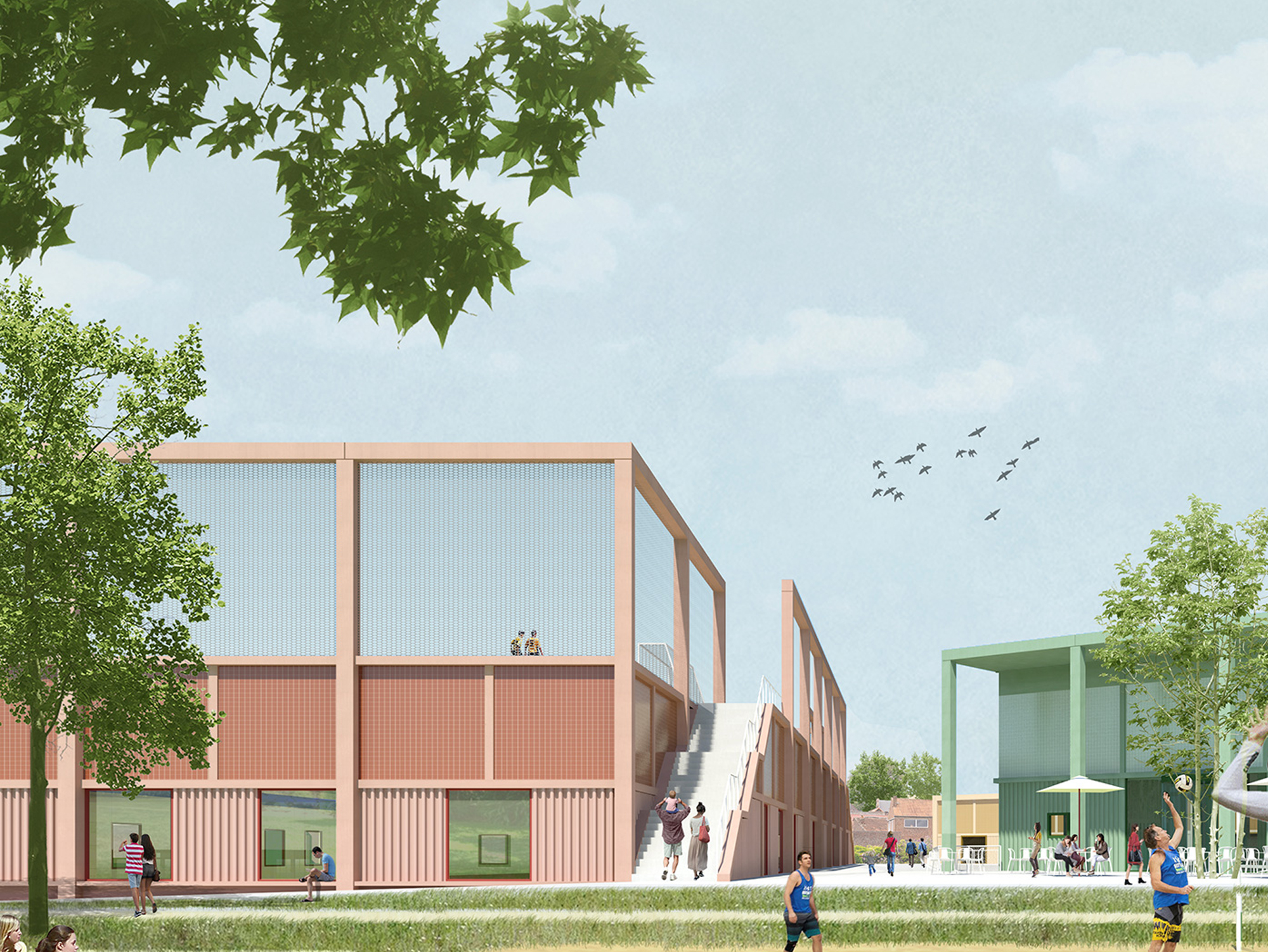


SportHalle on the Zenne
Sport – once the exclusive domain of sports clubs – is now an inseparable part of everyday social life. Sport charges public space with activity, dynamism and social encounters. The social and economic value of sport is at the forefront of politics, the civil service and the media. The importance of sport in society gets its spatial translation in Halle through a new urban typology: the hybrid urban sport park, which is embedded both spatially and programmatically in the existing city. The sports cluster is not a building or complex but, above all, an important public place within Halle’s inner-city pedestrian network.


The new sports building manifests itself at ground level as a cluster of three volumes around a sunken patio. The modest footprint and height of the volumes above ground preserve views and leave room for two pedestrian connections from the surrounding residential buildings towards the Zenne park.

The volumes represent the aboveground part of the main sports hall and the gym as well as a centrally located park pavilion where the reception, the cafeteria, the offices and the meeting room are located. The transparent park pavilion forms the link between indoor (sports) and outdoor (sports), between park and patio and between the upper world and underground sports world organized on two levels.


plans of ground level and -2 level
The -1 level is for the spectator, in the form of a balcony with views on all sport halls. The sunken patio located here forms the heart of the sports cluster, providing daylight and orientation to the visitor. The -2 level is the domain of the athlete, giving access to the multi-purpose hall, the main hall, the martial arts hall and the gymnastics hall. The two main halls are provided with generous windows on all sides at ground level and open completely on one longitudinal side towards the balcony on level -1.


The main hall is dimensioned (67x32m) to increase flexibility and permit a wider range of sporting opportunities. The multifunctional pavilion and the clear logistics with separated levels for athlete and spectator/visitor ensure that the sport cluster can also accommodate other functions such as markets, parties, performances, exhibitions or major school exams.
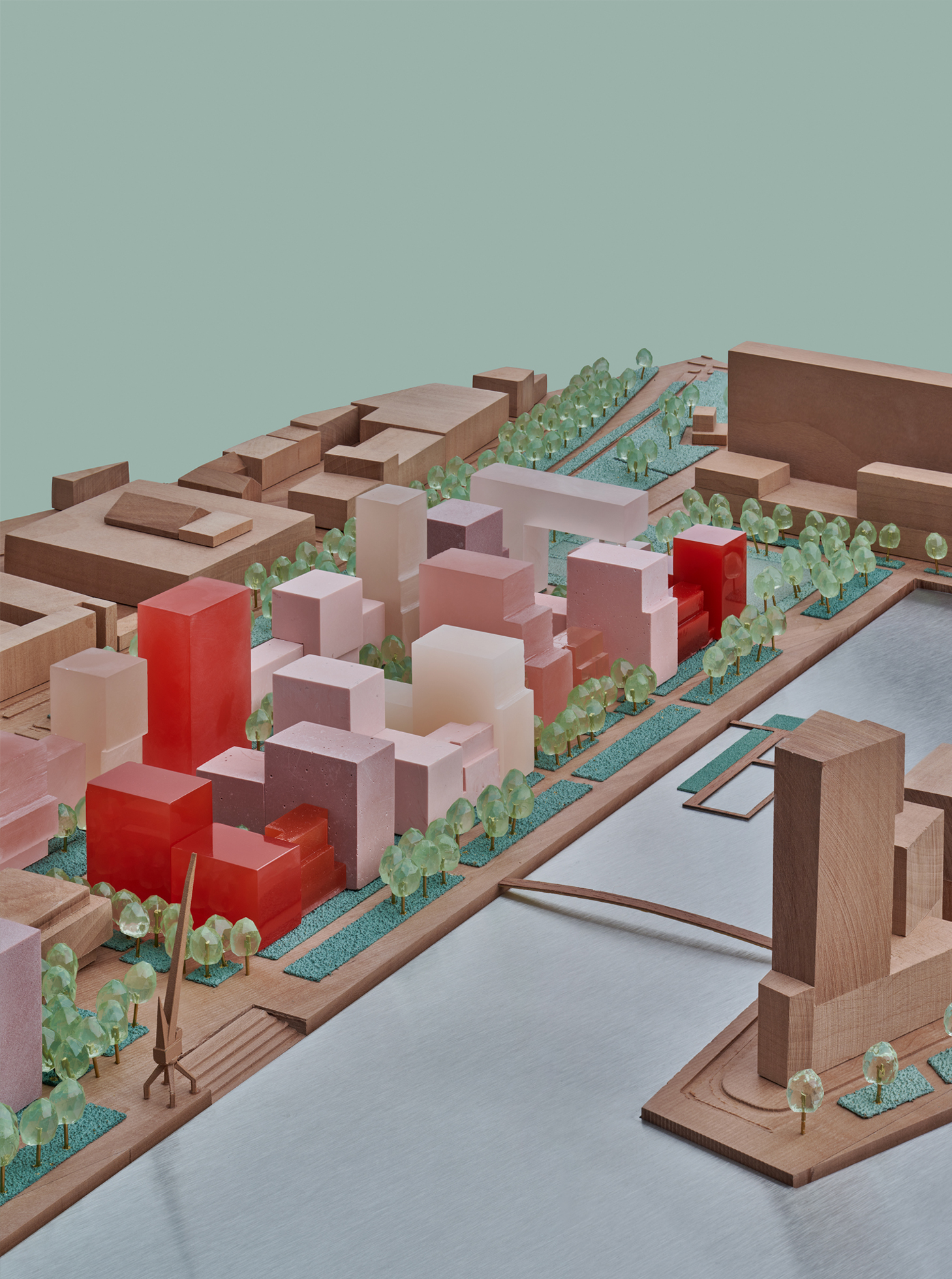

Schiehaven Noord
The masterplan for Schiehaven Noord capitalizes on the opportunity to further develop Rotterdam as a city on the river. It shows how inner-city densification of port areas can go hand in hand with creating high-quality public spaces and facilities that function both at the level of the city as that of the neighborhood. In its renewed relationship with the river, the neighborhood celebrates liveliness and urban connections as well as tranquility and intimacy. The plan is developed in close collaboration with the Municipality of Rotterdam and BplusB urbanism and landscape architecture.

The green urban plan provides for a varied mix of 1000 new homes, half at affordable and half at market price, thus making an important contribution to tackling the housing shortage through inner-city densification. The existing heritage (the Maaskant building with offices and the Marshall warehouse with cultural and social functions) are logically integrated in the plan and complemented with other strategically located public facilities in the plinth of various buildings.
A 40m quay extension makes it possible to combine the significant building program with a wide range of green public and collective spaces, as a welcome addition to the stony character of the adjacent Lloydpier and Müllerpier, and compensating for the wide area with underground infrastructure where no construction is allowed. Specific hindrances of this former harbor area such as the impact of wind and noise ask for an intricate urban fabric of medium height (instead of high-rise) that can provide shelter and security.


The urban design features a differentiated ensemble with a strong character, fabric and vertical silhouette. At the level of the city, the plan manifests itself as two superblocks matching the size of the port. On the scale of the neighbourhood, the plan reads like a sequence of green courtyards that together form a green residential fabric. On the scale of the building, a conscious effort is made to use a small grain that reflects the rich mix of residential typologies and residents, as well as enables identification with one’s own residential building.
Each layer of the plan connects to the city and the public space on a different level.
The superblocks relate to the two urban axes of the quay (Maaskade) and the dike (Westzeedijk) and as well as to the green connection on top of the underground infrastructure. The series of courtyards form wind and noise-free green collective spaces for the neighbourhood community. Finally, the individual buildings have addresses towards all sides so that the plan has no backsides. With carefully designed transitions between private, collective and public space, including raised terraces in front of the ground-floor homes, they contribute to the synergy between living and public space.


Within the range of Rotterdam’s (post-)industrial harbours, Schiehaven Noord is special because of its large contact with both the river and the dike. These two long lines of water and earth are used to give identity to the plan. A wide landscaped quay redefines Delfshaven’s relationship with the Maas by giving the opportunity to experience the river up close. The proposed new city square in front of the Maaskant building will have wide, sturdy stairs descending towards the water: De Maastribune. Existing and new sports facilities, as well as sunbathing areas on the quay, bring urban activity right down to the water. Natural zones and native plants are located both on and along the quay and reinforce the ecological position of the Lloydkwartier along the banks of the Maas.
At the other side of the plan, a differentiated urban facade is proposed along the dike. Ground bound dwellings with front doors on the dike alternate with apartment buildings with see-through entrance lobbies. This setup with addresses along the dike ensures liveliness and urbanity to this important scenic urban structure of Rotterdam.


The street between the two superblocks is an extension of the northly situated Oostkousdijk and Havenstraat in Delfshaven, strongly connecting the new neighbourhood to the inner dike city parts. This slow traffic axis connects to three parallel slow traffic routes: one along the dike, one in the inner area and one on the quay. They accentuate the characteristic longitudinal direction of the harbour and connect the Lloydkwartier with the former Schiemond port area and the De Kroon site. The car is given a subordinate place in the plan by accommodating it in two parking hubs on either side of the plan: a fully underground parking garage (2 layers) on the East side and a demountable multi-level parking garage on the West side. The quay and the dike route are only accessible to car traffic for the purpose of garbage collection, parcel services, moving and emergencies.


The project strives for a differentiated unity, both at the urban and architectural level. The two super blocks are made up of individual buildings placed next to each other, which clearly acquire their own character within a common architectural DNA. This creates a family of buildings that shape the quay, dike and courtyards by means of differentiated urban walls. In addition to the so-called “Rotterdam layer” consisting of 3 to 6 floors, the plan has a rich collection of higher volumes up to a maximum of 15 layers. The “Rotterdam layer” is oriented to the ground level and shapes the urban spaces. The height accents, situated in a checkerboard pattern, focus on the view and give the project its own distinctive skyline with staggered height accents.


Westwijk Rooted
Westwijk, an icon neighborhood of post war urbanism, needs renewal. Both the original housing stock and the public space are outdated. The clear urban layout designed by Willem van Tijen offers a good basis to further draw upon. At the same time we will have to break with some of the original principles. We have to move form tabula rasa to tabula scripta and from a separation to combination. More specifically, this means that the relation between the residents (and their houses) and the ground has to radically change and that both the housing stock and the public space has to become more attractive, diverse and sustainable.
Westwijk Rooted is about a neighborhood that is linked to its reconstruction past, its wet soil, the adjacent polder landscape, the new metro station and of course with existing and new residents. A new ground level based on the wet soil condition forms the landscape framework of the plan. It makes the neighborhood climate-proof, water-resilient and biodiverse. At the same time, it creates the ideal conditions for attractive new living environments that are anchored in the ground level.
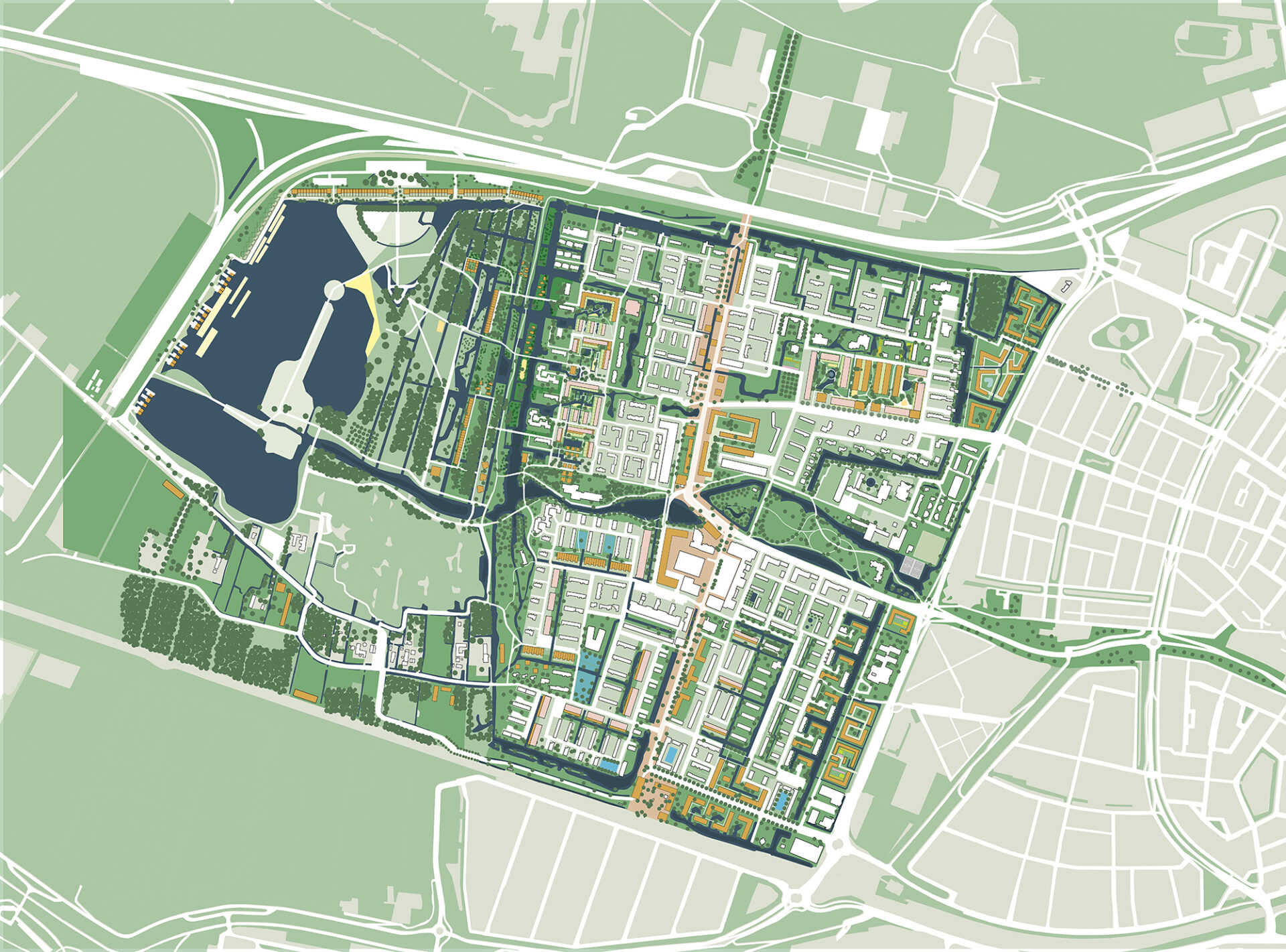
To help Westwijk and its residents take root, we use the following five strategies:
From floodings … to a climate-adaptive living environment
Westwijk was built in the 1950s on a thick layer of sand without any relation to the peaty ground. By excavating the sand layer in the public space, adding much more surface water to the neighborhood and raising the Krabbeplas area in strategic places, attractive and climate-adaptive residential environments with limited subsidence are created.
From isolated … to connected
In addition to the interweaving of Westwijk with the Krabbeplas recreation area, the connection with the new metro station must also be strengthened. What is needed is an entrance square, a station development with housing and an improvement of the north-south axis that also establishes the link with the Broekpolder.
From skimpy green … to green with value
By better attuning the greenery to the water-rich soil condition, less maintenance will be required and the ecological quality will increase. A greater biodiversity goes hand in hand with a more recreational qualities and attractive walking routes. The green can also be used functionally due to its water purifying capabilities.
From uniform housing … to a diverse mix
Our plan focuses on a varied housing stock with an emphasis on more ground-based housing in the private sector. In Van Tijen’s urban stamps, the necessary adaptions because of the energy transition are used to realize a combination of demolition, new construction, renovation and transformation. In the new development locations on the edges of the neighborhood, a combination is also being sought between homes for young and old, both in the private sector and in social rent sector.
From social isolation … to communities
We are committed to stimulating communities. Communities consisting of residents with a mix of economic strength, age and family situation. Communities that feel connected to their immediate living environment. In addition to the housing supply, the design of the public space plays a decisive role in the creation of these communities.
The deployment of the various strategies provides the ambition map for the Nieuwe Westwijk. This map is not a blueprint, but a dot on the horizon to work towards. Based on two prototypical case studies, we show how this ambition can be put into practice.

Wetering: Core of the neighborhood
In the core of the neighborhood, stamps with one-sidedly oriented residential blocks and an indefinable public space currently dominate the image. By demolishing part of the residential blocks and replacing them with ground-level homes and transforming some of the blocks into homes for families and the elderly, a rich mix of housing types is created. In the public space, a climate-robust, connective and biodiverse outdoor space is created by cutting roads, excavating soil and connecting waters. In the south a more urban wall is being created by the addition of life-course-proof apartment buildings.





Lage Weide: Connection with the landscape
The current situation is characterized by a hard division between landscape and neighborhood. They are separated from each other by a wide watercourse without bridge connections. Our approach is to interweave landscape and neighborhood and to connect both with the natural wet soil condition. This creates a connecting water landscape that forms the basis for new living environments. The current homogeneous housing stock in the stamps is supplemented with new housing typologies with an emphasis on ground-based family homes. To this end, both new constructions (after demolition) and transformation of the existing flats are applied. In order to create more water, ground is excavated. Excavated soil is used to create mounds for a mix of recreation and housing in the landscape.


Ring around Krabbeplas
In order to co-finance the large-scale transformation of the public area of Westwijk in particular, we see an opportunity to make a limited number of specific forms of housing possible in – and especially around – the Krabbeplas area. The condition is that living remains subordinate to recreation and that the residential buildings make a significant financial contribution to the transition of Westwijk. In addition to the residential enclaves located on mounds in the transition area between landscape and neighborhood, we are also providing noise barrier houses along the A20 in the north. Together with water houses on the west bank of the Krabbeplas and a series of CPO residential areas on the southern polder ribbon (Zuidbuurt), a new route around of Krabbeplas is created.



Rozemaai at home
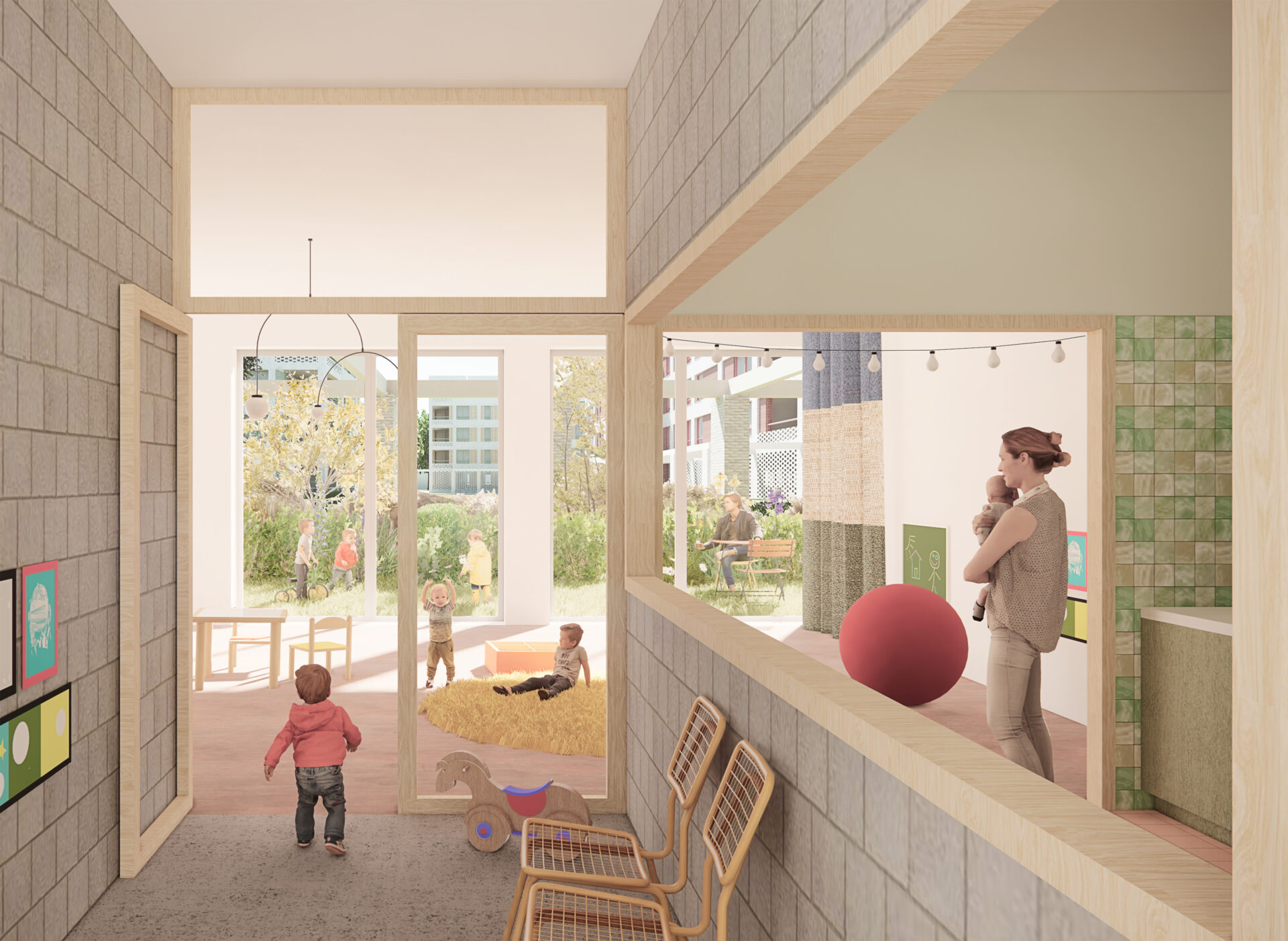
Rozemaai at home is a plan for 140 social houses, 30 medium-priced houses, a day care center, commercial facilities and an array of public spaces. The site is part of Rozemaai, a postwar extension district of Antwerpen in modernist tradition, that is undergoing a massive transition. A masterplan by Buro Lubbers for the whole district includes a new natural park along a re-opened creek, the Donkse Beek. The jury, chaired by city architect Christiaan Rapp, praised the way our winning entry – At Home in Rozemaai – relates to the fragmented urban context and in particular to the new landscape of the creek’s valley.
The main contradiction in social housing today is the tension between the necessity for standardization on the one hand and the need for identity on the other. Housing blocks, urban spaces, buildings and units should all be the same for financial reasons and all be different for socio-cultural reasons. Team BOGDAN & VAN BROECK and Shift A+U has chosen to explicitly use this ambiguity in the urban scheme, the building typologies and the architecture of their project for Veld 15a in Rozemaai.
Currently Rozemaai lacks any kind element in the public space that embodies the idea of community. The question therefore is how can we create a home, both on the level of the city and the house, that combines the suburban living qualities with a landscape design that is based on strong ecological connections and accessible green spaces of quality.
“Rozemaai at home” is the result of a search for an environment in which houses and inhabitant are part of larger whole, a Habitat. Neither the modern city with its isolated machines for living nor the traditional city with its perimeter blocks, streets and squares, provide the answer in the context of Rozemaai. The answer lies in residential buildings and inhabitants that relate in an alternative way to one another, to the ground and to the landscape.

The urban scheme consists of an ensemble of solitaire blocks and slabs which together form clearly defined public spaces that balance between open and enclosed. Because of their clear definition, hierarchy and function these so called outside rooms are clearly different from the flowing and desolate public spaces of the modern city around. At the same time this new urban fabric offers enough openness for the creek valley to be experienced from the houses and for this water landscape to physically enter the project. In this way the most important feature of Rozemaai, its creek valley, becomes an integral part of the daily living experience of the new inhabitants.


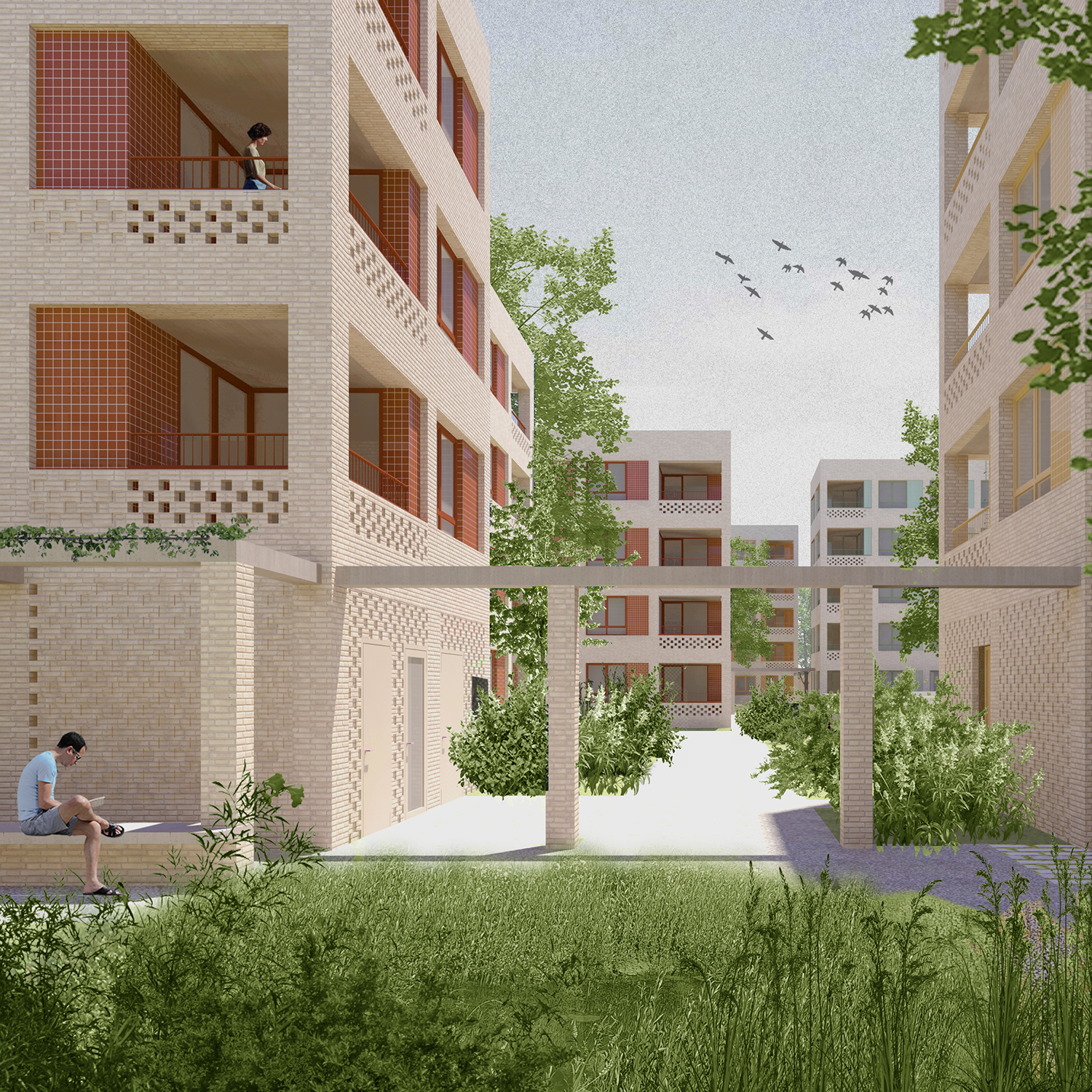
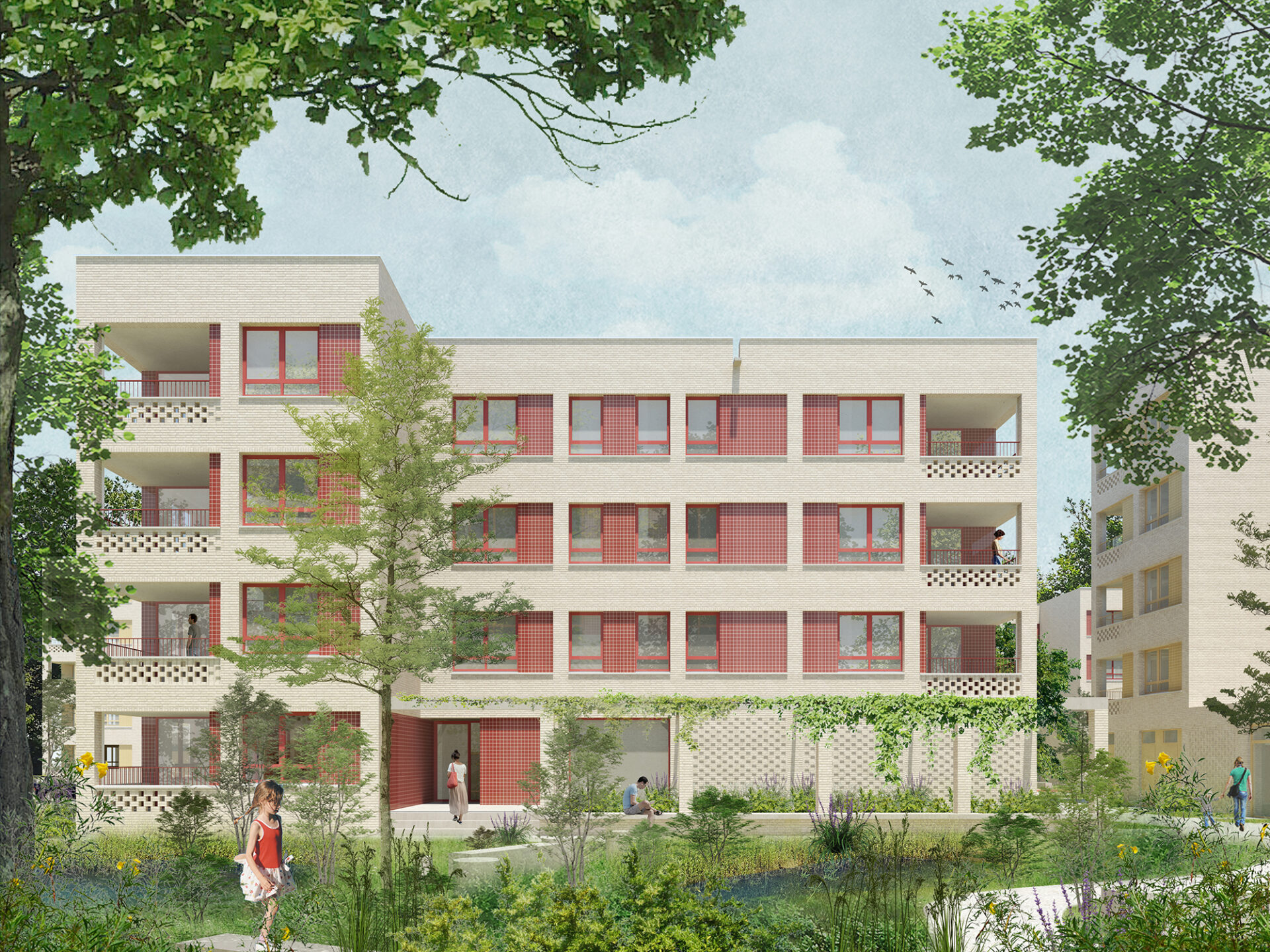
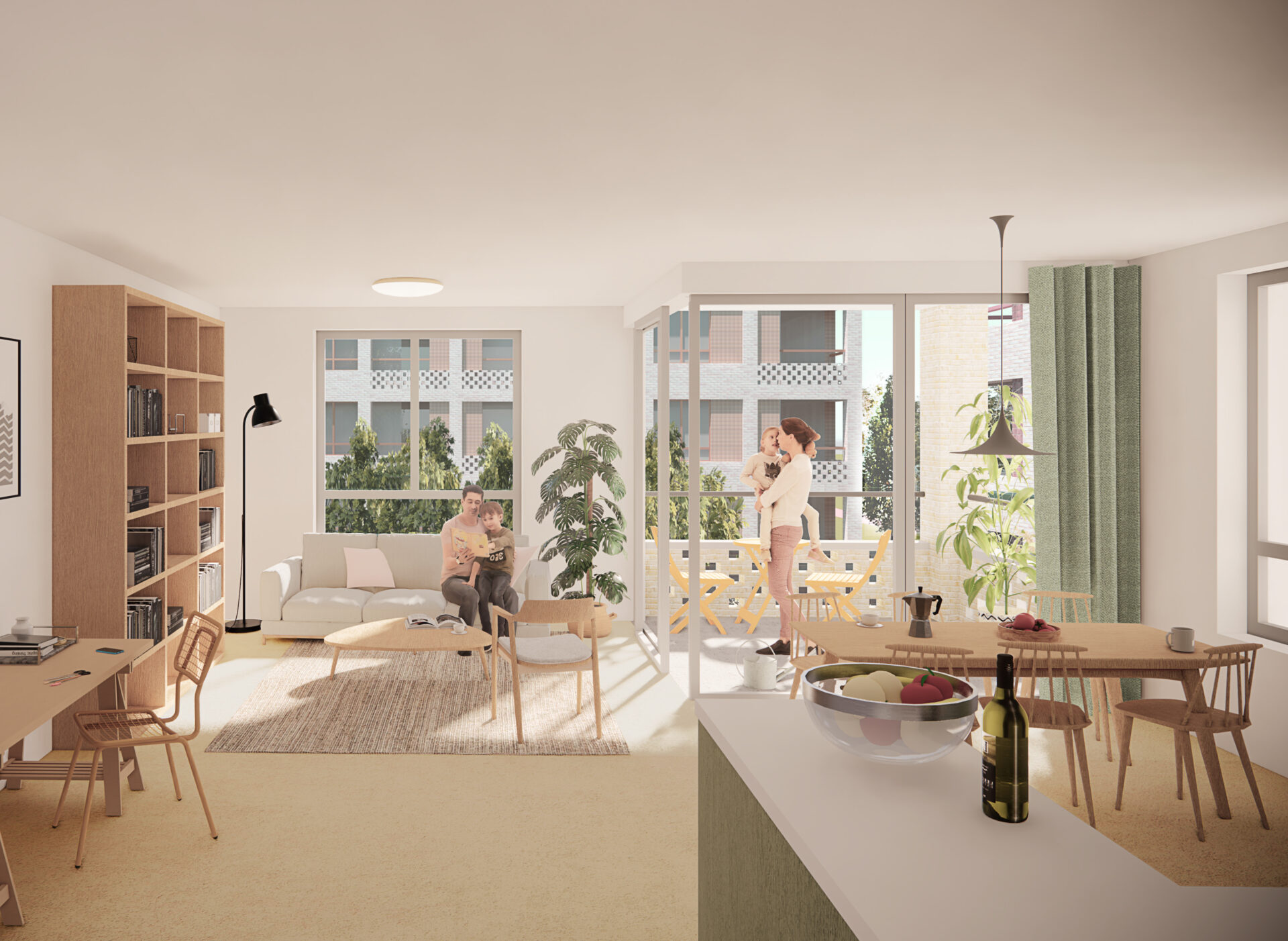
The proposed buildings have a relatively fine grain size. This results in public spaces and housing blocks with a human scale that allow for appropriation and identification by the inhabitants. It also leads to apartments with a lot of living quality in terms of light and view. All apartments in the blocks are corner apartment with a two sided orientation that offers views of two different outside rooms. The galleries in the slabs are relatively short and they are loaded with so called see-through apartments.

The outside rooms are clearly different in scale, function and degree of openness. The parking program is distributed across several small green parking’s along the perimeter of the site. In this way, large and desolate parking fields are avoided and in time, when car sharing becomes the norm, they can step-by-step be replaced by green. Each housing cluster has a central court with an enclosed character. The intimate quality of these residential courts is enhanced by a system of pergolas between the blocks that also articulates the entrance zone to the blocks. Lastly, a large multifunctional square connects both new residential clusters with each other and with the adjacent gallery flats.
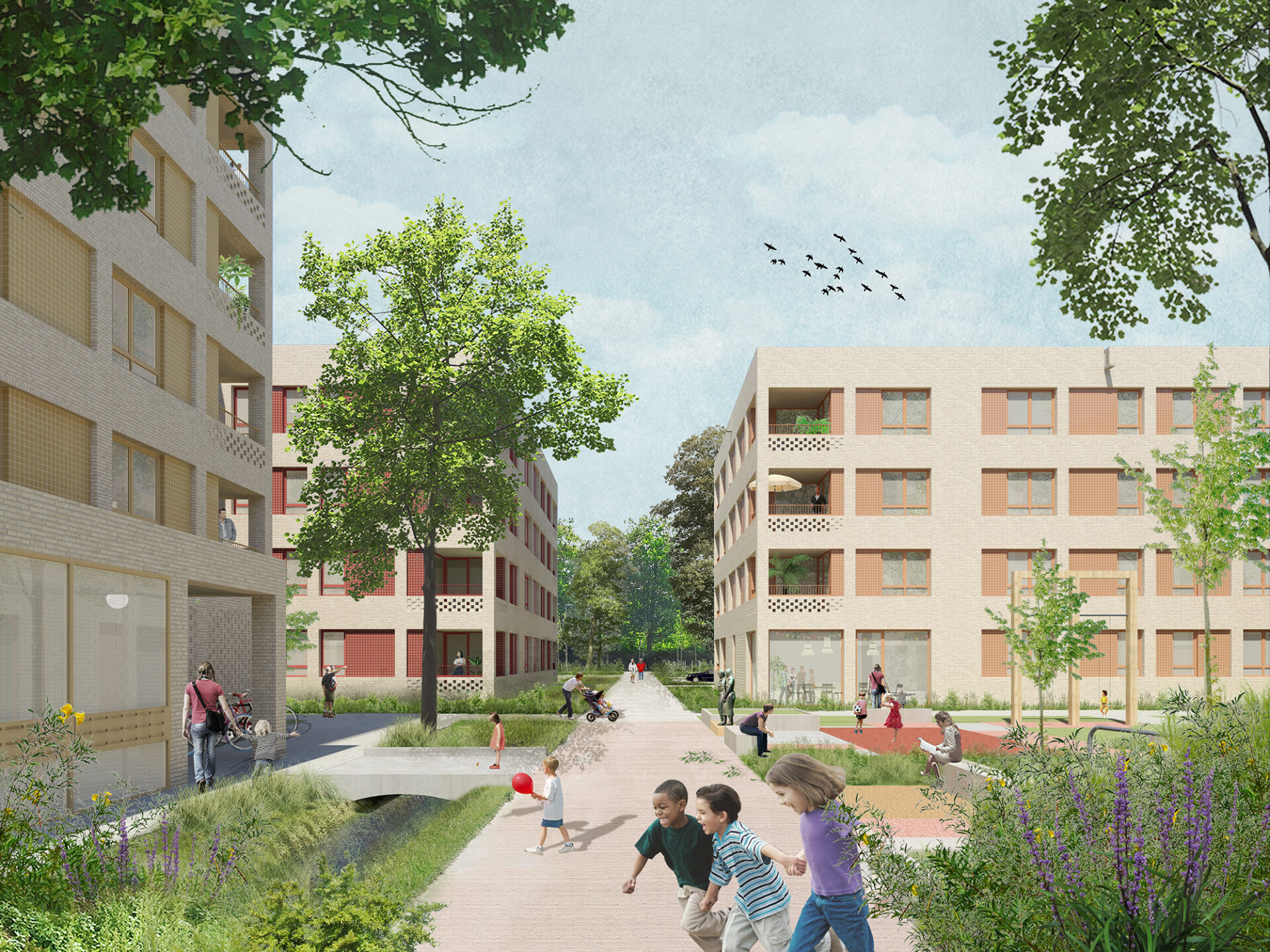
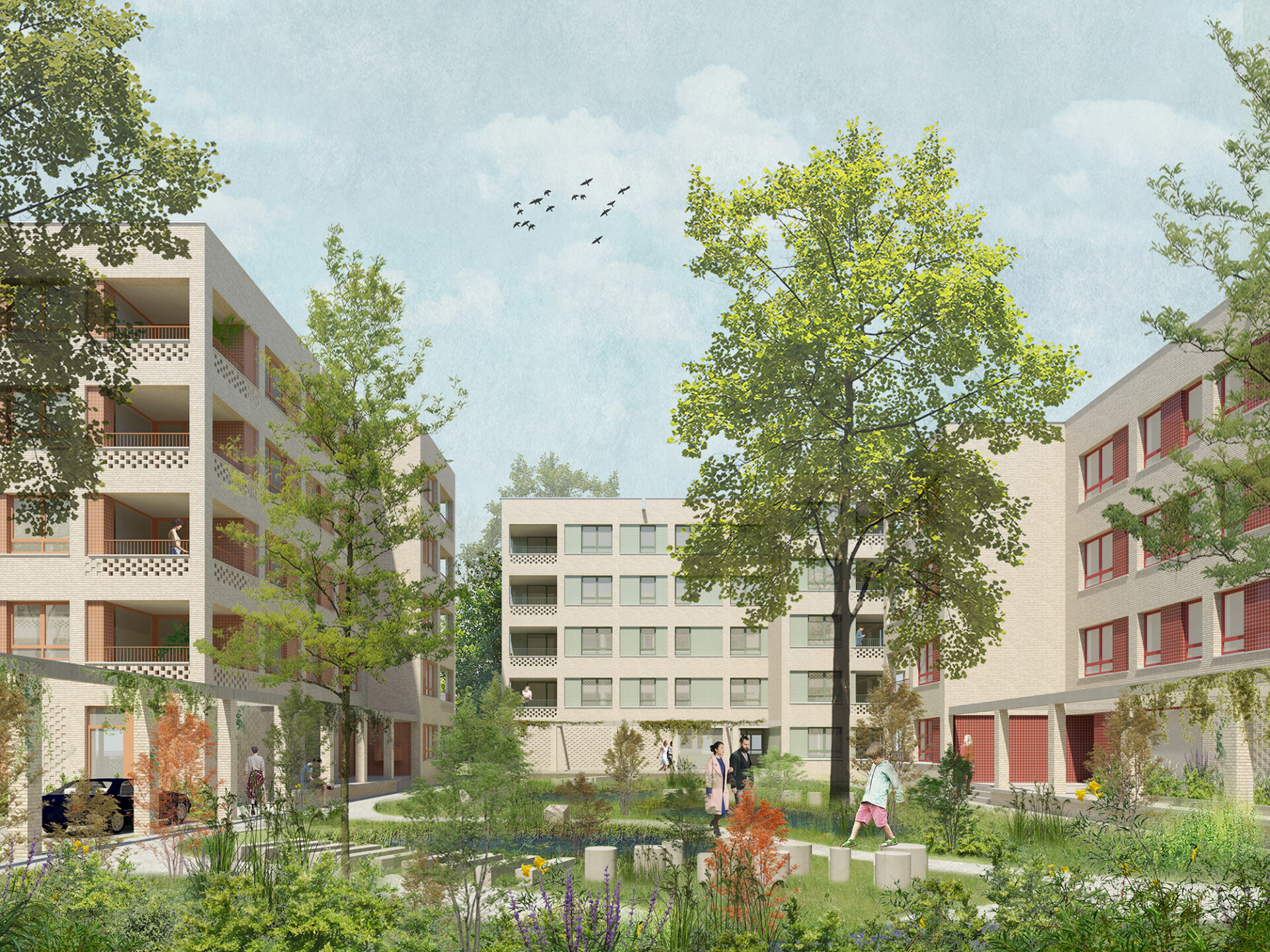


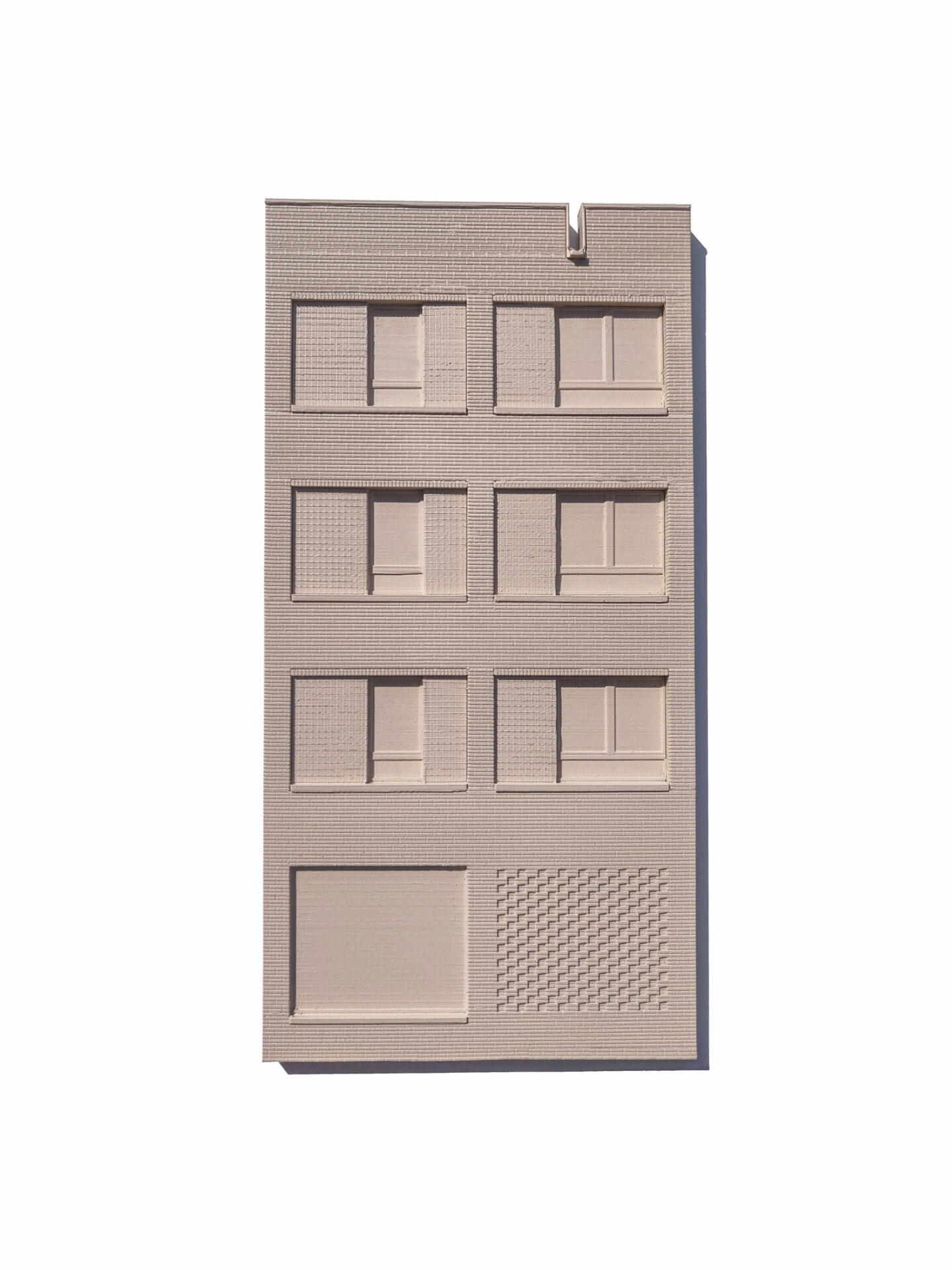
By using a common DNA for the architecture, a family of buildings is created that clearly belong together but at the same time are all unique. Both the blocks and the slabs are based on a rational typological system that allows for high degree of variations in terms of apartment types. In the blocks, each specific configuration of apartment types leads to its own building mass, that subtly differs The rational facades balance between solid and transparent, creating both an analogy and a contrast with the radical transparency of the gallery flats by Kempe Thill with which the project clearly seeks a dialogue.


Batavialand
The Batavialand Foundation aspires to become THE museum in the Netherlands that portraits the origins of our national DNA, developed by living on the border between land and water. In order to achieve this ambition a large-scale expansion and transformation of the current museum is necessary. Shift architecture urbanism has been commissioned to do a spatial exploration that investigates how to translate the new Batavialand program into an architectonic, urbanistic and landscape design that does justice to this ambitious assignment within the context of the Lelystad Batavia quarter.


formal frame versus informal landscape
Batavialand will become a world in which the visitor is guided along experiences that feature the historical, current and future relationship of water versus land in the Netherlands. This time travel runs through the recreated historical landscapes of the prehistoric creeks, Flevo Lacus of Roman times, the Zuiderzee in the Middle Ages and finally the international exploration of the world’s oceans with the Batavia ship as a highlight. Subsequently the present and the future are presented, in the form of a manufacturing landscape, a shipyard, and an information center where companies in the field of water management demonstrate their current and future knowledge and skills.

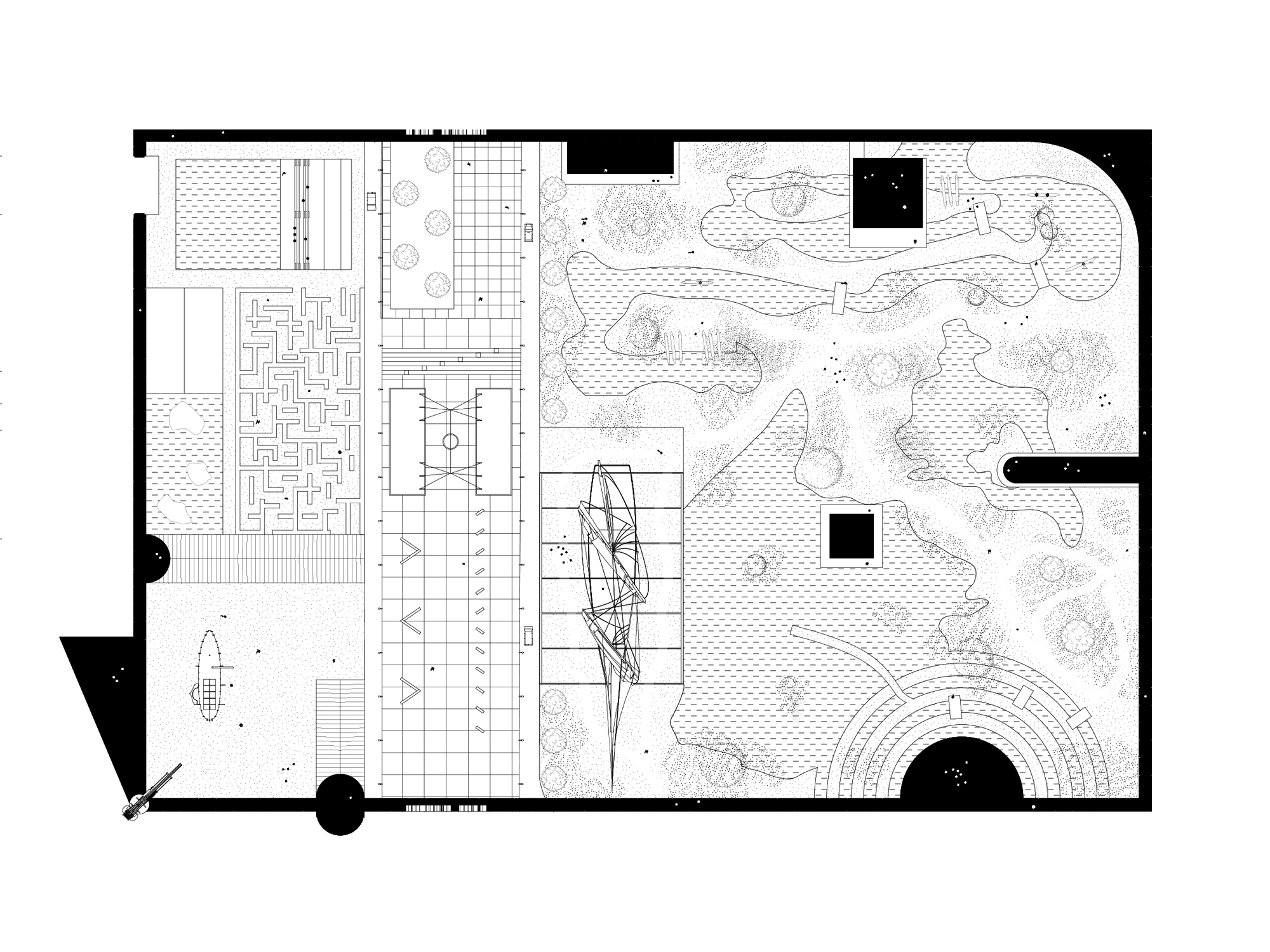
Our proposal consists of a fixed, uniform and formal framework that encloses a flexible, differentiated and informal world. This frame both unifies and separates. It unifies the varied parts of the museum by embracing the different landscapes and by connecting the different buildings. It separates by defining a clear limit between museum and its surroundings, creating a clear entity towards the outside and an introvert inner world that lends itself for a varied collection of simulacra that recreate the Dutch relation of water and land over time. By incorporating the public promenade that runs right through the museum, the clear division between inside and outside is locally released. Here, museum and city are intertwined.

The frame contains a covered walkway that opens inwards and has a more closed character towards the outside. The formal indoor route it creates contrasts with the labyrinthine outdoor routes through the landscapes it surrounds. The visitor can freely switch between these two ways of navigating the museum.Both existing and new buildings are situated on the inside and on the outside of the frame. Within the buildings there is room for museum experiences with more depth and reflection; in the framed, free outdoor space there is room for play, infotainment and discovery.

Klaksvik United
Klaksviks sublime location has become its weakest link. Present day Klaksvik is a spatially divided town. Ironically it is precisely the spectacular estuary location, and the way it is occupied, that causes this separation. Both the bay and the central isthmus act as barriers that split the town into two linear settlements with little connection to the water.

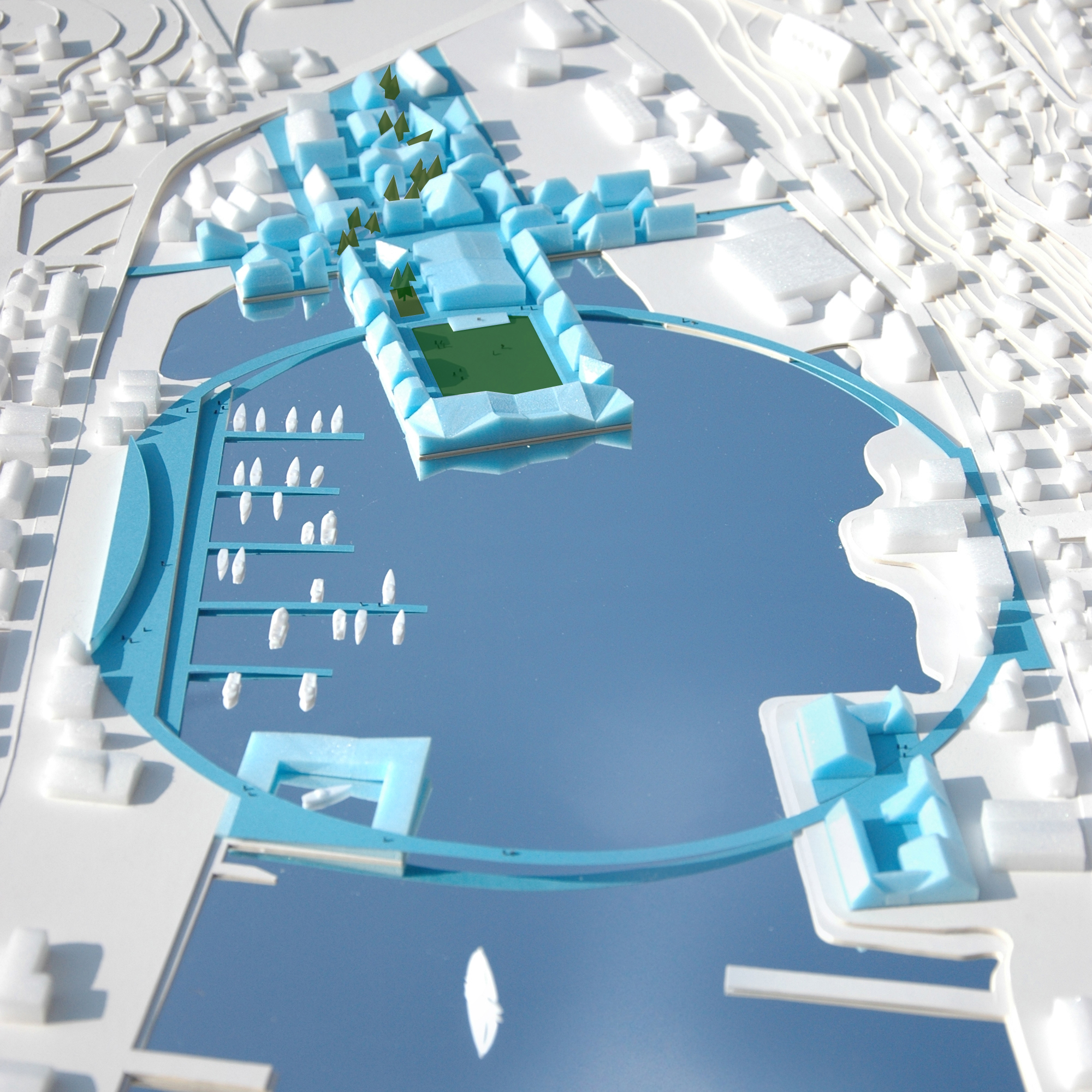
Our proposal, Klaksvik United, aims at creating a new town center that unites Klaksvik with itself and its waterfront. Two strong forms, a ring and cross, are used to transform the open water and the empty center from barriers into connectors and from non-places into places. They function as fixed armatures for flexible city center developments. Their unifying gesture opposes ánd incorporates the urban fragmentation of the site and creates multiple links between east and west, north and south, water and land, old and new. The new center makes Klaksvik into one and celebrates its unique location.


The Ring reinforces Klaksvik’s relation to the sea by connecting both parts of the town an uniting them with the water. It functions as a pedestrian boardwalk of exactly one kilometer long that links a variety of waterfront programs, both new and existing and defines a new water square. In a mere 10 minutes walk one can experience the vital role that the sea plays for Klaksvik. The ring connects the outdoor event area of the new cross with the existing marina, the ferryboat terminal, the second landfill and the existing shopping street on the south bank.
The ring transforms the bay experience into Klaksvik’s main asset.

The Cross, consisting of various spatial typologies designed to minimize the disturbing winds, establishes two crucial connections.
Main street runs from North to South and connects the separated halves of Klaksvik. Its mixed use program of retail, services and housing creates a lively street that forms the backbone of the cross development.
In the other direction, a central square with public facilities and a wind free labyrinth neighboorhood connect the green isthmus with the bay and reestablish the relation of the old center of Klaksvik with the water. The central square is surrounden with a multifunctional event hall, the administration building and the tourist information, which protect it against the wind and use it to program cultural outdoor festivities, year round. The intimate and wind free labyrinth invites for strolls along its shops. Existing buildings are integrated in a compact urban tissue. The small block size allows for a flexible infill with a variety of retail and leisure programs combined with housing.


Superhub
Waalhaven Zuid, a derelict harbor area in the South of Rotterdam, has an outstanding location in the network of freight transport. It has connections to road (A15 highway), water (both short and deep sea) and rail infrastructure (Betuwelijn).
This project proposes to transform Waalhaven Zuid into a logistics superhub that combines a very high distribution capacity with an excellent connection to all these modes of transport.


Gradual transformation
The project takes the existing layout and road infrastructure of Waalhaven Zuid as a given. Within this framework the area will be gradually transformed into a hyper efficient logistic superhub. In order to do so, the buildings are scaled up drastically in all three dimensions.

The core business of Superhub is Value Added Logistics. Instead of just storing and trans-loading cargo, the cargo will be subject to a simple production operation such are repacking, labeling or assemblage . In this way value is added, money is earned and jobs are created.

By connecting the area directly with rail and water, Superhub triggers the use of these modes of transport as an alternative to road transport. This so called “modal shift” is necessary to reduce the dependence of the Dutch (and European) logistic sector on truck transport.

In Superhub, business clusters (fashion, food, electronics, etc.) will be created to achieve synergy advantages, share services and improve the corporate appeal of the area.

The final masterplan consists of an array of purely functional buildings around a linear plaza that forms the social heart of the area. Here one finds large truck parking’s and services for the users of the Superhub: truckers and employees.


A new container terminal links Superhub’s distribution capacity directly to both short- and deep sea.

By introducing multi-storey warehouses, the distribution capacity of the site will literally be multiplied. A central system of ramps makes it possible for trucks to navigate the buildings vertically. The so called 3D-Distri buildings are framed by functions that relate to the distribution function of the complex and the specific product group it deals with. One can think of offices, shops, consulting services, outlet centers and showrooms.

Superhub Waalhaven provides a model for concentrated logistic main ports, being an alternative for the sprawl of logistic business parks all over Holland that fully depend on car and truck mobility.


Concentrating logistic mainports
The project also pleads for bringing back true harbor activity in the immediate vicinity of Rotterdam. A city struggling with an unrealistic vision of “city harbors” that envisages fantastic housing ambitions along the river it cannot make true. Rotterdam is a working city.

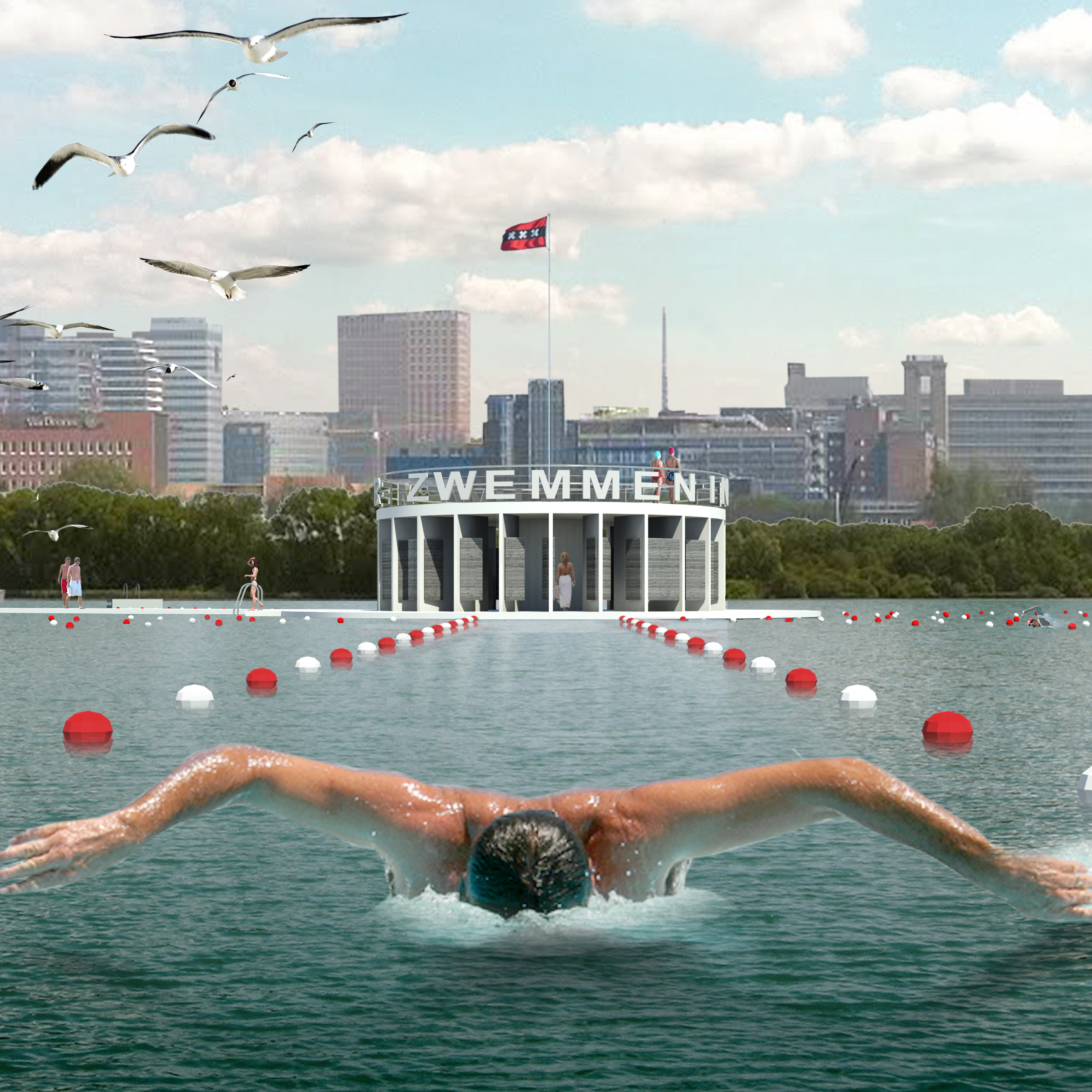

Sport Axis


from an archipelago of isolated sport enclaves to a Sport Axis with integrated sports facilities


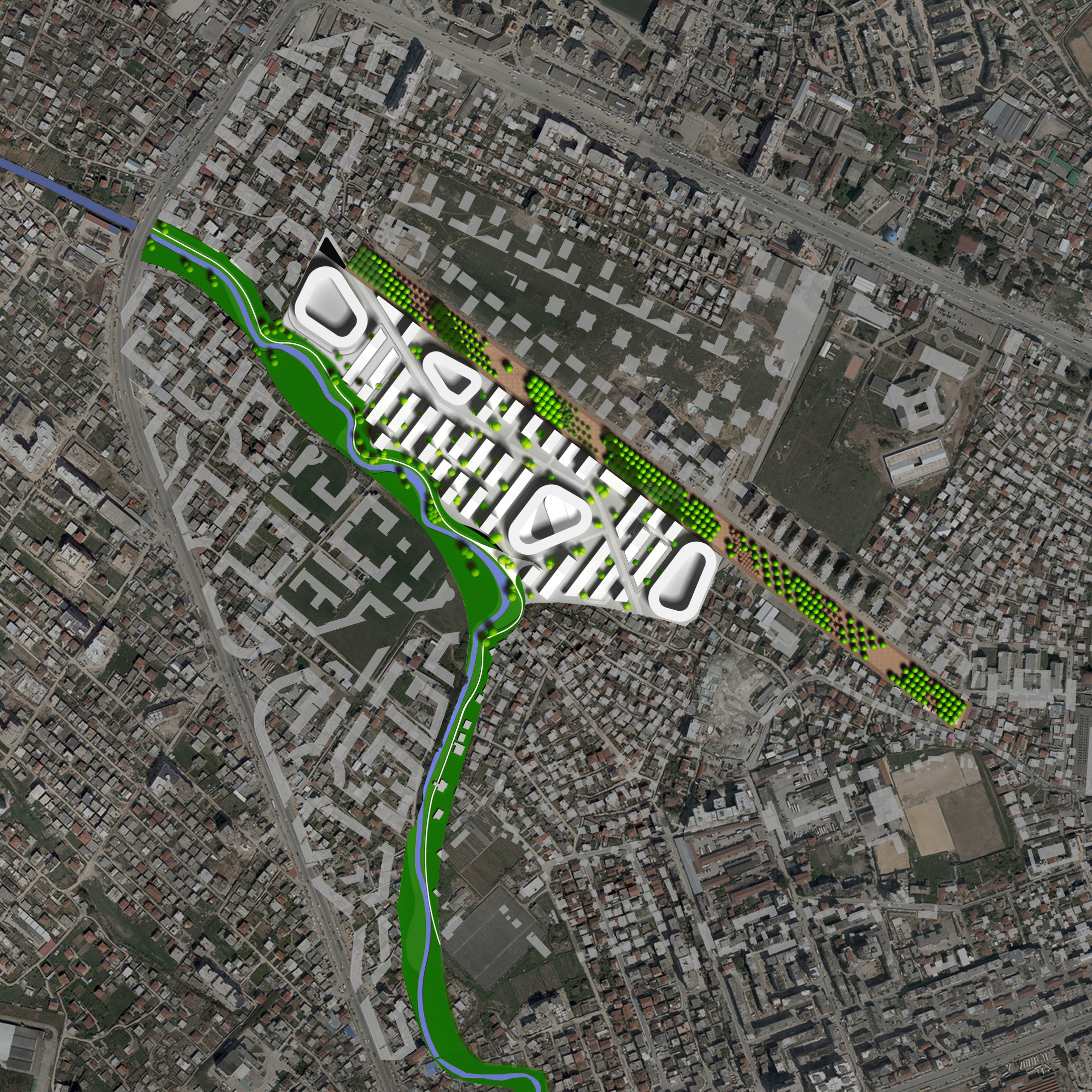

Park City
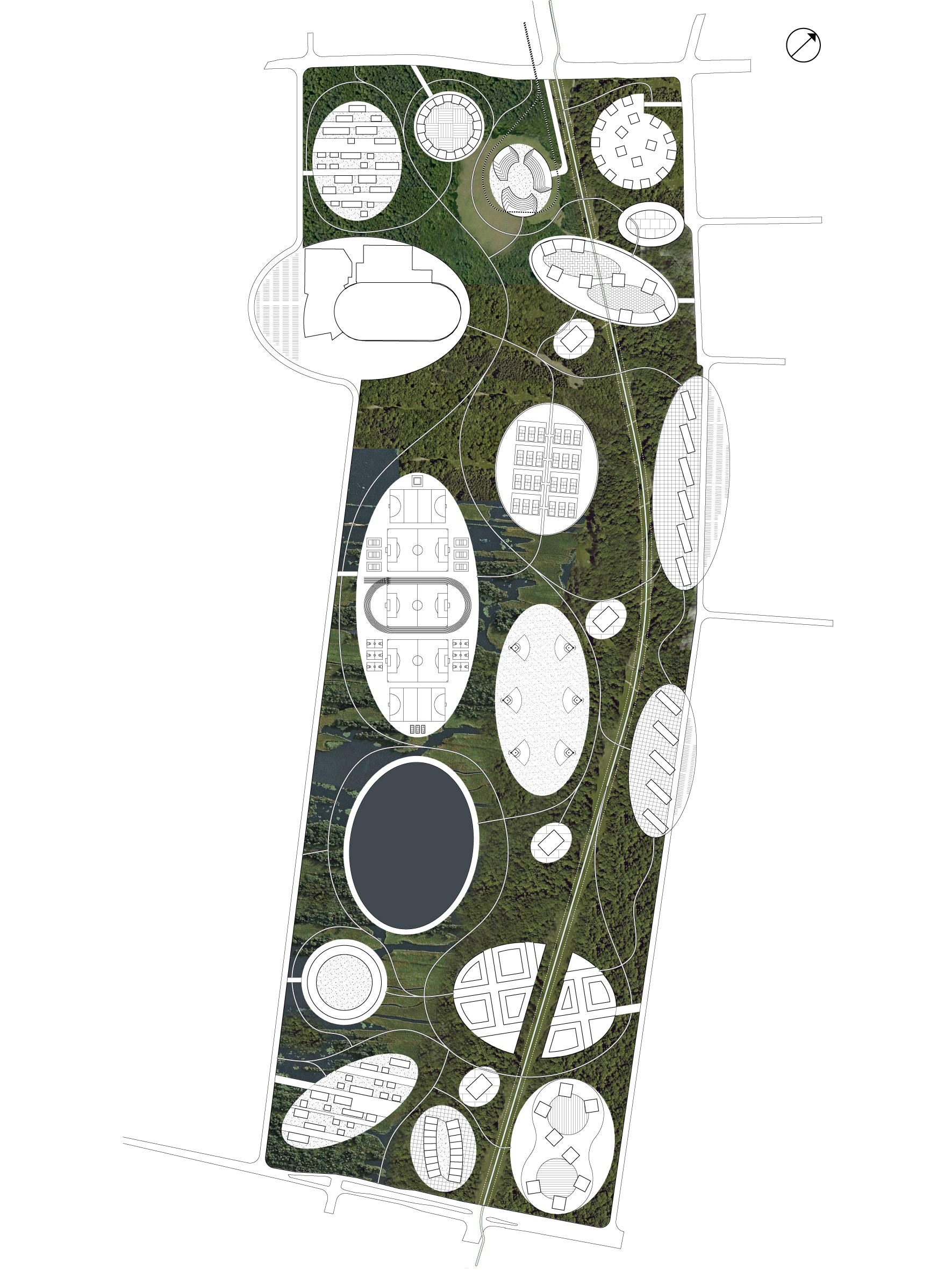

Green Archipelago
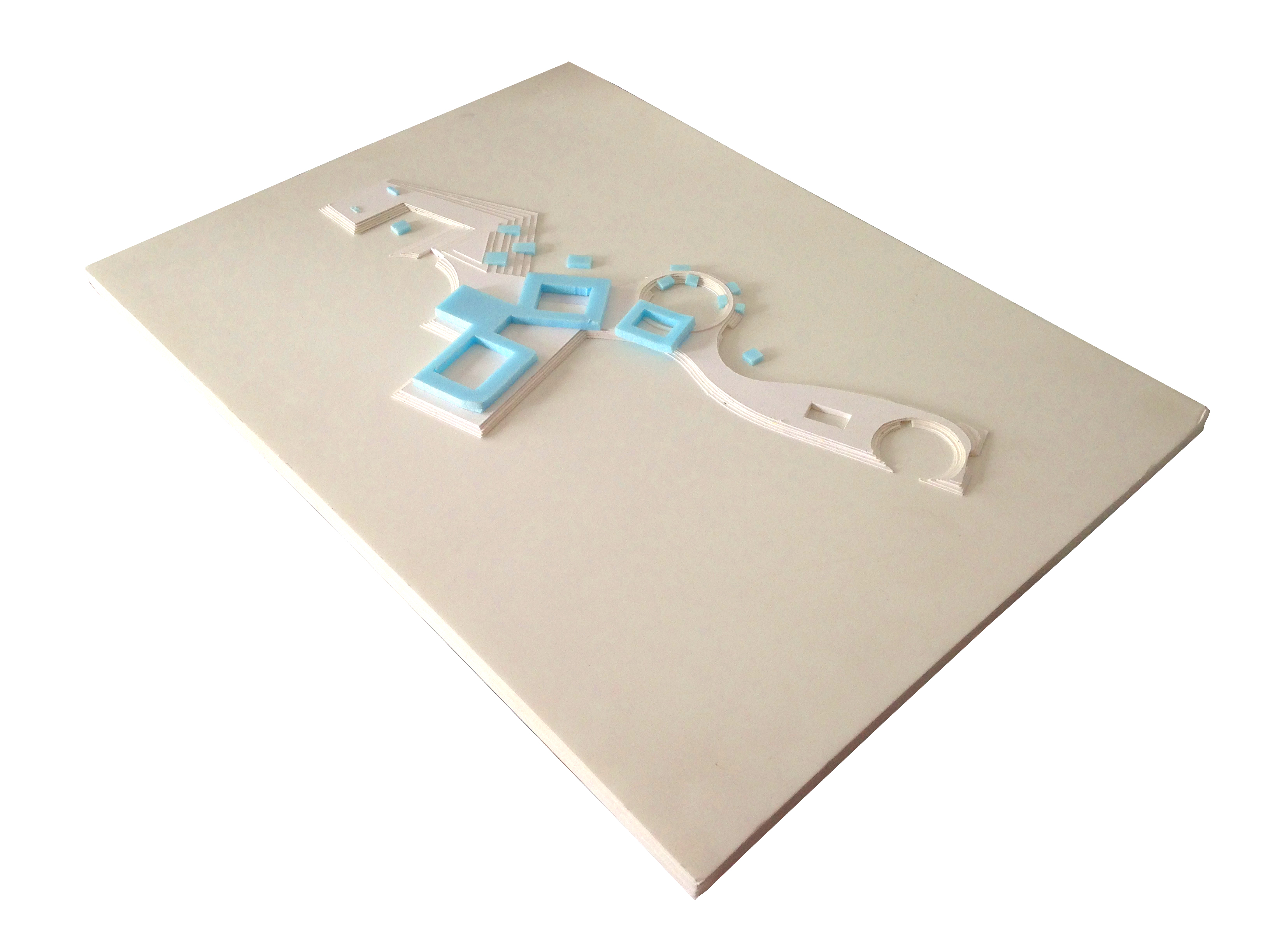

Topos
Landgoed De Groene Kamer seeks to develop a new type of country estate in the southwest of the city of Tilburg where eco-retail, nature and recreation are brought together. A place where city and countryside meet, both physically and programmatically. Shift’s proposal, Topos, focuses on a radical integration of architecture and landscape.


Masterplan
Topos transforms the flat body of earth in the existing master plan of .Fabric and LOLA into a differentiated earthwork. The boulevard, the squares and the buildings are placed in and on this earthwork. The body of earth is used as an instrument for place making and therefore becomes topographic. Each retail cluster is embedded in a specific three dimensional earth shape to create a sequence of differentiated places (topos). Shopping on the green boulevard becomes a natural experience in which the division between city and countryside, between architecture and landscape, is dissolved.


The entrance square is formed by a bowl-shaped earthwork which opens towards the parking arboretum. The circular shape embraces the visitors and welcomes them into a different world that invites for exploration. The various buildings situated in, on or under the earthwork bowl can be accessed from the square. Each building typology has its own specific connection with the earthwork and the surrounding landscape.
Block

The block houses a so-called landwinkel, a large shop where local food products are being sold. It functions as one of the anchor programs of the whole Groene Kamer development and is therefore prominently placed on top of the earthwork. The omnidirectional block manifests itself as a transparent greenhouse with a “wooden sculpture” inside.

This sculpture is designed as a cross shaped volume which allows for open corners in the building. The corners function as indoor gardens that literally bring the outside inside and vice versa. The cross volume is carved open on the ground floor, introducing a continuous and flexible floor plan that connects the corner gardens.

Campus

The campus is designed as a distinct and recognizable cluster of three retail buildings, literally embedded in the landscape. The entrances of the buildings are oriented towards the inside of the campus, to create a shared court that seduces the visitors inside. All buildings have a maximum transparency towards the shared interior. The other, more closed, facades are provided with a continuous horizontal strip window that follows the topography of the earthwork. This strip window introduces a new “constructed” horizon which dramatizes the three dimensional character of the earthworks both from the inside and from the outside.


Restaurant

The restaurant manifests itself as a triangular carve through the body of earth. The carve accommodates an open entrance towards the square, a covered middle part with the seating area and a large terrace towards the south. The other functions of the restaurant are situated in the body of earth adjacent to the carve. Foldable window panels allow the complete south façade to open up, erasing the border between inside and outside.


Solitaire

The solitaire is designed as a “programmed vase” that provides a distinct landmark for the square. The vase consists of a closed core that evolves into a circular dish with a large mix of vegetation on top. The closed core house secondary functions, while the space under the dish functions as a ring shaped pavilion enclosed by glass panels. The system of sliding panels allows for different open-closed-configurations of the pavilion.


