

Westwijk Rooted
Westwijk, an icon neighborhood of post war urbanism, needs renewal. Both the original housing stock and the public space are outdated. The clear urban layout designed by Willem van Tijen offers a good basis to further draw upon. At the same time we will have to break with some of the original principles. We have to move form tabula rasa to tabula scripta and from a separation to combination. More specifically, this means that the relation between the residents (and their houses) and the ground has to radically change and that both the housing stock and the public space has to become more attractive, diverse and sustainable.
Westwijk Rooted is about a neighborhood that is linked to its reconstruction past, its wet soil, the adjacent polder landscape, the new metro station and of course with existing and new residents. A new ground level based on the wet soil condition forms the landscape framework of the plan. It makes the neighborhood climate-proof, water-resilient and biodiverse. At the same time, it creates the ideal conditions for attractive new living environments that are anchored in the ground level.
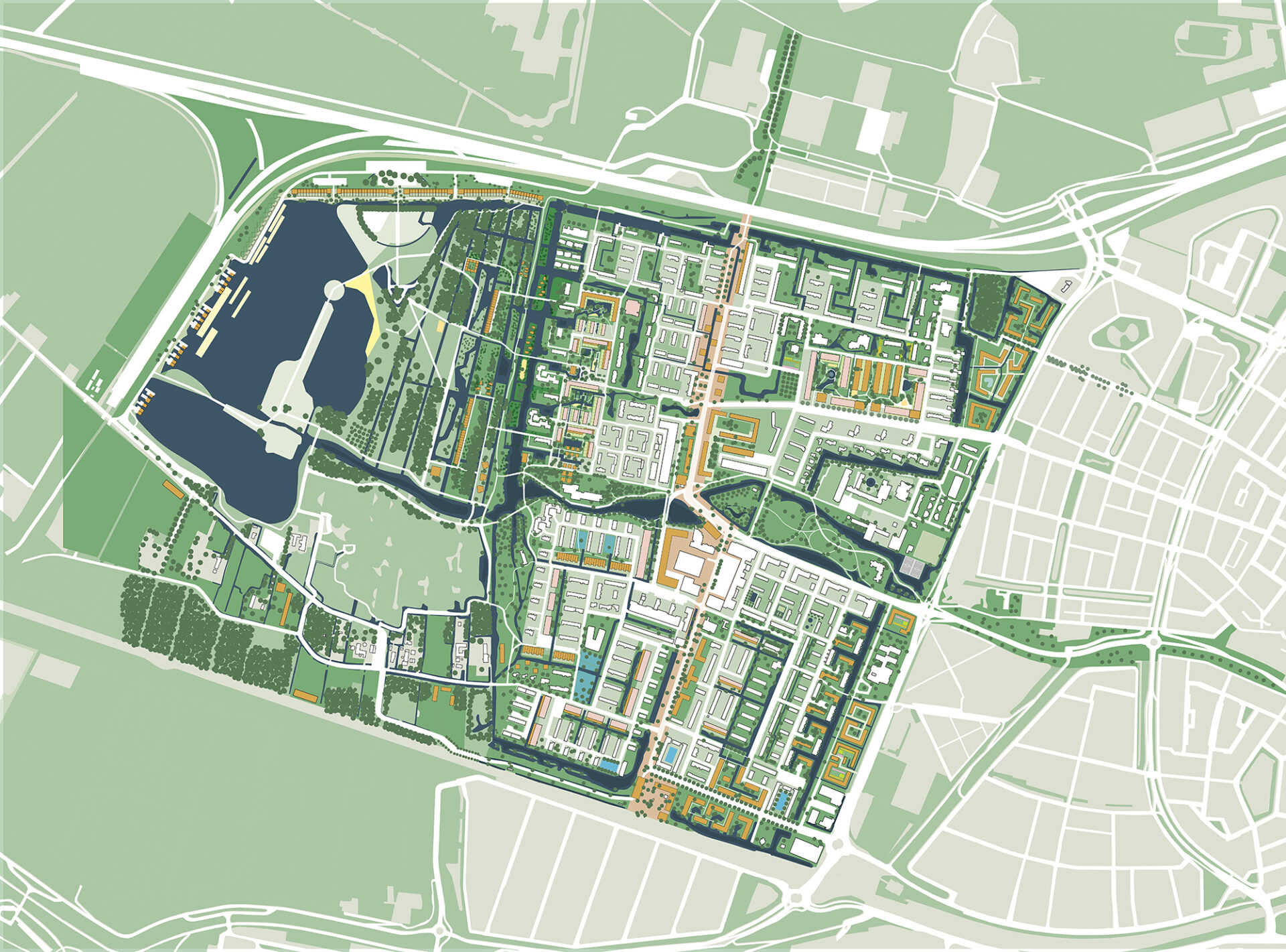
To help Westwijk and its residents take root, we use the following five strategies:
From floodings … to a climate-adaptive living environment
Westwijk was built in the 1950s on a thick layer of sand without any relation to the peaty ground. By excavating the sand layer in the public space, adding much more surface water to the neighborhood and raising the Krabbeplas area in strategic places, attractive and climate-adaptive residential environments with limited subsidence are created.
From isolated … to connected
In addition to the interweaving of Westwijk with the Krabbeplas recreation area, the connection with the new metro station must also be strengthened. What is needed is an entrance square, a station development with housing and an improvement of the north-south axis that also establishes the link with the Broekpolder.
From skimpy green … to green with value
By better attuning the greenery to the water-rich soil condition, less maintenance will be required and the ecological quality will increase. A greater biodiversity goes hand in hand with a more recreational qualities and attractive walking routes. The green can also be used functionally due to its water purifying capabilities.
From uniform housing … to a diverse mix
Our plan focuses on a varied housing stock with an emphasis on more ground-based housing in the private sector. In Van Tijen’s urban stamps, the necessary adaptions because of the energy transition are used to realize a combination of demolition, new construction, renovation and transformation. In the new development locations on the edges of the neighborhood, a combination is also being sought between homes for young and old, both in the private sector and in social rent sector.
From social isolation … to communities
We are committed to stimulating communities. Communities consisting of residents with a mix of economic strength, age and family situation. Communities that feel connected to their immediate living environment. In addition to the housing supply, the design of the public space plays a decisive role in the creation of these communities.
The deployment of the various strategies provides the ambition map for the Nieuwe Westwijk. This map is not a blueprint, but a dot on the horizon to work towards. Based on two prototypical case studies, we show how this ambition can be put into practice.

Wetering: Core of the neighborhood
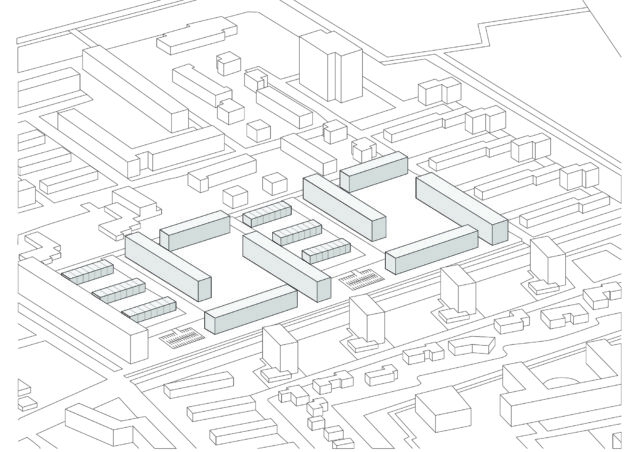
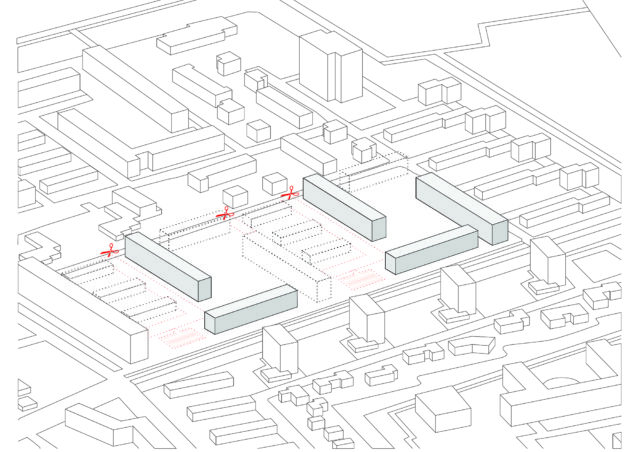
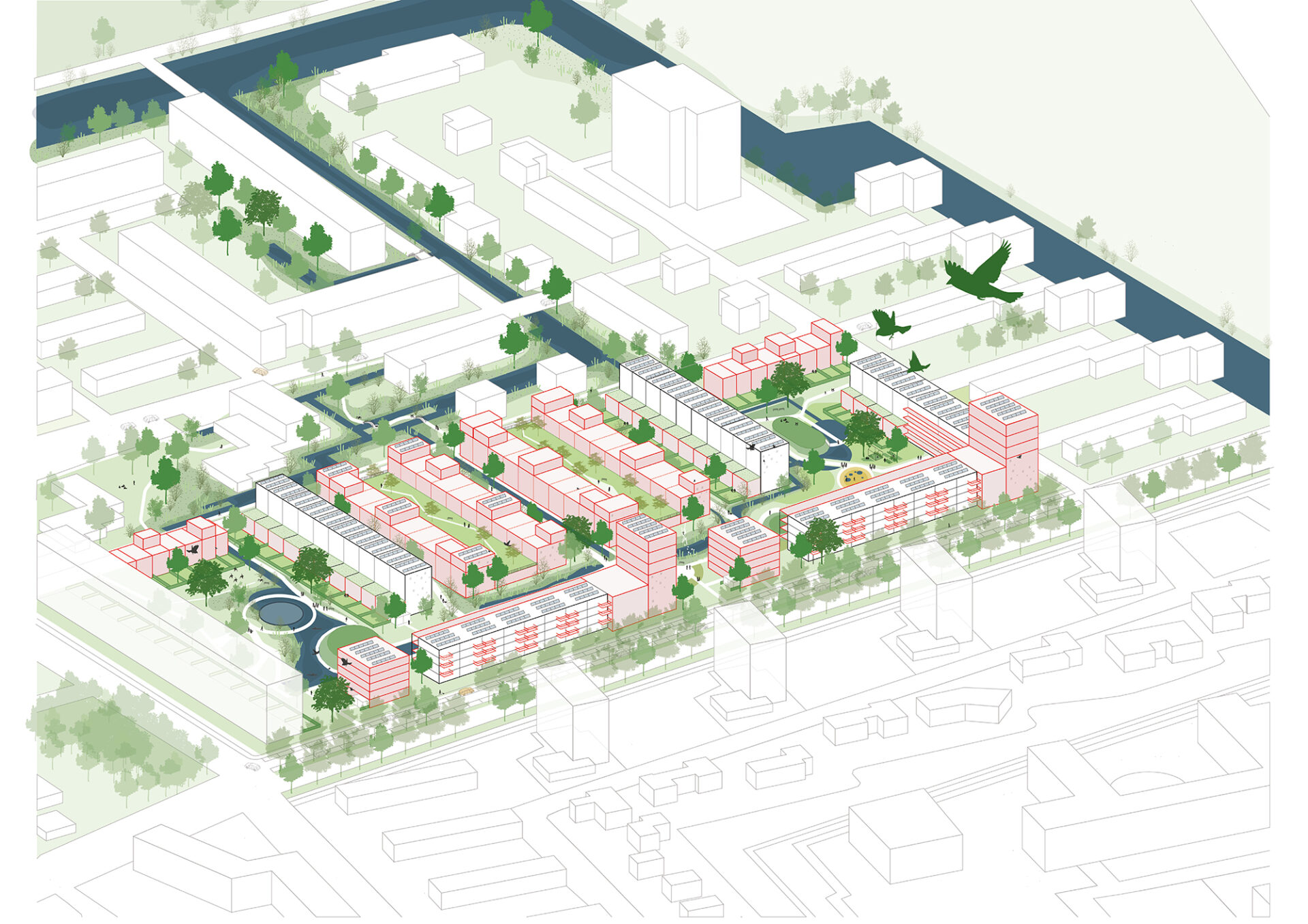
In the core of the neighborhood, stamps with one-sidedly oriented residential blocks and an indefinable public space currently dominate the image. By demolishing part of the residential blocks and replacing them with ground-level homes and transforming some of the blocks into homes for families and the elderly, a rich mix of housing types is created. In the public space, a climate-robust, connective and biodiverse outdoor space is created by cutting roads, excavating soil and connecting waters. In the south a more urban wall is being created by the addition of life-course-proof apartment buildings.





Lage Weide: Connection with the landscape
The current situation is characterized by a hard division between landscape and neighborhood. They are separated from each other by a wide watercourse without bridge connections. Our approach is to interweave landscape and neighborhood and to connect both with the natural wet soil condition. This creates a connecting water landscape that forms the basis for new living environments. The current homogeneous housing stock in the stamps is supplemented with new housing typologies with an emphasis on ground-based family homes. To this end, both new constructions (after demolition) and transformation of the existing flats are applied. In order to create more water, ground is excavated. Excavated soil is used to create mounds for a mix of recreation and housing in the landscape.


Ring around Krabbeplas
In order to co-finance the large-scale transformation of the public area of Westwijk in particular, we see an opportunity to make a limited number of specific forms of housing possible in – and especially around – the Krabbeplas area. The condition is that living remains subordinate to recreation and that the residential buildings make a significant financial contribution to the transition of Westwijk. In addition to the residential enclaves located on mounds in the transition area between landscape and neighborhood, we are also providing noise barrier houses along the A20 in the north. Together with water houses on the west bank of the Krabbeplas and a series of CPO residential areas on the southern polder ribbon (Zuidbuurt), a new route around of Krabbeplas is created.



Zwanebloem Inside Out
A child has three teachers: the first are the other children, the second is the schoolteacher and the third is the spatial environment. (Swedish saying)

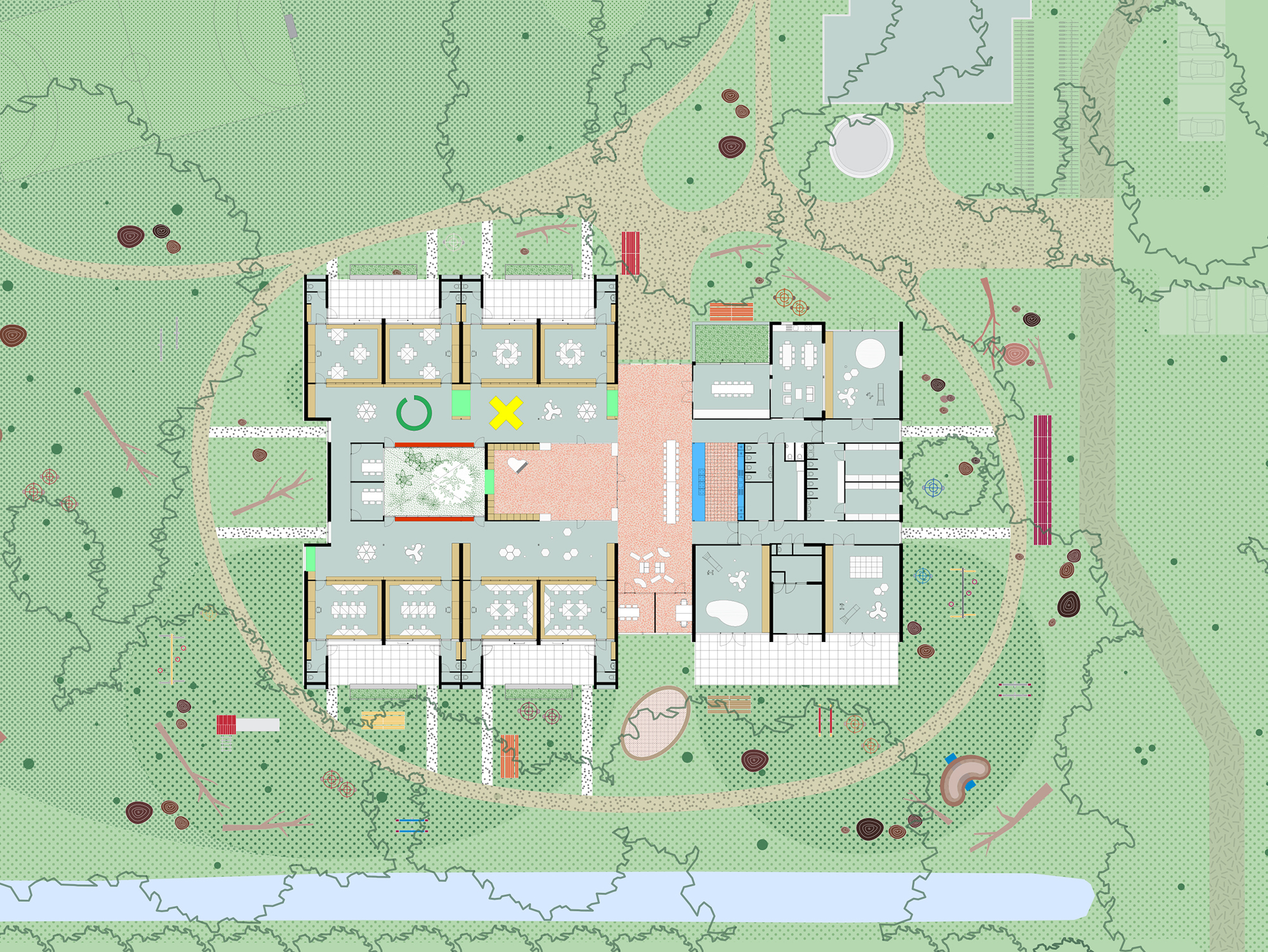
Zwanebloem INSIDE OUT is a proposal to transform the existing 1970ies elementary school into an “Integrated Child Center”, consisting of an elementary school, nursery, daycare and community center, embedded into a unique green outdoor domain. The combination of these functions into one complex makes it possible to provide a consistent environment for the development of the child, guided by a single pedagogical vision. Zwanebloem’s vision promotes the idea of the school as foremost the place for meeting and interacting with the others, besides being a learning environment. The child becomes part of a larger whole, learning how to live together with the other children and teachers, in a community where everyone feels safe, secure and valued. The educational vision is based on a play-learning process in which the child is encouraged to shape his/her own playing and learning environment indoors as well as outdoors, in the school’s extensive and exceptional green domain. Besides the usual activities like sports, play and gardening, it is the school’s ambition to regularly organize here outdoor classes, reinvigorating the open-air school Dutch tradition.

The original building is a standardized design of the “corridor school” type with two rows of class rooms arranged on the two sides of a wider corridor area, where several communal functions are organized. A central patio that used to bring light in the central area had to make way in recent years to an enclosed playroom. Subsequent adaptations of the layout to incorporate new functions have compromised the original clear spatial design. Despite large windows in the classrooms, the physical connection between classroom and the outdoors is missing.


In order to meet the ambitions for outdoor education and the new pedagogical vision, we have literally turned the school inside out. Each classroom is provided with its own little entrance building situated in front of the existing façade and containing the garderobe and a toilet. Like this, each class has its own address at the outside domain, situated on a path that encircles the school. Each year the children move to the next class, completing during their educational cycle at Zwanebloem the complete circle. Two opposite entrance buildings define the space for an outdoor classroom, which can be used by two adjoining classes. In the other direction, this outdoor classroom is equipped with two long benches: one formed by the oversized windowsill in the original façade and the other by a large new planter containing the educational garden for each class.


Inside the school building, the original construction with columns allows for variations in the layout of the classrooms. Instead of the classic setup with large classrooms along a corridor, a new layout is proposed with “core classrooms” and “learning plazas”. Each classroom is compressed into a more compact space where the teachers can instruct the children, while the rest of the space forms together with the corridor a “learning plaza”, an open collective space shared by all the classes, where the children are encouraged to find their own place for self-study or work in groups. The resulting plan is a layered composition of parallel bands, offering a variety of spaces and learning conditions from private, quiet and intimate, to open, lively and collective.


various scenarios for how the different spaces are used: morning, afternoon, good weather, after school and event
At the core of the building, the wide corridor is extended to form a cross-like figure combining all the collective functions. The vertical arm of the cross separates and at the same time connects the school on the western side and the nursery/daycare on the eastern side. Here the new central entrance is situated as well as the coffee corner, refectory, library and meeting rooms. The horizontal arm of the cross accommodates the central kitchen, meeting rooms, a new patio that brings light and green back into the heart of the building and the playroom. The removable walls of the playroom convey the possibility to create a central plaza for school events or neighborhood gatherings at the heart of the cross.

Besides on spatial aspects, the transformation also focuses on climatological aspects, providing new insulation of the outer skin and a new ventilation system. The ventilation system is realized centrally for the daycare/nursery and decentral for the classrooms and “learning plazas”. The decentral ventilation units are placed on top of the toilet/garderobe in each of the new entrance buildings, integrating the ventilation grills as decoration in the facades.


successive cross sections
The research was commissioned by Mevrouw Meijer, an idealistic research platform that aims to improve the architecture of schools through initiating research by design trajectories. The foundation is committed to the revaluation of existing real estate, acknowledging the societal meaning of the school building and the more prominent role of architecture in this.

Matryoshka house
Matryoskha House transforms an early 20th century townhouse into two high-end apartments by radically opening it up. Situated in the center of Rotterdam, the house was in a derelict state due the previous owner’s conversion of it into a sub-standard workers’ hotel. Bothered by the neglect, a neighbor acquired the property and gave Shift architecture urbanism the commission to give it an extreme makeover.

The house was stripped to nothing but its envelope and flooring structure, the later partly removed in each unit to create double-height living spaces. The private spaces are suspended in these tall spaces creating the matryoshka effect: a box within a box.
The lower apartment features double-height spaces at both the front and rear façade, isolating the volume of the bedrooms and bathroom as floating in its center. The two voids provide the living areas of this 14m deep half-basement level with plenty of daylight.
The upper apartment is conceived as an inversion of the mass-void relationship of the lower apartment. Here the bedrooms, rather than the voids, are placed against the façades, opening up a spectacular double-height space at the center of the apartment, brightly lit by a large skylight.


The historic elements of the street façade were restored. The rear façade was removed entirely and replaced by a portal frame construction in galvanized steel providing structural stability. A large sliding door and three floor-to-ceiling double doors ensure that both living rooms can be fully opened up towards the garden.

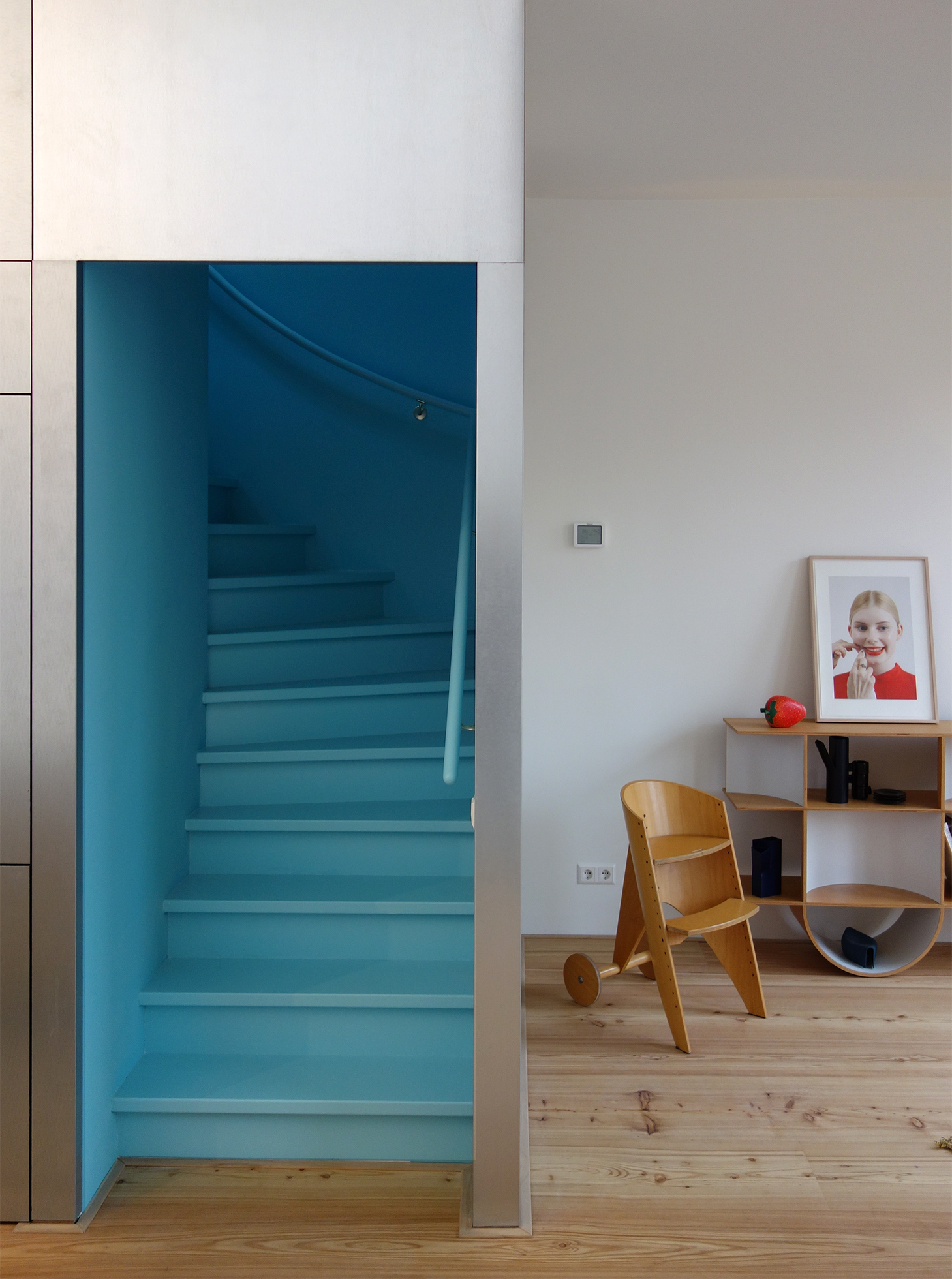
In the center of the apartments a single galvanized steel cladded volume incorporates stairs, toilets, storage spaces and kitchen equipment. A free-floating kitchen island finished in white tiles stands at the heart of each apartment.


The interior of the house is a dialogue between old and new, contemporary and traditional, polished and rough, finished and unfinished. When possible original details of the old house were preserved.
Brickwork was left exposed and roof trusses left bare, stained glass window panes were restored and placed within new frames. Warmer materials and colors balance the use of reflective metal, concrete and black steel.


Museumplein Limburg
Museumplein Limburg is a trinity of complimentary museums combining design, science and technology in one museum district in Kerkrade, a town at the Dutch-German border. The existing Continium (a discovery centre for science), has been extended with Cube (a design museum consisting of exhibitions and exploratory labs) and Columbus (housing a unique Earth Theatre and a 3D cinema), as well as a wide range of public facilities for events, workshops and education.
Capitalizing on the strategic location, the museum quarter formalizes the entrance into Kerkrade for both train passengers and visitors arriving by car from the main access road.

The brief required the extension of the existing museum with two new institutions, each with an own identity, but which can also function as a whole. Our answer is an ensemble of clearly recognizable volumes connected by an elaborate underground public space.

Above ground, a cube and a sphere, spectacular in their absoluteness, provide the two new institutions with distinct identity. With their pure geometry and omnidirectional orientation, the cube and the sphere counteract the amorphous and introvert character of the existing museum. However, their iconic character doesn’t make them into isolated urban objects. Together with another primary solid, the 80m long beam which doubles as a giant canopy, they are carefully placed in relation to the nearby station to articulate the public route between the station and the city centre. On this public walkway, the volumes reveal themselves towards the pedestrians with lively areas such as the entrance hall underneath the beam and the design labs underneath the cube.

Underground, the sunken square, the best feature of the original museum, is extended underneath the new volumes. A continuous landscape is created that connects all the facilities of the museum district, both old and new, and allows them to function as a single whole.


The new enlarged sunken square forms the heart of Museumplein Limburg. It extends seamlessly underneath the beam that hovers above the double height entrance hall. This linear entrance hall serves as the logistic backbone of the whole museum district. Visitors descent via one of two wide staircases at both ends: one orientated towards the train station and the other towards the town’s centre.


In addition to the new museum square and entrance hall, the underground landscape hosts a restaurant, an enclosed patio and two tunnels connecting to Cube and Columbus.


All stairs, walls and floors of the underground landscape are made of a uniform earth tone concrete to emphasize the connective character of the space and to create the suggestion of an excavation. The walls were poured in a formwork of rough wooden planks adding a tactile quality that contrasts with the abstract volumes above ground. The excavation out of red concrete, combined with the experience of descending below ground, refer to the mining past of Kerkrade.


Floorplans

Content-wise, Museumplein Limburg aims to be a “museum without boundaries”. As opposed to the static vision of the museum as an island offering a passive escape from reality, the “museum without boundaries” is an interactive workshop where visitors are regarded as participants rather than spectators. They discover the world and their place in it through interaction, participation and debate.
Our ambition was to translate this concept architecturally by blurring the boundaries between museum space and public space, and make Museumplein Limburg an integral part of Kerkrade.

By situating a large portion of functions underground, the built footprint on the ground level was minimized, thus leaving space for public walkways to criss-cross the museum district. The route to and from the train station, designed as a scaled up zebra crossing, creates a visual dialogue between the museum district and station area and adds to the experience of both the museum visitor and the train passenger.

A transversal walkway, punching through the entrance hall, connects the sunken museum square to the district’s bus terminal in the forecourt. This walkway provides train and bus passengers direct access to the museum’s restaurant which can double as waiting room, transforming the museum square into a true extension of the public realm of Kerkrade.


The combination of public space and public transport with the museum district fits perfectly with the ambition of a “museum without boundaries”: even passers-by become participants.




CMY pavillion
The CMY pavilion transforms the glass structure of Tschumi into a three dimensional graphic work that shifts its composition and color scheme with the viewpoint of the spectator.

The Tschumipavilion was originally built as a video pavilion for the city-wide exhibition-event “What a Wonderfull World” in 1990. Scattered around the city, five pavilions brought pop-music videos into the public realm. They were designed by the architectural avant-garde of the time, labeled two years earlier as ‘deconstructivist’ by the MOMA. The pavilions of Eisenman, Hadid, and Himmelblau disappeared, while the ones of Koolhaas and Tschumi remained.
Remarkably, it is OMA and Tschumi’s very different approach to program that have made their pavilions last. OMA’s programmatic alchemy, pairing of the pavillion with a bus stop, is the reason it survives today. Tschumi’s pavilion has persisted precisely because of the opposite reason: its lack of any precise program. Being a transparent envelope, it has been used as a public/urban event-space for temporary art projects since 1995.

In the middle of a busy roundabout in Groningen, Tschumi created one of the most transparent buildings ever built: its facades, roof as well as structure are made of clear glass. Tschumi chose glass for its reflective quality to create “instable facades” that would reflect the video images endlessly. These videos transformed the “invisible pavilion” into an “illusionistic spectacle” in which the virtual image from the reflections mix with the real image from the monitors and the city.

Shift’s intervention reinterprets the idea of “instable facades”. Instead of using the glass envelope to mix videos, the CMY pavilion uses the glass to mix colors. By applying translucent films in the colors cyan, magenta and yellow onto the glass, the pavilion turns into a three dimensional graphic piece that changes continuously with the movement of the spectator.


The colored pattern of diagonal bands that wrap around the building is derived from the rigid paneling system of the structure. Because of the parallel transparent facades, the color bands start mixing according to the subtractive color model. The overlap of the “real” primary colors on the glass create secondary “virtual colors”: C + M = Blue, Y + C = Green, M + C = red. The transparent pavilion becomes a dynamic color space with a strong urban presence.

From different angles come different experiences of the CMY pavilion. People circulating on the roundabout will experience continuously changing colors and patterns. Standing on the square facing its long side, one perceives a cross-hatch pattern in six colors (CMYRGB). One waiting for the bus with an oblique viewpoint sees the “actual pattern” of diagonals in three colors (CMY).

Inside another appearance is uncovered: here the colors mix with the city rather than with each other. Since there is no more overlapping of colors, the diagonal CMY color bands are clearly visible. Their diagonal wrapping enhances the destabilizing, girating effect that Tschumi intended by tilting the building.



Vertical Loft
This so called do-it-yourself dwelling in the centre of Rotterdam is part of a bold experiment initiated by the municipality to revitalize dilapidated urban areas. Run-down pre-war dwellings are renovated on the outside and brought back to their monumental appearance, while the interiors are stripped bare.

The empty shell dwellings are primarily bought by enthusiastic young people who transform them according to their specific needs, desires and budgets. Real estate developers have picked up the initiative and a new demand driven market of urban housing has been generated in recent years. The result is a growing number of contemporary custom-made dream houses within the uniform old fabric of the traditional nineteenth and early twentieth century city.

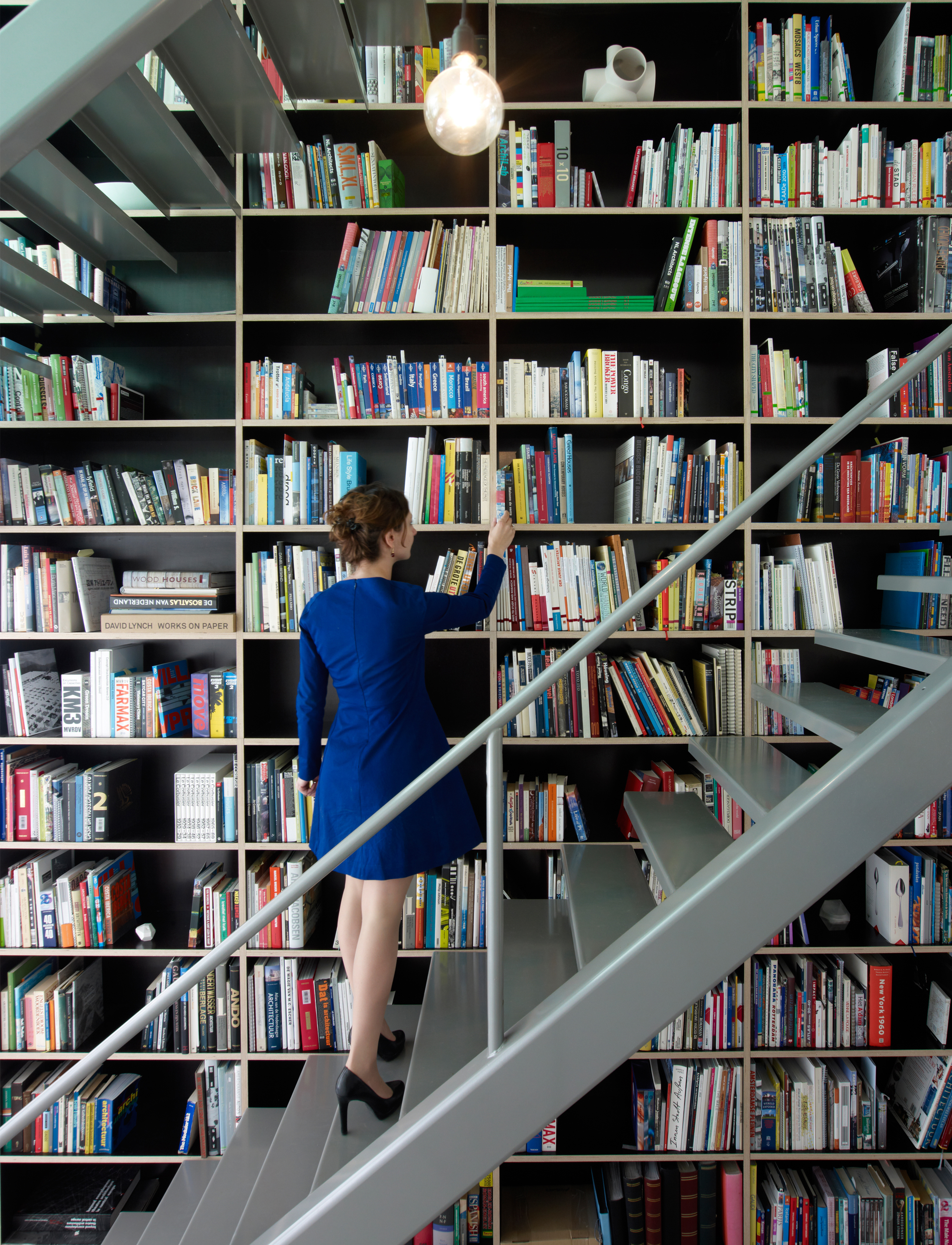
Vertical loft is a house without walls, where the three floors are stitched together into one continuous space. One oversized closet connects all the floors and functions as a storage device for the whole house. This piece of XXL-furniture, measuring 10 meters in length and 9 meters in height, replaces the load bearing middle wall of the original house. Its modular system integrates kitchen appliances, bookshelves, wardrobe, and a walk in closet.


The introduction of a central void reinforces the presence of the closet. The void enables diagonal views through the house in which the closet is experienced in its full height. It also makes daylight penetrate far into the 14 meter deep house. Two steel stairs in the void make the bookshelves accessible and create a vertical circulation along and through the closet.


The extreme makeover of the house is combined with a selective preservation of elements of the old casco. Industrial materials such as the phenol coated multiplex of the closet and the polyurethane flooring are balanced by the longitudinal brick wall that is left bare, the stained glass and the original doors that are restored and re-used. The roughness of the wall, full with traces of the past, tells stories about the continuous makeovers that the house has undergone in the last hundred years.



Transformation Oude Dijk monastery complex
The existing complex of the Oude Dijk monastic community is not tailored to offer elderly care for the monastery’s aging population. The assignment is to realize 100 elderly care apartments in the convent garden, while preserving the continuity and the exceptional green character of the garden.

The convent of the Sisters of Charity in the centre of Tilburg is a unique ensemble formed by buildings and their adjacent outer spaces including the highly maintained garden. This large green oasis brings the much needed tranquility within the urban field. From the first establishment in 1832, the complex and its garden is undergoing a process of continuous spatial transformations following the changing needs of the sister community, with the last generation of buildings from the 1980ies. We see the current assignment as a logical next phase in this ongoing process. The challenge is to develop a spatial concept that answers the current (housing) need while anticipating the moment when the complex will be fully inhabited by laymen and the garden will be open to the public.

Despite its central location, the complex has a limited physical relationship with the surrounding city, partly due to the intrinsic monastery function, but also to the fact that the city in its development has consistently turned its back to the monastery. By selectively opening the complex in strategic places towards the surrounding public space, we see an opportunity to take the monastery complex out of its isolation without sacrificing the private monastic atmosphere.

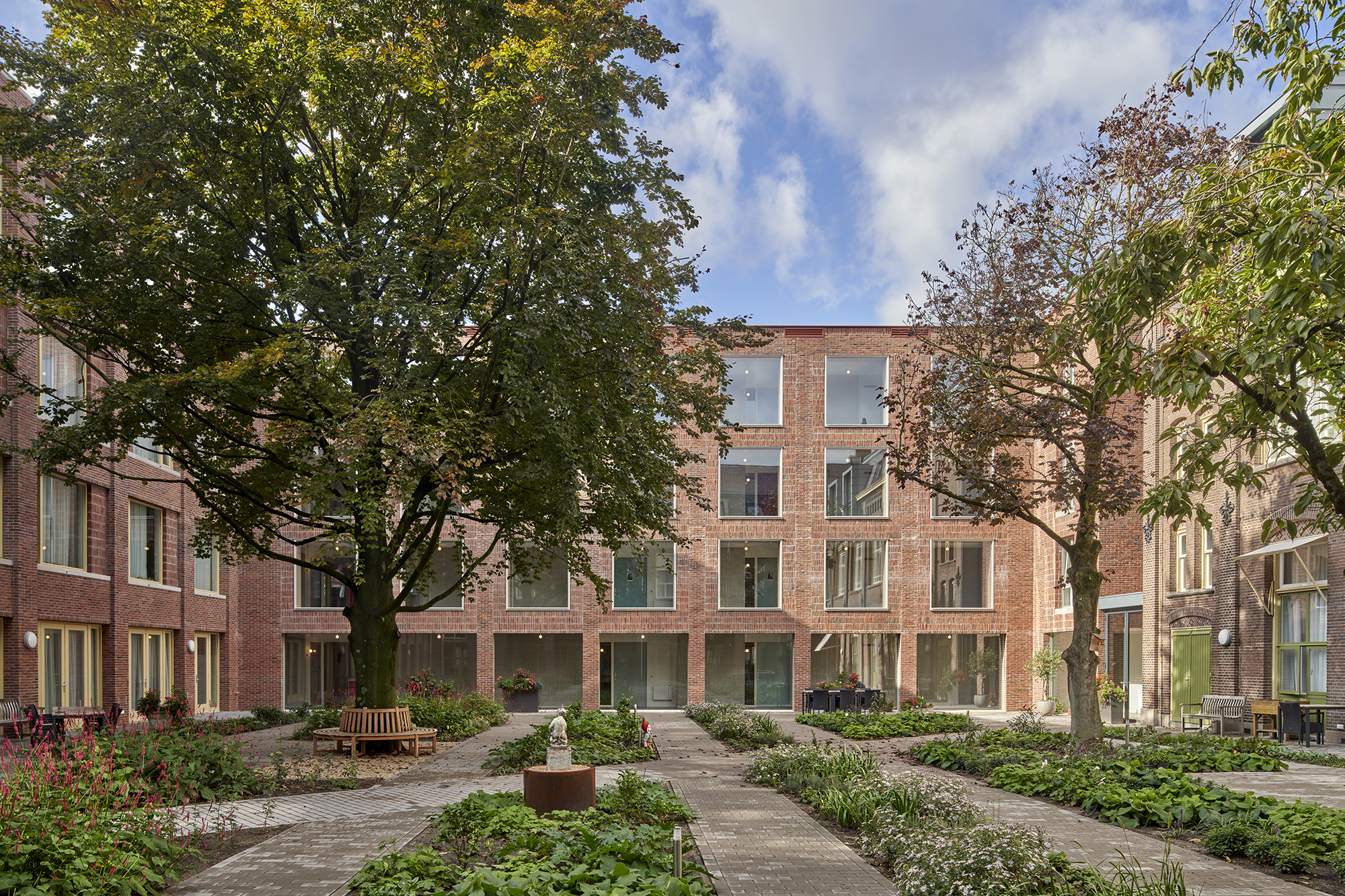
The starting point of the new design is the historical courtyard typology, present at several moments in the convent’s development. We propose three new courtyards at the edges of the convent’s garden, each with its own character and functionality. The new volumes forming the courtyards are not to be recognized as independent buildings, but rather as (decor) walls of the new (and existing) courtyards. They are subordinated to the overall figure of the ensemble by taking over the volume height and size of the existing.


In a first phase, the monumental wing of the “Oude Ontmoetings Centrum” (transformed into housing with high care level for psycho-geriatric patients) and a new volume at its west side (with medium care apartments) define two new courtyards. A private, closed courtyard forms a secure outdoor area for the psycho-geriatric patients. An open, city-oriented courtyard serves as an entrance square for both buildings and creates a new formal entrance to the adjacent city park (once part of the monastery garden, at this moment poorly accessible).
In the second phase, the outdated ’80ies central wing of the complex will be demolished. On its place, two new volumes, together with the western ’80ies wing, will define a new residential court. One of the new volumes sticks out through the current northern alignment of the complex, opening up the courtyard and announcing the presence of the complex towards the city centre. Perpendicular to it, the other new volume is positioned in such a way to create two openings towards the convent garden. The new residential court acts as a stepping stone between the city and the convent garden, spatially regulating the limited opening of the garden.

The materialization and façade design of the new volumes is derived from the urban concept of the courts, dictating the adjacent walls of a courtyard to have similar façades, and not the single volumes. This results in volumes with different “faces “, depending on the court they are oriented. When a façade is oriented to a monumental part of the monastery, the rhythm and proportion of the openings is adapted accordingly, when a façade is oriented to the garden, the design of the openings is more “free” and can therefore be maximized. These façade families along with the consistent use of a brick similar to that of the monument provide a sense of continuity in the overall ensemble between old and new. The flat detailing and the use of multiple bonds within the same plane create a contemporary look.


The new volume in the first phase has 4 floors, where the sisters will live in groups of 10 per floor. A transparent double-height entrance hall, placed in the corner of the entrance court, runs through until the garden and connects it visually with the city. The apartments are ordered by a common corridor, with most(8) oriented towards the garden and two on the entrance court. The corridor is generously lit via the closed courtyard and widens at the place of each apartment entrance. The relatively high surface requirements for care accessible housing combined with the desire to achieve a compact building has resulted in a particular typology of the apartments. These are made up of three naves, with the central nave functioning as both living room and connection between the other rooms.


The two new residential buildings of phase 2 with a total of 60 apartments create a new courtyard together with a renovated existing west wing. This residential courtyard functions as a buffer and at the same time as a future stepping stone between the city and the monastery garden. Both buildings have a fully sunken parking garage that allows the new residential courtyard to be car-free.

The north-south oriented residential building of phase 2 has a wide central corridor with entrances and daylight on which 36 relatively compact and affordable three-room houses are situated. The east-west oriented volume is accessed via three porches containing two luxury flats per floor, one with standard four rooms and one with standard three rooms. The very large nave dimension of 8.6m for residential construction, which is spanned in one go, gives residents a lot of freedom of layout.


The project brings biodiversity, water storage and reduction of heat stress in the middle of the city. The smart implantation of the new volumes maximises the preservation of existing greenery. This is combined with the generous planting of new vegetation and the placement of several nesting boxes.


Open house
Shift architecture urbanism has redesigned an historic family house in the “Indies Neighborhood” of Amsterdam to maximize its relationship with both the street and its garden. A multifunctional wall cabinet, 14 meters in length, plays a key role in opening up the ground floor. This furniture element contains all servant functions, allowing for one open and flexible space for living that spans between street and garden.

The relation to the street is emphasized by the absence of an entrance hall: one enters the house directly into the open living space. Thus, the house is linked to the attractive sidewalk with its vertical gardens, typical for Amsterdam. The seamless continuation of indoor living area into the private garden is strengthened by extending the wall cabinet into the garden to define a private terrace.


The juxtaposition of three contrasting finishes for the cabinet differentiates the main living space. Each material provides the space with a specific character that connects to its use: a warm plywood for the living, a sanitary pink laminate for the kitchen and dining area, and a weather resistant anodized aluminum for the terrace.

The plywood section of the cabinet integrates a small winter-entrance, a stair, TV & audio and a wardrobe. The part in pink laminate contains kitchen appliances and cupboards. Its arch-shape makes room for a recessed kitchen in black MDF. The last piece in natural aluminum accommodates a toilet and a garden storage. The aluminum cladding reflects the garden vegetation back into the house, enhancing the experience of the private garden, a true luxury in the old neighborhoods of Amsterdam.


In contrast to the common use and open character of the ground floor, the two upper floors are divided for a functional layout of individual rooms for this young family. The first floor contains a working space, a master bedroom with walk-in-closet and a bathroom for the parents. The second floor contains three small bedrooms and a second bathroom for their three kids.


Open House is an example of how the Dutch inner city housing stock can be adapted to the needs and desires of young families with kids, avoiding them to flee the city for its lack of (outdoor) space and appropriate dwellings. Urban residential areas such as the “Indies Neighborhood” should house multiple generations, cultures and incomes to remain attractive and socially sustainable.

Jozefzorg
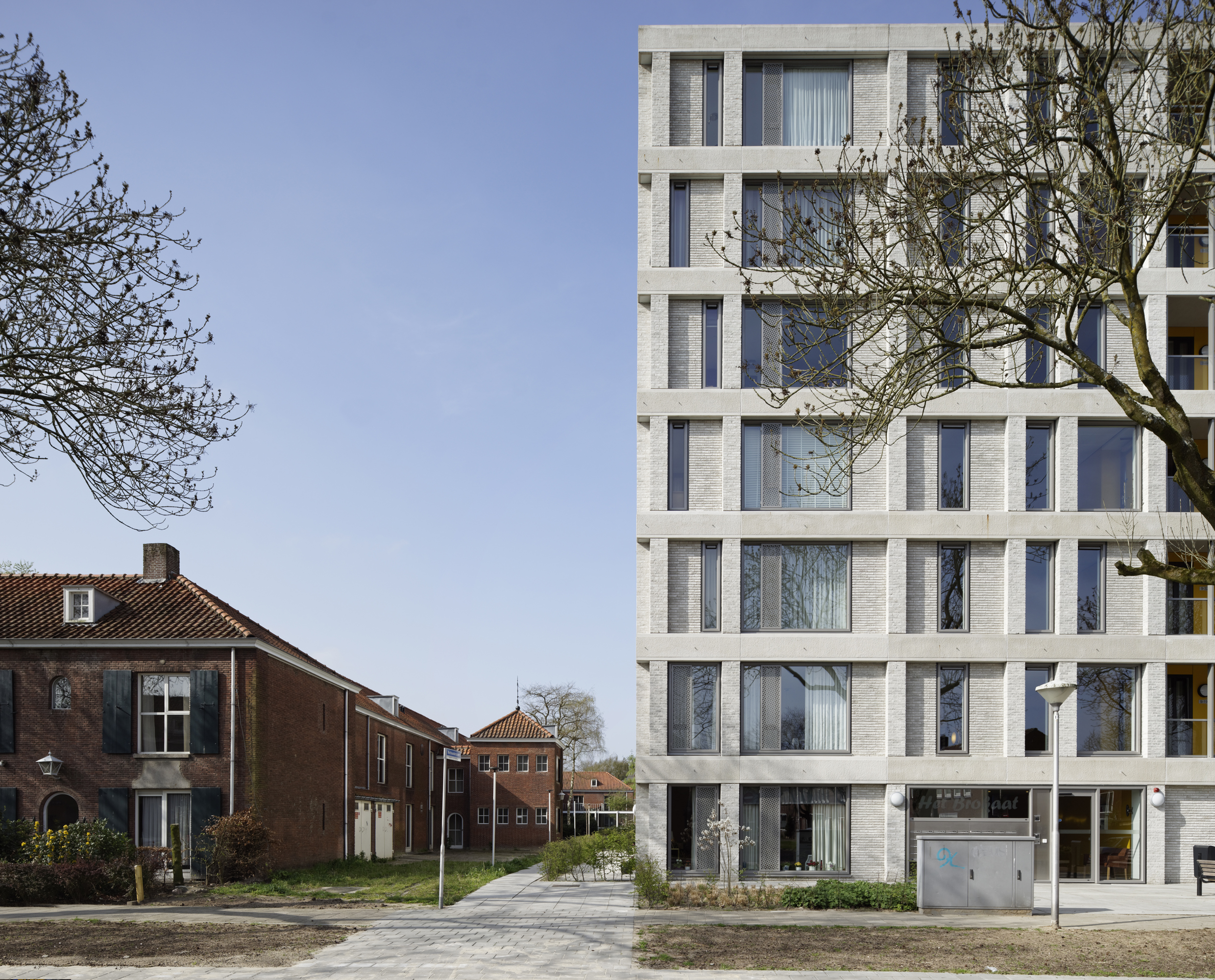
This project deals with the redevelopment of an outdated care complex in Tilburg. Some buildings have to be kept, others need to be demolished. The new program consists of 120 apartments for seniors , 60 high care units and a local care center.


Our winning proposal introduces a meandering urban figure, a snake, that creates an intimate living environment for seniors along a series of open courtyards. It absorbs all program in one differentiated gesture whose form is derived from the existing comb-shaped monument with its typical open courts, an icon of post-war housing by architect Jos Bedaux. Two high-rise volumes at the perimeter of the site relate to the city, while the low-rise inside relates to the monument.

Two new east-west axis´ -one for car acces and one promenade- open up the site towards the adjacent neighbourhoods. The new courtyards relate towards these public routes without giving up their intimate quality. They function as collective garders for the inhabitants.
On the western side of the project area, the building frames the existing chapel and creates a new public square where the new housing, the monument and the city meet.


Plans groundfloor and first floor

The project will be realised in two phases. Phase one was completed in 2014. Its homogeneous grid facade emphasises both the horizonality of the urban figure and the verticality of the main housing block. The overall gesture is further strengened by the monochrome charachter of the light concrete in combination with the cemented brickwork.


Phasing


Dentist with a view
The task of this project was to transform and extend a historical house in the centre of Best, a village in the south of The Netherlands, into a dental practice with four treatment rooms. The central question was how the extension responds to the existing architecture and how it profits from the green setting.


The four new treatment rooms are situated in a new volume that at the same time mimics and contrasts the existing house. Its archetypical volume is derived from the existing house – it takes over the exact same inclination of the pitched roof – while it is being materialized in a very different material.


All secondary functions of the dentist practice are positioned in the existing house without harming its structure and typical 1930’s details. The patient enters and waits in a homely and familiar atmosphere that, together with the experience of the surrounding garden from the extension, makes the necessary visit to the dentist in a (slightly) more comforting experience.


A glass corridor separates and connects the new volume to the historical house.


The new volume provides each treatment room with the archetypical space of a miniature house. Its high ridge and steep ceiling results in a vertical space that connects to the perspective of a patient in the dentist chair.


A roof light in each treatment room enables the patients to relate with the outside, even during treatment. A large ‘flower window’, that also serves as a bench, floods the rooms with daylight and provides both the staff and their patients with a framed view of the surrounding green.


Both the roof and the facades of the extension are clad with zinc. This strengthens the iconic quality of the archetype and renders the new extension into a “contextual alien” that blends into the rural surroundings and at the same time creates a clear new landmark that expresses its new function.

Living apart together
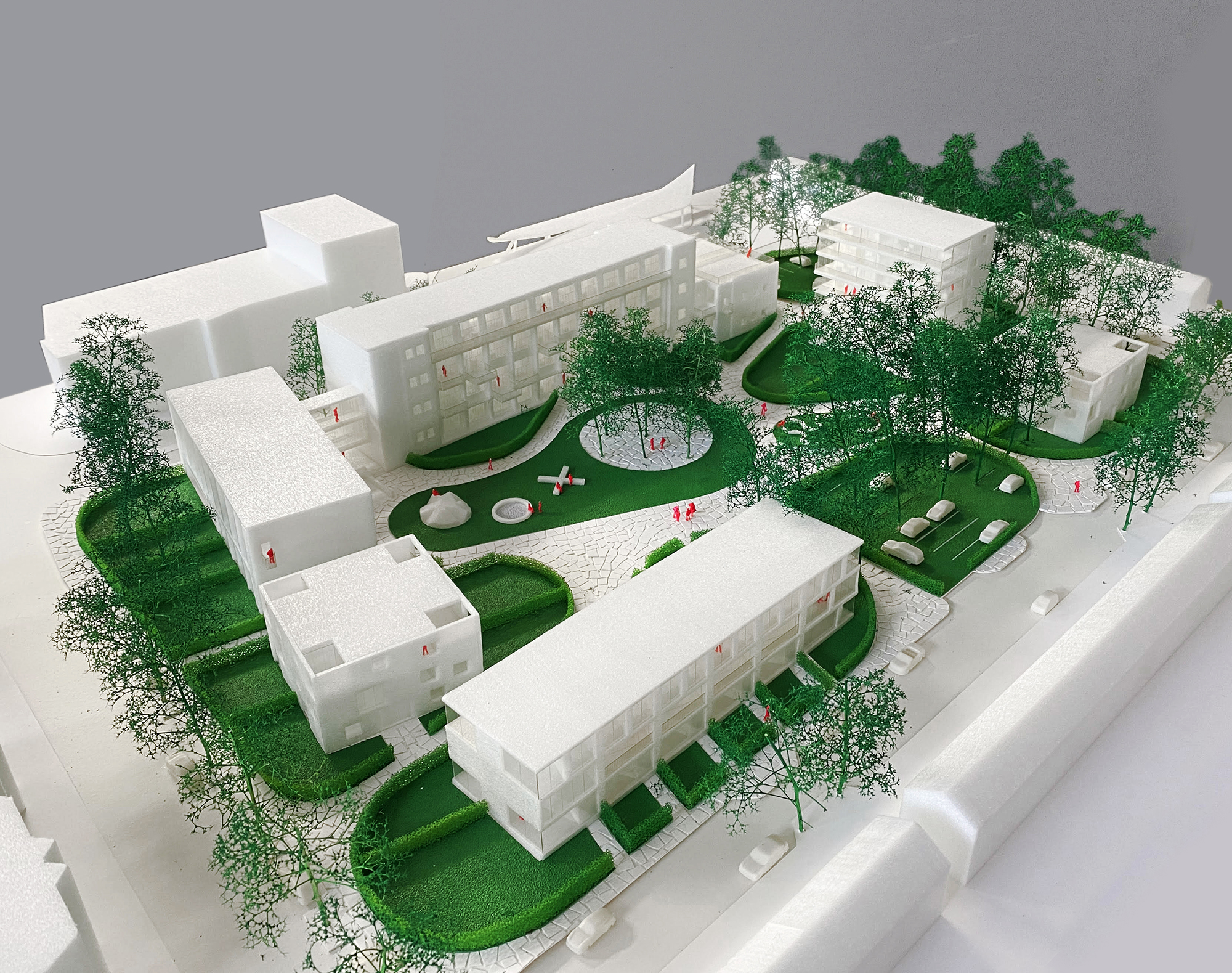
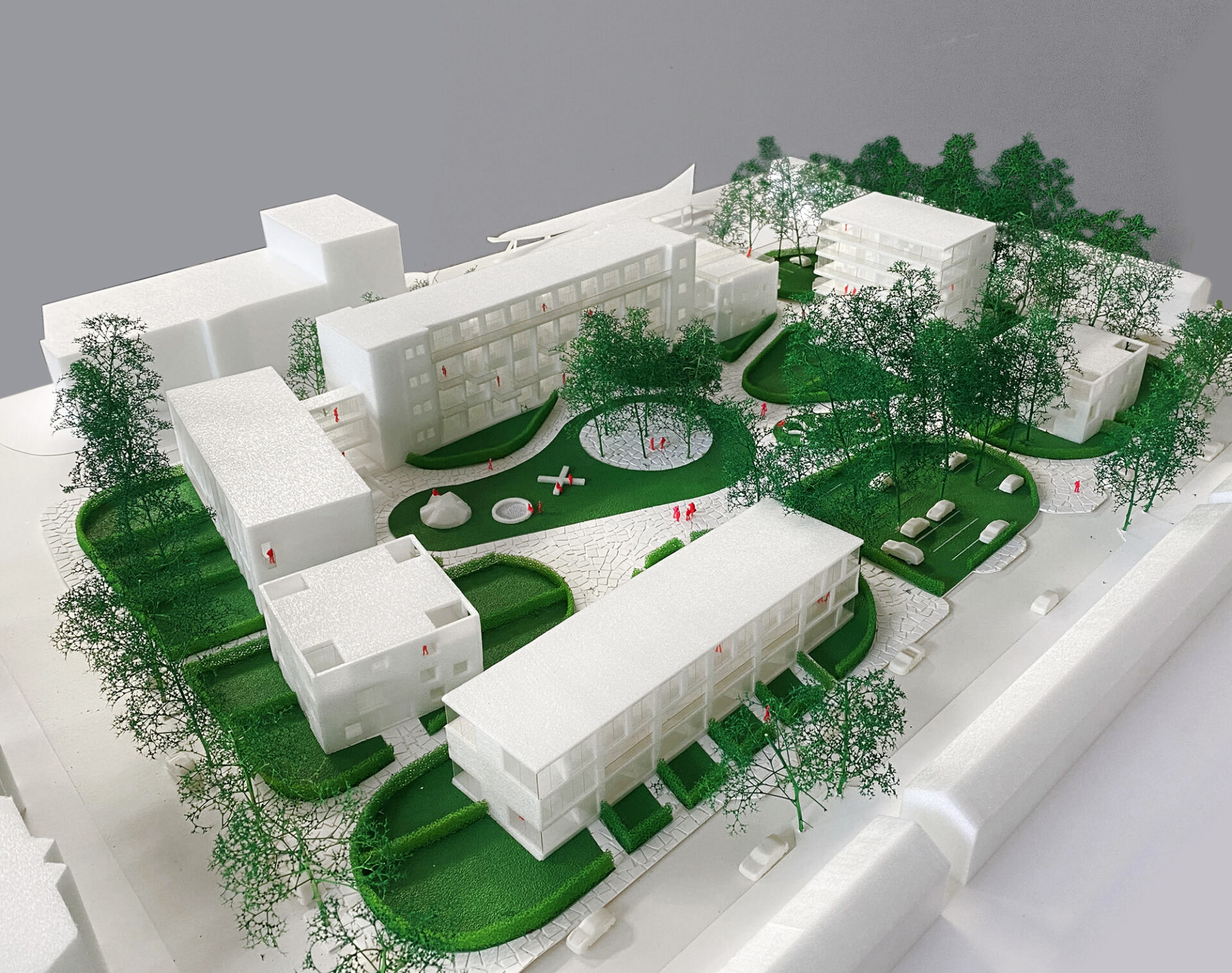
The municipality of Waalwijk selected six national developer/architect teams to envisage an urban vision for the redevelopment of De Walewyc School location into a specific, differentiated and high profile living environment.
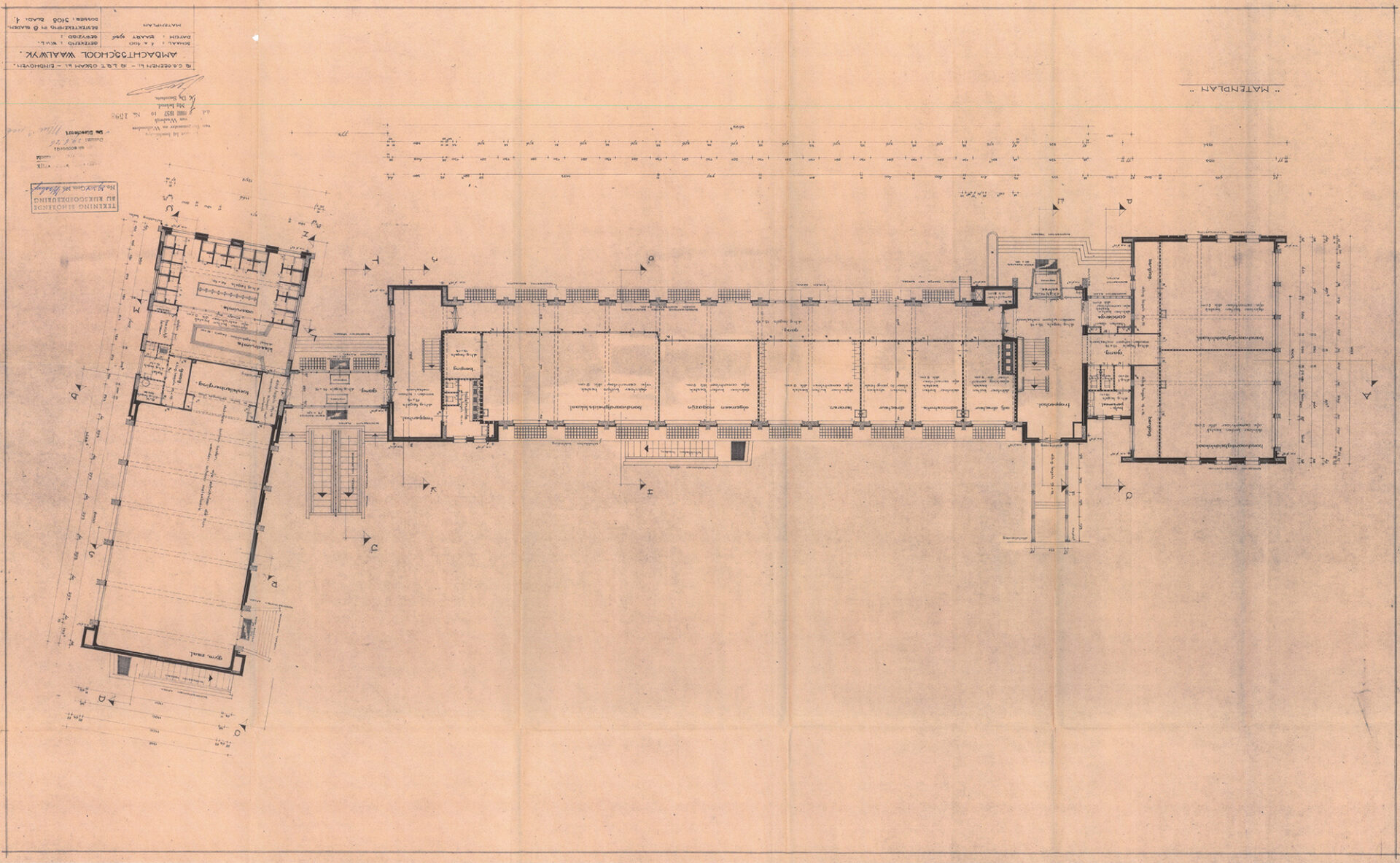

In order to fulfil this ambition, we found it essential to reconsider the municipality’s suggestion to demolish the existing school buildings. De Walewyc School is an icon of post-war reconstruction architecture in a surprisingly good and original state. Besides the cultural and historical value, a building’s potential for future uses should determine the choice for demolition or conversion. The former school’s urban situation, its transparent architecture, high ceilings and internal layout create the premises for a unique housing ensemble with spatial qualities difficult to match nowadays.


Scheme
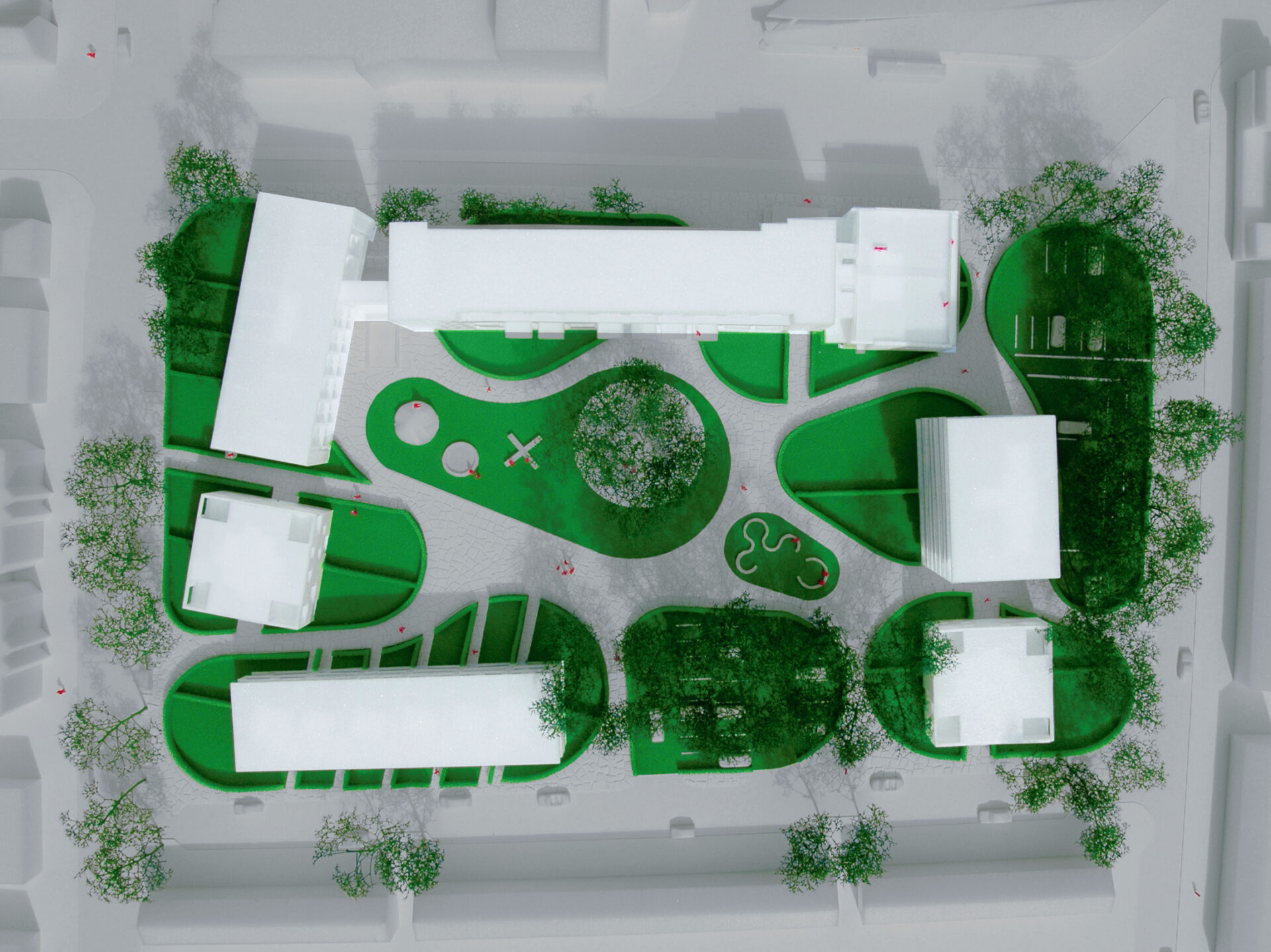
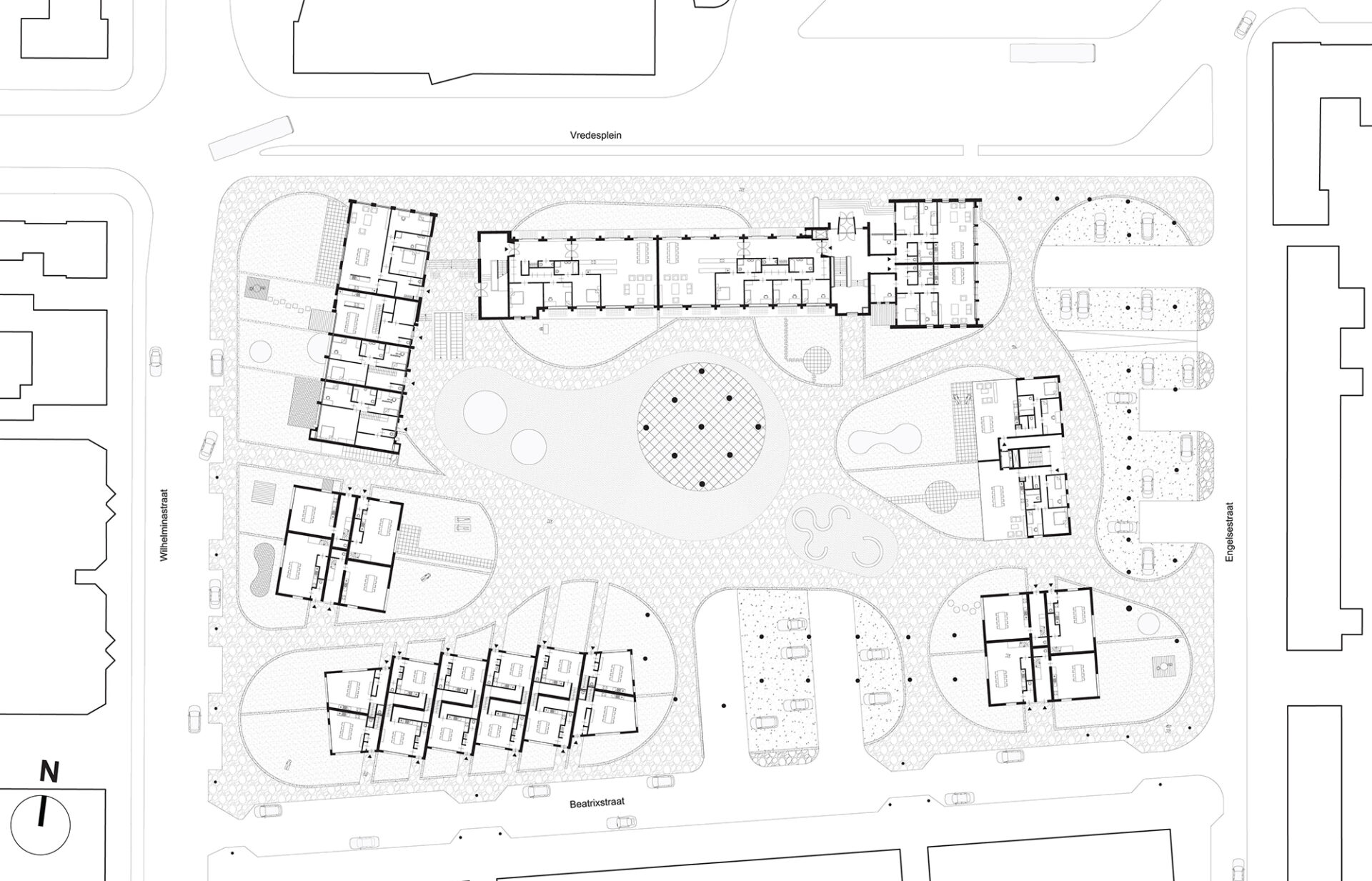
Our proposal preserves the school’s three original buildings and adds four new ones around the former schoolyard. The building volumes form a permeable ring of solitaires that – together with the row of existing trees – define the limits of a public park (the former schoolyard). The volumes are positioned in such a way that the park is visible and accessible from the surrounding neighbourhood without losing its strong definition. By replicating the existing volumes’ DNA into the new ones, a family of buildings is created. This family has two generations, three volume sizes and several housing typologies, derived from each building’s specific orientation. The building solitaires are imbedded in an archipelago of green islands, consisting of public green, private gardens, and parking pockets. The green islands manifest themselves beyond the ring of buildings towards the surrounding streets, emphasizing the park-like character of the entire development.
The School

The existing school lends itself perfectly for appartments. Luxurious high ceilings, a corridor to the north and large windows to the south. Simply adding balconies and (roof)gardens to the building is enough to convert the school building into a rich collection of different typologies.


School New Floorplan

The Row Houses

The row houses are designed as back to back houses. Each floor flips to the other side of the block, creating houses that are orientated towards the park as well as the street.


Mirroring floor plans

The Block

The small blocks are designed as helix houses: each floor of the house jumps to the other corner, creating houses that touch each corner of the block: 360 degrees orientation towards the park as well as the street.


Rotating floorplans

The Tower

The apartment tower is dived in two halves: a closed part that houses the night program and an open part, orientated towards the park and the sun, that houses the day program.


Floorplans


